Arts
Andy Warhol and Pop Art: Biography and Study Notes
The man who put canned soup in the museum
Study this topic in OriaThe essentials
Born in Pittsburgh to a family of immigrants from what is now Slovakia, Andy Warhol became New York's star illustrator, then the central figure of Pop art with his Campbell's soup cans and silkscreened Marilyns. You'll discover Pop art on both sides of the Atlantic and beyond, the technique of silkscreen printing, the Factory, the 1968 shooting, his “business art,” and the legacy of an artist whose canvases are now worth hundreds of millions of dollars.
Key dates and facts
- 1928
- Born in Pittsburgh
- 1936
- The illness that keeps him bedridden
- 1949
- Graduates and leaves for New York
- April 1961
- First Pop paintings in a shop window
- July 1962
- The 32 Campbell's soup cans in Los Angeles
- August 1962
- First silkscreened Marilyns
- 1985
- Digital portrait on an Amiga
- 1986
- The Last Supper series
- 1987
- Dies in New York
🏭 A working-class childhood in Pittsburgh
Andrew Warhola was born on August 6, 1928, in Pittsburgh, Pennsylvania. His parents were Rusyns (or Ruthenians) from the village of Miková, then in the Austro-Hungarian Empire and today in northeastern Slovakia. His father, Andrej, emigrated in the early 1910s and worked in a coal mine; his mother, Julia, joined him only in 1921. Andy was the youngest of three brothers. The family, modest and hit by the Great Depression, was deeply religious: it attended a Byzantine Catholic church, and the boy grew up surrounded by icons.
🛏️ A sick child who cut out the stars
At eight, an infection, which could not yet be treated in the absence of antibiotics, developed into rheumatic fever and then Sydenham's chorea, a neurological disease that causes involuntary movements. Bedridden for long stretches, he drew, cut out pictures from the comic books his mother bought him, and made scrapbooks with photos of Hollywood stars clipped from magazines. He also loved the family camera, so much so that his father and brothers set up a darkroom for him in the basement. Stars, printed images, photography: his future subjects were already there.
🎓 A talent spotted early
In 1937, a teacher noticed his talent and had him enrolled in the Saturday drawing classes at Pittsburgh's Carnegie Institute. In May 1942, his father died. After high school, he won a place in 1945 at the Carnegie Institute of Technology, where he studied pictorial design until 1949. As a student, he sold fruit and vegetables in the streets with a peddler and sketched his customers, from the richest to the poorest, in a series of satirical drawings that won a prize. He also worked as a window dresser in a department store and developed a highly personal drawing technique, the blotted line.
👠 New York's star illustrator
In June 1949, degree in hand, he left for New York with a fellow student, the painter Philip Pearlstein. On his second day, he showed his drawings to the art director of Glamour magazine, who commissioned shoe illustrations for the September issue. It was on that occasion that his name, simplified, became Andy Warhol.
✒️ The blotted line
His style was recognizable at a glance. The process, which he had invented as a student, was simple: he taped a pencil drawing against a sheet of smooth board, went over part of the outline in ink and then, while the ink was still wet, pressed the two sheets together to transfer the line. He repeated this in small sections until the whole image was reproduced. The result was an irregular, broken line dotted with small blots that he deliberately kept, never correcting them, and highlighted with slightly off-register colors. It was already a rudimentary form of printing: an image no longer entirely made by hand.
👞 The king of shoes
Fast, always on deadline, willing to change anything, he became art directors' favorite illustrator: Vogue, Harper's Bazaar, advertisements, record covers, television sets, greeting cards for the jeweler Tiffany. From 1955 on, his drawings for the shoe company I. Miller caused a sensation and won him awards from the Art Directors Club. A photographer recalled that “nobody drew shoes the way Andy did”: each one seemed to have a temperament of its own. He earned a very good living and in 1960 bought a house on Lexington Avenue in Manhattan, where his mother came to live with him.
🖼️ Dreaming of being a real artist
But Warhol wanted to be recognized as an artist. In 1952, a gallery showed his drawings inspired by the writings of Truman Capote. In 1956, MoMA politely declined the gift of one of his drawings for lack of space, while including another shoe drawing in a group show, his first appearance in a museum. That same year, he traveled around the world. But in the New York art world, advertising was frowned upon: painters who did it for a living hid it or worked under a false name. Warhol was so well known as a commercial artist that his painting was not taken seriously.
The rest of the course
This page publishes the first 2 parts. The full course has 9: here is what the next ones cover.
- 🥫 What is Pop art?
The origins and features of Pop art, from London's Independent Group to the New York artists, and its variations in France, Japan, Italy and Spain.
- 🎯 Campbell's soup, dollars and silkscreen
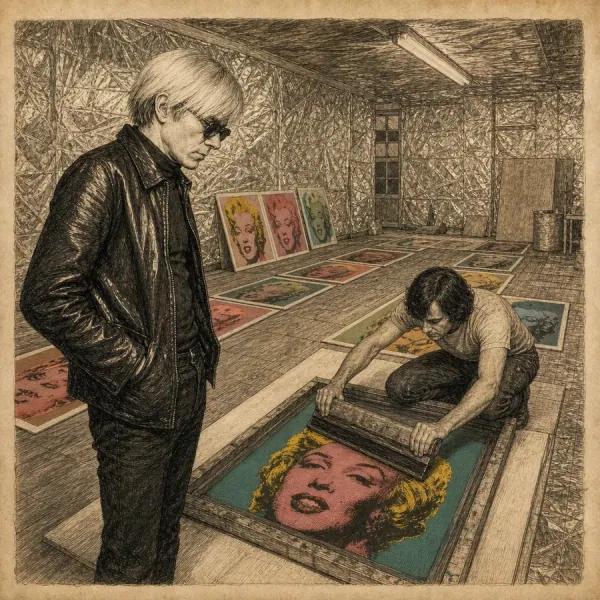
Warhol's first Pop paintings, the series of 32 Campbell's soup cans shown in Los Angeles in 1962, and his adoption of silkscreen printing, which became his signature.
- 💋 Marilyn, Elvis and death in series
The silkscreened portraits of stars after Marilyn Monroe's death, the Marilyn Diptych, the disaster series, and Warhol's breakthrough in New York in 1962.
- 🪩 The Factory: films, superstars and the Velvet Underground
Warhol's studio, the Factory, his Brillo box sculptures, his experimental films, his “superstars,” the Velvet Underground, and his famous line about fame.
- 🩹 The 1968 shooting and “business art”
The attempt on Warhol's life in 1968, the transformation of the Factory into a business, Interview magazine, his commissioned portraits, and his theory of “business art.”
- 🎨 Basquiat, the computer and The Last Supper
Warhol's final years: his collaborations with Basquiat, his experiments with digital art, his quiet Catholic faith, The Last Supper series, and his death in 1987.
- 💲 The legacy: museums, the market and copyright
The Warhol foundation and museums, his archives, the soaring prices of his work on the art market, and the 2023 U.S. Supreme Court ruling on his portraits of Prince.
Study “Andy Warhol and Pop Art” with flashcards and quizzes
In Oria, you read the full course, then practice on it: flashcards, multiple-choice quizzes, open questions or the Feynman method. Cards and questions then come back in your daily review, paced by spaced repetition.
Study this topic in OriaSources
These notes draw on the sources below. If a point seems doubtful, refer back to them.