Science
Archimedes: Biography and Study Notes
The genius of Syracuse who measured the world
Study this topic in OriaThe essentials
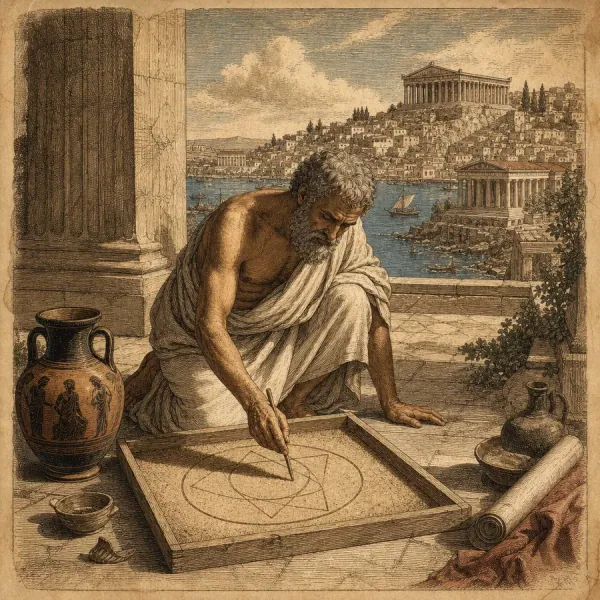
Archimedes lived in Syracuse, a Greek city in Sicily, in the 3rd century BC. A brilliant mathematician, he pinned down the number π, calculated the volume of the sphere and counted the grains of sand in the Universe; a physicist, he stated the law of the lever and the principle that bears his name; an engineer, he defended his city against Rome. You'll discover his great ideas explained simply, how much of his famous anecdotes is legend, his death during the siege of Syracuse and the incredible story of the erased manuscript that revealed his secrets in the 20th century.
Key dates and facts
- c. 287 BC
- Born in Syracuse
- 270 BC
- Hiero II begins his reign
- 215 BC
- Death of Hiero II
- 212 BC
- Fall of Syracuse and death of Archimedes
- c. 950
- Byzantine copy of the treatises
- 1229
- The manuscript is erased and written over
- 1906
- Heiberg identifies Archimedes' texts
- 1998
- Auction in New York
🏛️ A Sicilian Greek in the shadow of King Hiero
Archimedes was born around 287 BC in Syracuse, on the east coast of Sicily. Syracuse was then a powerful Greek city: for centuries, Greek colonists had founded many towns in southern Italy and Sicily, a region known as Magna Graecia (“Greater Greece”). Its people spoke Doric Greek, the dialect in which Archimedes would write all his treatises.
🗓️ A date worked out by deduction
His date of birth is not known for certain. It is calculated from a statement by a 12th-century Byzantine scholar, John Tzetzes, according to whom Archimedes lived seventy-five years before dying in 212 BC. In one of his books, The Sand Reckoner, Archimedes himself tells us that his father was named Phidias and was an astronomer; nothing else is known about him.
👑 Close to the king
Archimedes lived in the service of Hiero II, who ruled Syracuse from 270 to 215 BC and remained a loyal ally of Rome. According to the Greek historian Plutarch, the scholar was even related to the king; other Latin authors, such as Cicero, present him on the contrary as a man of humble origins. We don't know whether he married or had children.
📚 A man known through others
Every biography of Archimedes runs into the same problem: his contemporaries wrote almost nothing about him. A life of Archimedes, attributed to a certain Heracleides, is lost. We know him through two kinds of sources. On one side, his own mathematical treatises, about a dozen of which have come down to us, and the letters that accompany them. On the other, accounts by historians and writers who often lived long after him:
- Polybius, a Greek historian of the 2nd century BC, the closest source;
- Livy, a Roman historian of the 1st century BC;
- Vitruvius, a Roman architect who tells the bathtub story, about two centuries after Archimedes' death;
- Plutarch, a Greek writer of the 1st and 2nd centuries AD, in his Life of Marcellus.
These accounts mix fact and legend. That's why, in the parts that follow, we need to distinguish what Archimedes actually proved, which we can read in his works, from what is told about him, which sometimes belongs to myth.
✉️ Letters to Alexandria
In the 3rd century BC, the great scientific center of the Greek world was Alexandria, in Egypt, with its famous Library. Archimedes worked in Syracuse, but he stayed in constant contact with the scholars of Alexandria. There were no scientific journals: Archimedes made his discoveries known by sending his treatises, each preceded by a letter, to colleagues there.
📨 His correspondents
Archimedes first wrote to the astronomer Conon of Samos, who worked at the court of the Egyptian king Ptolemy III; those letters are lost. After Conon's death, he addressed his treatises to one of Conon's pupils, Dositheus of Pelusium: it is to him that On the Sphere and Cylinder, On Spirals, On Conoids and Spheroids and The Quadrature of the Parabola are dedicated. In the preface to On Spirals, he notes that many years have passed since Conon's death, which suggests he was already old when he wrote some of his works. He also wrote to Eratosthenes of Cyrene, the head of the Library of Alexandria.
🐂 A challenge: the cattle problem
To Eratosthenes and the mathematicians of Alexandria, Archimedes issued a challenge that has remained famous, the cattle problem, in the form of a poem: the task is to count the herd of the Sun god from a set of relationships between their numbers, which amounts to solving several equations at once. The text was rediscovered in 1773 by the German writer Lessing in a library in Wolfenbüttel. In its hardest version, the solution is a gigantic number with about 206,545 digits: the mathematician A. Amthor was the first to solve this version, in 1880.
🌀 Archimedes' screw
Archimedes' screw is a helix turning inside a tilted cylinder: as it turns, the water trapped between its blades rises from a low level to a higher one, for example from a river to an irrigation channel. According to the Greek historian Posidonius, Archimedes invented it during a stay in Egypt. But its origin is debated: some researchers think he found the Egyptians already using it, and the Assyriologist Stephanie Dalley has even argued that bronze screws watered the gardens of Babylon centuries earlier. We don't even know whether he really traveled to Egypt, although one ancient historian, Diodorus Siculus, says he did.
A machine made of a helical surface turning inside a tilted tube. Each turn lifts a pocket of water one step higher. It is still used today in wastewater treatment plants and, run in reverse, as a small hydroelectric turbine on low-head rivers.
What is certain is that a contemporary treatise, written between 250 and 220 BC, already mentions it as a pump for draining water from the hold of a huge ship built for King Hiero II. Spread throughout the Roman world, from Spain to Egypt, it has come down through the centuries.
The rest of the course
This page publishes the first 2 parts. The full course has 8: here is what the next ones cover.
- 📐 Pinning down π: the method of exhaustion
How Archimedes calculated the area of the circle and bracketed π with 96-sided polygons, and how he found the area of a parabolic segment with an infinite sum.
- ⚪ The sphere, the cylinder and the grains of sand
The result Archimedes was proudest of (sphere and cylinder, ratio 2/3), his wish for his tomb, The Sand Reckoner and the count of the grains of sand in the Universe, the Ostomachion and the polyhedra.
- ⚖️ “Give me a place to stand”: the lever
The law of the lever proved in On the Equilibrium of Planes, the center of gravity, the launch of the ship Syracusia, pulleys and the “mechanical method” revealed by the palimpsest.
- 🛁 “Eureka!”: the crown and buoyancy
Archimedes' principle as stated in On Floating Bodies, the story of Hiero's crown told by Vitruvius, the doubts about it, and the more likely method of the hydrostatic balance.
- 🛡️ The siege of Syracuse and the scholar's death
Syracuse switched to Carthage's side during the Second Punic War; Archimedes' machines held Marcellus's Roman fleet at bay; the legend of the mirrors; the fall of the city in 212 BC and the accounts of his death.
- 📜 From the erased manuscript to the Fields Medal
The tomb found by Cicero, the transmission of the works through Byzantium and the Arab world, the admiration of Galileo, Leibniz and Gauss, the story of the palimpsest rediscovered in 1906, and modern tributes.
Study “Archimedes” with flashcards and quizzes
In Oria, you read the full course, then practice on it: flashcards, multiple-choice quizzes, open questions or the Feynman method. Cards and questions then come back in your daily review, paced by spaced repetition.
Study this topic in OriaSources
These notes draw on the sources below. If a point seems doubtful, refer back to them.