Geography & countries
Australia: Summary and Study Notes
An island continent, home to one of the world's oldest living cultures and a nation of immigrants
Study this topic in OriaThe essentials
Australia is both a country and a continent: vast, flat, dry, and home to animals found nowhere else. Its First Peoples have lived there for more than 50,000 years, long before the British penal colony founded in 1788. You'll discover its landscapes, its long history and its wounds, its multicultural society, its mining economy, its institutions, its place between the United States and China, and the debates stirring it today.
Key dates and facts
- 65,000 years ago
- Possible first human traces
- 42,000 years ago
- Human remains at Lake Mungo
- 2,500 years ago
- Settlement of the Torres Strait Islands
- 1788
- Arrival of the British First Fleet
- 1606
- First documented European landing
- 1770
- James Cook claims the east coast
- January 26, 1788
- The First Fleet settles at Sydney Cove
- 1851
- The gold rush begins
- 1854
- Eureka Rebellion at Ballarat
- 2017
- Uluru Statement from the Heart
🦘 An island continent
Australia is the only country in the world that occupies an entire continent. With about 7.7 million km² of land, it is the sixth-largest country on the planet, just behind Brazil. It is often called the “island continent”: it includes the Australian mainland, the large island of Tasmania to the south and thousands of smaller islands, surrounded by the Indian and Pacific Oceans.
It is the flattest and driest inhabited continent on Earth. Its average elevation is only 325 m, compared with 870 m for the continents as a whole. About 70% of the land is arid or semi-arid, and nearly a fifth is true desert. An average of 470 mm of rain falls each year, with huge variations from one year to the next, bringing droughts and floods in turn.
⛰️ Landforms worn down by time
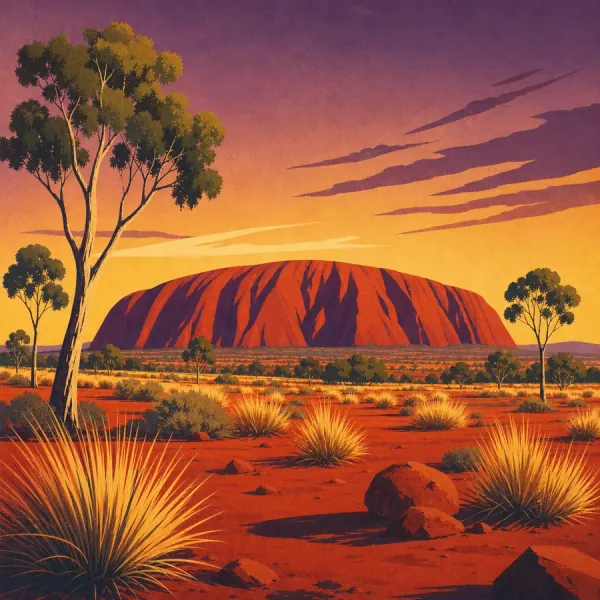
Australia sits in the middle of a tectonic plate and has no active volcanoes or young mountain ranges on the mainland. The oldest zircon crystals on Earth, 4.4 billion years old, have been found there. In the east, the Great Dividing Range runs along the coast; its highest point, Mount Kosciuszko, is only 2,228 m high. The main river system, the Murray-Darling, drains much of the southeast, but Australia's rivers carry less water to the sea than those of any other continent. In the center rises Uluru, a huge red sandstone monolith, sacred to the Aṉangu, its traditional owners.
Off the northeast coast stretches the Great Barrier Reef, the largest coral reef in the world, extending for more than 2,300 km. With about 3.4 people per km², concentrated on the coasts, Australia is one of the least densely populated countries in the world.
“I love a sunburnt country, / A land of sweeping plains, / Of ragged mountain ranges, / Of droughts and flooding rains.”
Dorothea Mackellar, “My Country,” The Witch-Maid, and Other Verses (1914)
🌦️ From the tropics to snow
The north is tropical, with a summer monsoon and cyclones; the center is desert; the south is temperate, and it snows in winter on the high ground of the southeast and in Tasmania. Since 1910, temperatures have risen by about 1.5 °C, with more heat waves and a longer fire season in the south. The bushfires of the 2019–2020 “Black Summer” destroyed more than 3,000 buildings, directly killed 33 people and killed or displaced about three billion animals, according to estimates.
🐨 Unique wildlife and plants
Isolated from the other continents since it split from Antarctica about 35 million years ago, Australia has developed a living world of its own. It is one of the 17 so-called “megadiverse” countries: about 94% of its amphibians, 93% of its reptiles and flowering plants, and 69% of its mammals exist nowhere else. It is home to about two-thirds of the world's marsupial species, such as the kangaroo, the wallaby and the koala, which feeds almost exclusively on eucalyptus leaves. But this richness is under threat: over the past two centuries, Australia has lost more mammal species than any other continent, because of changes to the landscape, introduced species such as cats and foxes, and climate change.
🔥 The First Peoples
Indigenous Australians form two main groups: Aboriginal peoples, from the mainland and many islands including Tasmania, and Torres Strait Islanders, a distinct Melanesian people living between the mainland and New Guinea.
🧭 The first seafarers
According to researchers' estimates, the ancestors of Aboriginal people arrived from Southeast Asia 50,000 to 65,000 years ago, during the last ice age. Sea levels were lower then: they could travel across land bridges, but also had to cross short stretches of sea. The Madjedbebe rock shelter, in Arnhem Land, may be the oldest site of human occupation in the country. The oldest known human remains, those from Lake Mungo, are about 42,000 years old. Tasmania was only cut off from the mainland by rising seas about 6,000 years ago.
🗣️ Hundreds of languages
When the Europeans arrived, Australia was not a single country but a mosaic of societies speaking more than 250 distinct languages. Estimates of the Aboriginal population at the time vary enormously, from 300,000 to 3 million people. Aboriginal culture is considered one of the oldest continuous cultures on the planet, passed down without interruption for tens of thousands of years.
These societies had very varied economies. Some groups practiced fire-stick farming, regularly burning the vegetation; others raised fish in purpose-built ponds or built semi-permanent shelters. Researchers still debate how best to describe them: as simple “hunter-gatherers,” or as true managers of the landscape.
In Aboriginal cultures, the “Dreaming” (Tjukurpa in the Aṉangu language) refers to the sacred era when ancestral beings shaped the landscape, animals and humans, and laid down the laws of society. These stories are passed on through song, dance and painting, and they bind each group to its country, which is considered sacred.
🎨 An ancient art
Australia has more than 100,000 rock art sites, some of them protected by UNESCO, such as Kakadu National Park and Uluṟu-Kata Tjuṯa National Park.
🌊 Peoples of the sea and of trade
Torres Strait Islanders settled their islands at least 2,500 years ago. Seafarers, they lived off the resources of the reefs and seasonal gardening, and villages existed there by the 14th century. In the north, Aboriginal people also traded, at least from the mid-18th century, with fishermen from Makassar (in present-day Indonesia) who came to harvest sea cucumbers, also known as trepang. Australia was therefore not a closed world before the British arrived.
The rest of the course
This page publishes the first 2 parts. The full course has 9: here is what the next ones cover.
- ⛵ From explorers to six colonies
European exploration, the penal colony of 1788, the dispossession of Aboriginal peoples, the gold rush and the birth of six self-governing colonies.
- 🏛️ The Australian nation
From Federation in 1901 to the present: the White Australia policy, the world wars, mass immigration, Aboriginal rights, the Stolen Generations and the national apology.
- 🎭 A people from all over the world
Australia's population today: immigration, origins, languages, religions, culture, the arts, film, food and sport.
- ⛏️ A resource-rich economy
Australia's economy: high living standards, mining and energy, services, dependence on exports to China, housing and the energy transition.
- 🗳️ A federal parliamentary monarchy
Australia's institutions: constitutional monarchy, a Westminster parliament and American-style federalism, compulsory voting, parties and the 2025 elections.
- 🌏 Between the American alliance and Asia
Australia's foreign policy: a middle power, the alliance with the United States, AUKUS, relations with China, the Pacific and New Zealand.
- 🔭 Today's challenges and debates
Australia's big debates of the mid-2020s: reconciliation and the 2023 referendum, the gap in Indigenous living conditions, climate, the Bondi attack, social media and housing.
Study “Australia” with flashcards and quizzes
In Oria, you read the full course, then practice on it: flashcards, multiple-choice quizzes, open questions or the Feynman method. Cards and questions then come back in your daily review, paced by spaced repetition.
Study this topic in OriaSources
These notes draw on the sources below. If a point seems doubtful, refer back to them.