Economics
Capitalism: Summary and Study Notes
The history, thinkers and debates of a system that conquered the world
Study this topic in OriaThe essentials
Capitalism is today the economic system of almost every country. But where did it come from, and how does it work? Here you'll follow its birth among Italian and Dutch merchants, its rise with the Industrial Revolution, the great thinkers who explained, fought or defended it (Smith, Marx, Weber, Schumpeter, Keynes, Hayek), its transformations in the 20th century, its different varieties and today's big debates over inequality, ecology and democracy.
Key dates and facts
- 13th century
- Venice, Florence and Milan pass 100,000 inhabitants
- 1602
- Founding of the Dutch East India Company
- 1623
- England's first patent law
- 1765
- Invention of the spinning jenny
- 1791
- Freedom of trade and industry in France
- 1846
- Repeal of the Corn Laws in the United Kingdom
- 1944
- Hayek publishes The Road to Serfdom
- 1979
- Margaret Thatcher comes to power in the United Kingdom
- 1989
- Fall of the Berlin Wall
- 1991
- Dissolution of the Soviet Union
🧭 What is capitalism?
The word is everywhere: in textbooks, political speeches and protests. Yet its definition varies with the era, the country and the opinions of the people using it.
An economic system based on private ownership of the means of production (factories, machines, land, patents) and on their use to make a profit. Its characteristic features are the accumulation of capital, competition in markets, wage labor and the pursuit of innovation and growth.
🧱 The ingredients
- Private property: it is neither the state nor the community but private individuals or companies that own most of the means of production.
- Profit: the aim of producing is not just to meet one's needs but to generate a gain, which can be reinvested.
- Accumulation: once reinvested, this gain makes capital grow, which makes it possible to produce more and earn even more.
- The market: prices, wages and quantities produced are set mainly through the meeting of supply and demand, under competition.
- Wage labor: those who own the capital and those who provide the labor are generally different people, bound by an employment contract.
Capitalist economies also go through cycles: periods of expansion followed by recessions.
🐄 From cattle to capital: the history of the words
The word capital comes from the Latin caput, “head,” as in “head of cattle.” In the Middle Ages, it referred to a sum of money to be made to grow. The word capitalist, “a person who owns capital,” appeared in the mid-17th century in a Dutch gazette, then in French in 1788. The word capitalism took hold in the 19th century: its modern use is credited to Louis Blanc in 1850 and Pierre-Joseph Proudhon in 1861. Coined by its opponents, it long carried a negative connotation; its defenders often prefer to speak of a market economy or “free enterprise.” Karl Marx, for his part, mostly spoke of the “capitalist mode of production.”
⚖️ Always a mixed system
“Pure” capitalism, with no government intervention at all, exists nowhere. Most economies today are mixed economies: they combine markets and private property with more or less extensive state intervention (taxes, public services, social protection, regulation, sometimes planning). How free markets are and the rules that define property are political choices. That is why people speak of several forms of capitalism: laissez-faire, social, state, or welfare-state capitalism.
Since the Industrial Revolution, this system has kept spreading, and today it is the system of most countries on the planet. A source of growth and development, it is also a source of inequality: it is this double face that has fueled passionate debates for two centuries.
⚓ The origins: merchants, bankers and companies
Capitalism wasn't born all at once. Merchants, moneylenders and small workshops employing wage workers had existed for centuries. But it was in Europe, between the late Middle Ages and the 18th century, that these practices gradually came together into a system.
🏦 The merchant cities
From the 11th century, Europe went through a Commercial Revolution: trade revived and towns grew. By the 13th century, Venice, Florence and Milan each had more than 100,000 inhabitants. The Italian city-states invented most of the tools of banking and finance; Venice dominated Mediterranean trade, Florence banking, and Bruges and then Antwerp became the great marketplaces of northern Europe. Hindu-Arabic numerals, which arrived through trade with the Arab world, made bookkeeping easier.
For the historian Fernand Braudel, author of Civilization and Capitalism, 15th–18th Century (1967–1979), capitalism was born from long-distance trade. Merchants who had invested in one-off ventures made their business systematic, became wholesale traders, then merchant-bankers: little by little, the center of gravity shifted from trade to finance.
👑 The age of mercantilism
From the 16th to the 18th century, a doctrine later called mercantilism prevailed. It was concerned above all with the power of the state: a country grows rich by exporting more than it imports and by accumulating precious metals. States granted their merchants monopolies, subsidies and protection. The flood of gold and silver from the Americas stimulated trade and the improvement of means of payment.
⛵ The joint-stock company
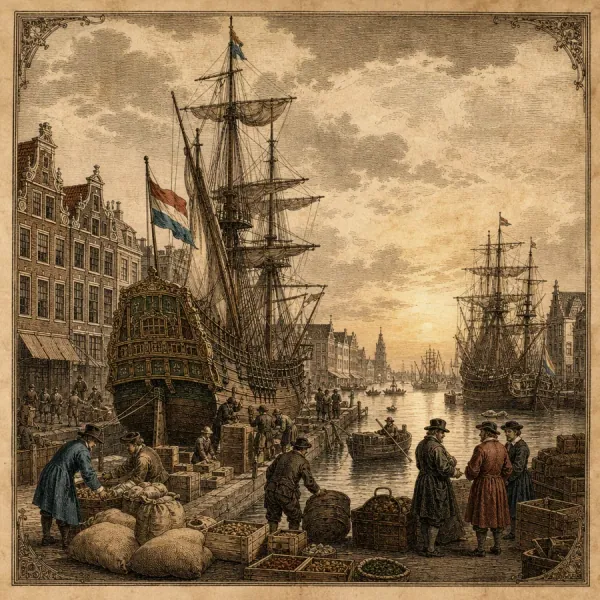
In 1602, the Dutch Republic created the Dutch East India Company. It was the first large joint-stock company in the modern sense: unlike earlier partnerships, set up for a single expedition, it was permanent, and its shareholders' liability was limited to what they had invested. Its shares traded on the Amsterdam Stock Exchange, and its dividends sometimes reached 15 to 25%. For Braudel, Holland then became the center of the “world-economy.” These companies also held colonial and military powers granted by the state: the rise of trade is inseparable from colonial expansion.
🌾 In the English countryside
Another transformation was under way in 16th-century England. The manorial system was breaking down, land was being concentrated in the hands of large landowners, and peasants were increasingly becoming tenant farmers or laborers paid in money. Landowners and tenants were pushed to raise yields in order to make a profit. This agrarian capitalism paved the way for industry by feeding a population that was soon to explode.
Historians still debate when we can start speaking of capitalism. For some, it exists as soon as people seek profit through exchange; for others, like the economist Karl Polanyi, it is truly born only when land, labor and money themselves become commodities, which happened only in the 19th century.
The rest of the course
This page publishes the first 2 parts. The full course has 9: here is what the next ones cover.
- 🏭 The Industrial Revolution: the great takeoff
How, from the 18th century in England, industry, factories, new legal rules and free trade made capitalism the dominant mode of production, with unprecedented growth in living standards and a debate over the role of the colonies.
- 📚 Understanding the system: Smith, Marx, Weber
Three great founding analyses of capitalism: Adam Smith's critique of mercantilism and the invisible hand, exploitation and crises in Karl Marx, and the “spirit of capitalism” born of the Protestant ethic according to Max Weber.
- 💡 Schumpeter, Keynes, Hayek: the great debate of the 20th century
20th-century thinkers confront capitalism: Schumpeter's creative destruction and innovating entrepreneur, state intervention against unemployment in Keynes, and the defense of markets and freedom in Hayek and Friedman.
- 🌍 The 20th century: welfare state, Cold War and neoliberalism
The major phases of capitalism in the 20th century: the managed capitalism of the postwar years, the crisis of the 1970s, the neoliberal turn of Thatcher and Reagan, the fall of the Soviet bloc and globalization.
- 🧩 One capitalism or many?
The main varieties of capitalism: the Anglo-Saxon and Rhine models according to Michel Albert, liberal and coordinated market economies according to Hall and Soskice, the German social market economy, the Nordic model, Japanese capitalism, state capitalism and authoritarian capitalism.
- ⚖️ Critiques and defenses
The main charges against capitalism (inequality, exploitation, crises, financialization, the environment, war) and the main arguments of its defenders (growth, the decline of poverty, innovation, freedom, coordination through prices).
- 🔭 Today's debates
The big current questions about capitalism: the lessons of the 2008 crisis, the role and responsibility of business, inequality, the ecological transition and degrowth, digital capitalism, rivalry with Chinese state capitalism and the link with democracy.
Study “Capitalism” with flashcards and quizzes
In Oria, you read the full course, then practice on it: flashcards, multiple-choice quizzes, open questions or the Feynman method. Cards and questions then come back in your daily review, paced by spaced repetition.
Study this topic in OriaSources
These notes draw on the sources below. If a point seems doubtful, refer back to them.