Technology & inventions
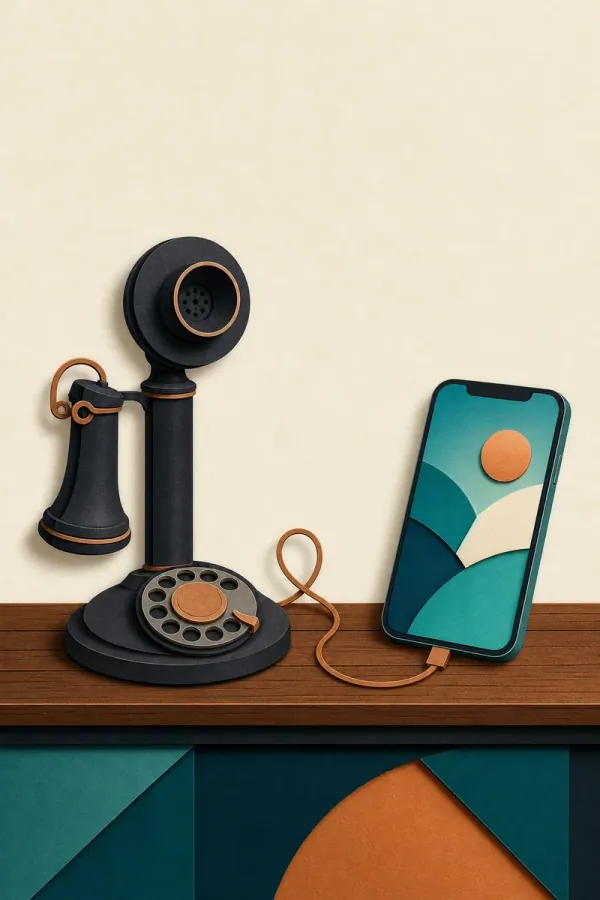
From the Telephone to the Smartphone: Summary and Study Notes
A hundred and fifty years of voices across distance, from copper wire to touchscreen
Study this topic in OriaThe essentials
In 1876, Alexander Graham Bell sent a human voice down an electric wire; a century and a half later, almost everyone on the planet has a phone in their pocket. You'll follow the race for the patent and the Bell–Meucci controversy, the building of the network with its switchboard operators and rotary dials, the birth of the mobile phone in 1973 and of GSM, then the iPhone and Android revolution. You'll understand in simple terms how a call travels through radio waves and cell towers, before examining how smartphones are used, the dependence they create and the concerns they raise.
Key dates and facts
- March 7, 1876
- Bell is granted the telephone patent
- March 10, 1876
- First message: “Mr. Watson, come here”
- Aug. 10, 1876
- First long-distance call, in Canada
- 1877
- The Bell Telephone Company is founded
- April 3, 1973
- First call from a handheld mobile phone
- 1979
- First automatic cellular network, in Tokyo
- July 1, 1991
- First GSM call, in Finland
- Dec. 3, 1992
- First text message sent, in the UK
- 1994
- IBM Simon, the first smartphone on sale
- Jan. 9, 2007
- Steve Jobs unveils the iPhone
📡 Before the telephone: making the voice travel
Talking to someone miles away seems ordinary today. In the mid-19th century, it was a challenge that many inventors set out to meet, building on a technology already mastered: the electric telegraph.
🥫 The principle of the string telephone
The basic idea had been known for centuries: two membranes, or diaphragms, connected by a taut string. When you speak, the membrane vibrates, the string carries those vibrations and the other membrane reproduces them. It's the principle behind the toy made of two cups and a string. But the range is only a few dozen meters: to go farther, sound has to be turned into electricity.
⚡ The telegraph, the first electrical network
In 1833, in Göttingen, the German scientists Carl Friedrich Gauss and Wilhelm Weber developed an electromagnetic telegraph. Over the following decades, the electric telegraph linked railway stations, post offices, stock exchanges and newspapers. It transmitted coded messages by opening and closing an electric circuit: pulses, not a voice.
The telegraph transmits a coded message as electrical pulses, which an operator must write down and then read. The telephone transmits the voice directly: sound vibrations are converted into an electric current that varies continuously, then turned back into sound at the other end.
💡 Bourseul's ideas and Reis's device
In France, Charles Bourseul, an official in the telegraph administration, published an article titled “Electrical Transmission of Speech” in L'Illustration on August 26, 1854: he described the principle of a telephone without building one. In Germany, on October 26, 1861, Johann Philipp Reis presented a device he called a “telephone” to the Physical Society of Frankfurt. It transmitted sounds electrically, music in particular, but it was hard to adjust and reproduced speech poorly. Thomas Edison would later recognize Reis as the first inventor of a telephone, but of a purely musical telephone, unable to transmit articulate speech.
🎼 The problem to solve
These early devices worked like the telegraph: they opened and closed the circuit. But the voice is a complex, continuous vibration made up of many blended frequencies. To transmit it faithfully, you need a current that never breaks but varies exactly like the vibrations of the air: a so-called undulating current. At the same time, inventors such as the American Elisha Gray were working on “harmonic telegraphs” capable of sending several musical notes down the same wire, so as to carry several messages at once. Gray obtained a patent for such a device in 1875. The race was on, and it would be decided by a matter of hours.
☎️ 1876: Bell and the first phone call
Alexander Graham Bell was born in 1847 in Edinburgh, Scotland. His father and grandfather were specialists in elocution, and he himself devoted his life to teaching speech to the deaf. Having settled in Boston, he founded a school there in 1872 to train teachers of deaf children, and in 1873 became professor of vocal physiology at Boston University. This intimate knowledge of the voice's vibrations would guide him toward the telephone.
🔔 The discovery of June 2, 1875
Like Gray, Bell was first working on a harmonic telegraph, with his assistant Thomas Watson. On June 2, 1875, a steel reed seemed to be stuck; at Bell's request, Watson plucked it to free it. At the other end of the wire, Bell heard his own reed reproduce exactly the same sound, with all its richness. He realized that the reed's motion had induced in the wire a current that varied like the vibration. If the circuit was never broken, then, every nuance of the voice could be transmitted.
📜 The patent and the first call
On February 14, 1876, Bell's lawyer filed his patent application in Washington; the same day, Elisha Gray's lawyer filed a caveat for a comparable device. Patent No. 174,465 was granted to Bell on March 7, 1876. Three days later, on March 10, in his Boston laboratory, Bell spoke into his device; Watson, in another room, heard the sentence and came running.
“Mr. Watson—Come here—I want to see you.”
Alexander Graham Bell, first telephone message, March 10, 1876
🔧 How Bell's telephone worked
The principle is remarkably simple. In front of an electromagnet is stretched a thin membrane carrying a piece of iron. When you speak, the membrane vibrates; the iron, moving near the magnet, produces in the coil a weak current that varies in rhythm with the voice. This current travels along the wire to the receiver, an identical device: the electromagnet makes another membrane vibrate, which recreates the sound in the air. The first sounds were faint, but distinct.
🎪 Convincing the world
In June 1876, Bell presented his invention at the Centennial Exposition in Philadelphia, where it impressed Emperor Pedro II of Brazil and the physicist William Thomson, the future Lord Kelvin. On August 10, 1876, in Canada, he received a call transmitted over the telegraph line between Brantford and Paris, Ontario, about 13 kilometers away: it is often considered the first long-distance call. On October 9 came the first two-way conversation, between Boston and Cambridge. In January 1878, Bell even gave a demonstration to Queen Victoria, who found the process “quite extraordinary,” although the sound was “rather faint.”
The Bell Telephone Company was founded in 1877 and quickly made Bell a wealthy man. The voice still had to be made louder: around 1878, the carbon microphone, developed independently by David Edward Hughes in England and by Emile Berliner and Thomas Edison in the United States, used carbon granules whose electrical resistance varied with pressure. It made long-distance calls truly practical.
The rest of the course
This page publishes the first 2 parts. The full course has 8: here is what the next ones cover.
- ⚖️ Who invented the telephone? Bell, Gray and Meucci
The controversies over who invented the telephone: Bell's and Gray's same-day filings, the case of Antonio Meucci and his 1871 caveat, the 2002 U.S. House resolution and Canada's response.
- 🔌 The network: operators, dials and switches
How the telephone became a network: exchanges and their operators, the first commercial exchange in 1878, Strowger's automation (1891), the rotary dial, uneven spread from country to country, then digitization.
- 📞 1973: the telephone goes mobile
From car radiotelephones (1946) to Martin Cooper's first call from a handheld phone (1973), the invention of the cellular network, the first analog networks, then the European GSM standard (1991), the SIM card and texting.
- 📶 How does it work? Radio waves, cell towers and generations
The journey of a mobile call explained simply: digitizing the voice, radio waves, cell towers, cells and handoff, then the generations from 1G to 5G and what is known about radio waves and health.
- 📱 2007: the iPhone and the smartphone era
From the first “smart phones” (IBM Simon, Nokia, BlackBerry) to the iPhone revolution of 2007 and the rise of Android, the world's most used system: how the smartphone absorbed the camera, GPS, music player and computer.
- 🧠 Uses, dependence and debates
How the smartphone transformed daily life, and the debates it raises: screen time, “nomophobia,” problematic use, dangers behind the wheel, school bans, and what research says.
Study “From the Telephone to the Smartphone” with flashcards and quizzes
In Oria, you read the full course, then practice on it: flashcards, multiple-choice quizzes, open questions or the Feynman method. Cards and questions then come back in your daily review, paced by spaced repetition.
Study this topic in OriaSources
These notes draw on the sources below. If a point seems doubtful, refer back to them.