Planet & nature
Fungi: Summary and Study Notes
Neither plants nor animals: mycorrhizae, the “wood wide web,” yeasts, penicillin and deadly mushrooms
Study this topic in OriaThe essentials
Fungi form a kingdom of their own, closer to animals than to plants, and we probably know not even a tenth of their species. You'll discover their hidden part, the mycelium, their role as the great recyclers, the age-old alliance they have formed with plant roots, and what science really knows about the “wood wide web.” Then we go from bread to penicillin, before taking stock of poisonous and disease-causing fungi.
Key dates and facts
- 1588
- First observation of spores, by Giambattista della Porta
- 1729
- Pier Antonio Micheli founds scientific mycology
- 2021
- The IUCN proposes adding “funga” to “fauna and flora”
- 1928
- Fleming observes a mold's effect on bacteria
- 1940
- Florey and Chain's team purifies penicillin at Oxford
- 1944
- 2.3 million doses ready for D-Day
- 1945
- Nobel Prize for Fleming, Florey and Chain
🍄 Neither plants nor animals: a kingdom of their own
Yeasts, molds, mushrooms with caps: all belong to the same kingdom of fungi (the Fungi). For centuries they were classed as plants, because they don't move, grow in the soil and produce spores like ferns or mosses. That idea still lingers among the general public. Yet fungi have features that clearly set them apart from plants.
🔬 What makes a fungus
- A fungus does not photosynthesize: it has no chlorophyll. Like animals, it is heterotrophic: it has to find its food ready-made.
- It doesn't eat, it absorbs: it releases digestive enzymes into its surroundings, then absorbs the small molecules they free up.
- Its cell wall contains chitin, the molecule that also makes up insect shells, rather than cellulose like that of plants.
- Like animals, it stores part of its reserves as glycogen.
Genetics has confirmed what these clues suggested: fungi are more closely related to animals than to plants. Together they belong to one large group, the opisthokonts, and are thought to have split from animals about a billion years ago. The science that studies them is called mycology, from the Greek mukês, “fungus.”
❓ A largely unknown world
About 148,000 species of fungi have been described. But a 2017 estimate puts their real number at between 2.2 and 3.8 million: more than 90% would therefore remain to be discovered. Every year, thousands of new species are named, with a record 2,905 in 2020. They live everywhere: in soil and dead wood, in the oceans and in undersea hot springs, in deserts, and even in environments exposed to high radiation. To highlight their importance, the IUCN Species Survival Commission asked in 2021 that we now speak of “fauna, flora and funga.”
Humans have used fungi since prehistoric times: Ötzi, the Iceman who died in the Alps about 5,300 years ago, was carrying two species of polypore, perhaps to start fires or treat ailments. Mycology became a science after the invention of the microscope. In 1729, the Italian Pier Antonio Micheli showed that spores placed in the right conditions give rise to the same species of fungus. The Dutchman Christiaan Hendrik Persoon, then the Swede Elias Magnus Fries, went on to establish the first classifications.
🧵 The mycelium, the hidden part
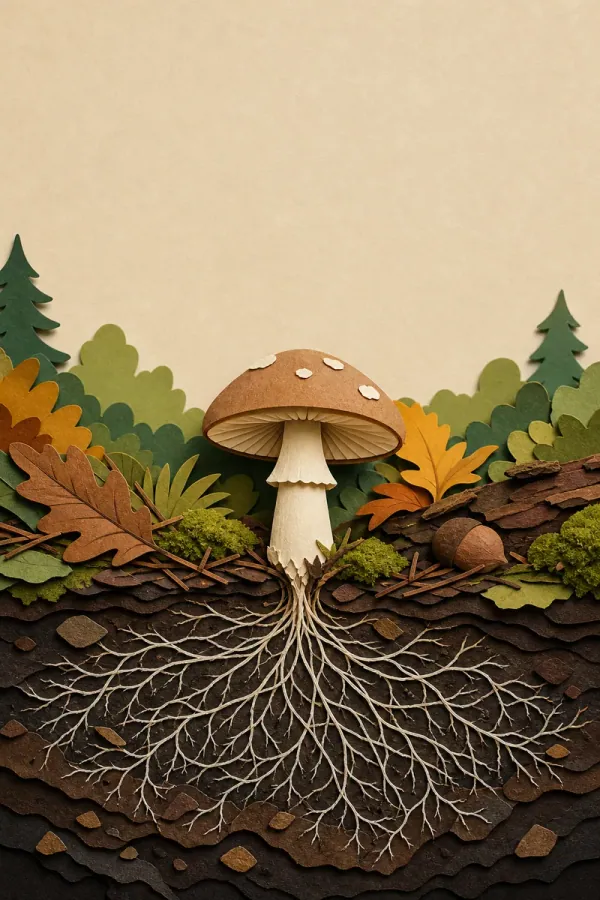
What we usually call a “mushroom,” with its stem and cap, is only the visible, temporary part of the organism: its reproductive organ, the fruiting body, a bit like an apple is the fruit of an apple tree. The real fungus lives hidden, in soil, wood or dead leaves.
🕸️ Microscopic threads
Most fungi grow as hyphae: microscopic filaments 2 to 10 micrometers across, which lengthen at their tips and branch out. When two hyphae meet, they can fuse. Together they form a network, the mycelium, which explores its surroundings in search of food. This threadlike form offers an immense contact surface for absorbing nutrients. Hyphae can also exert astonishing forces: some plant-parasitic fungi pierce leaves using a structure that reaches a pressure of more than 8 megapascals, about forty times that of a car tire.
Yeasts, for their part, are fungi that live mainly as single cells and multiply by budding. Molds are mycelia that have become visible to the naked eye, on a damp wall or spoiled food.
💨 Billions of spores
Fungi reproduce by means of spores, sexual or asexual, most often carried by the wind. Some launch them actively: under the gills of many capped mushrooms, each spore is shot off by a tiny drop of water, with an acceleration of more than 10,000 times gravity. Others rely on animals: truffles, which grow underground, give off a strong smell that attracts small mammals; these eat them and scatter their spores in their droppings.
🌲 The largest living thing?
A mycelium can live a very long time and spread very far. The honey fungus (Armillaria ostoyae), which parasitizes trees and forms clusters of honey-colored mushrooms in the fall, holds the records. In the Malheur National Forest in Oregon, in the United States, a single individual covers nearly 9 km² and could weigh up to 31,500 tonnes: it is thought to be the largest known living organism, and its age, according to some estimates, may approach 9,000 years. In Michigan, another honey fungus, about 2,500 years old, is estimated to weigh 440 tonnes, the equivalent of three blue whales.
🦴 A very long history
Fungi, soft and microscopic, fossilize poorly. A fossil discovered in the Canadian Arctic and described in 2019, Ourasphaira giraldae, may have grown on dry land a billion years ago, long before land plants. About 400 million years ago stood Prototaxites, a trunk-shaped organism up to 8 meters tall: it is generally considered a fungus, but the debate goes on. Sixty-six million years ago, just after the extinction of the dinosaurs, traces of fungi multiply: the death of most plants and animals is thought to have triggered a gigantic fungal bloom, as in an immense compost heap.
The rest of the course
This page publishes the first 2 parts. The full course has 8: here is what the next ones cover.
- ♻️ The planet's great recyclers
The role of fungi as decomposers, lichens, alliances with insects (ants, termites), the zombie-ant fungus, bioluminescence and pollution cleanup.
- 🌳 Mycorrhizae: the pact between fungi and roots
Mycorrhizal symbiosis: the principle of trading sugars for minerals, the types (arbuscular, ectomycorrhizae), the share of plants involved, their role in plants' conquest of land, and their discovery.
- 🕸️ The “wood wide web”: what we know, what we debate
Common mycorrhizal networks linking trees: Suzanne Simard's work, carbon transfers, “mother trees,” defense signals, and the scientific critiques of 2023 pointing to overstated claims.
- 🍞 Yeasts and molds: from bread to the lab
Yeasts and fermentation (bread, beer, wine), the history of their use from Egypt to Pasteur, food molds (cheeses, soy sauce, tempeh), Quorn and yeast as a model organism.
- 💊 Penicillin and other medicines from fungi
Fleming's discovery of penicillin in 1928, its purification at Oxford, its mass production during World War II, the 1945 Nobel Prize, the warning about resistance, and other drugs of fungal origin.
- ☠️ Deadly mushrooms and disease-causing fungi
Poisonous mushrooms (death cap, webcaps), delayed symptoms, ergotism and mycotoxins, fungal diseases of humans, amphibians and crops, and safety rules.
Study “Fungi” with flashcards and quizzes
In Oria, you read the full course, then practice on it: flashcards, multiple-choice quizzes, open questions or the Feynman method. Cards and questions then come back in your daily review, paced by spaced repetition.
Study this topic in OriaSources
These notes draw on the sources below. If a point seems doubtful, refer back to them.