Science
Gravity, from Newton to General Relativity: Summary and Study Notes
The force that makes apples fall, planets orbit and time slow down
Study this topic in OriaThe essentials
Why do things fall, and why doesn't the Moon fall onto Earth? We follow twenty centuries of answers, from Aristotle's physics to Galileo's experiments, up to Newton's universal gravitation and its triumphs. Then you'll see why Einstein rethought everything by making gravity a curvature of spacetime, how the 1919 eclipse, GPS and gravitational waves proved him right, and what gravity is still hiding from us.
Key dates and facts
- 1609
- Kepler's first laws
- 1666
- Newton and the apple, according to those close to him
- 1684
- De motu manuscript sent to Halley
- 1687
- Publication of the Principia
- 1781
- Herschel discovers Uranus
- 1798
- Cavendish publishes his measurement
- 1846
- Neptune found by calculation
- 1905
- Special relativity
- 1907
- The idea of the equivalence principle
- 1913
- Einstein and Grossmann adopt Riemannian geometry
🍂 Why things fall: from Aristotle to Galileo
Gravity, or gravitation, is the force that draws material objects toward one another. It gives objects their weight, makes rain fall, causes the tides, keeps the Moon around Earth and Earth around the Sun. Its range is infinite, even though it weakens with distance. But before it could be understood, a seemingly simple question had to be answered: why do things fall?
🏛️ Aristotle and “natural places”
In ancient Greece, Aristotle thought that each element has a natural place toward which it tends: earth at the center of the Universe, then water, air, fire and aether in successive layers. A stone falls because it is “going home.” Aristotle also claimed that the heavier an object, the faster it falls. This idea, intuitive but wrong, dominated thought for nearly two thousand years.
🌏 Ideas from everywhere
Other thinkers opened new paths. In the 6th century, the Byzantine scholar John Philoponus, in Alexandria, challenged the idea that a body falls in proportion to its weight. In 628, the Indian mathematician Brahmagupta described gravity as a force of attraction pulling objects toward Earth and named it gurutvākarṣaṇ. In the Persian world, Al-Biruni reasoned that Earth is not alone in attracting things: other celestial bodies should do so too.
🧪 The 16th century turns to experiment
In Europe, scholars began to test Aristotle. In 1551, the Spanish Dominican Domingo de Soto wrote that bodies in free fall accelerate uniformly. In 1586, in Delft, the Fleming Simon Stevin dropped two cannonballs of different sizes and weights from the top of a tower: they hit the ground at the same time.
⚖️ Galileo and the Tower of Pisa
According to his student Vincenzo Viviani, Galileo, then a professor in Pisa, dropped unequal weights from the top of the famous leaning tower between 1589 and 1592. Most historians think this was more likely a thought experiment than a real demonstration. The reasoning is formidable: tie a small stone to a large one. If heavy bodies fell faster, the small stone would slow the large one down, and the pair would fall more slowly than the large stone alone; but the pair is heavier, so it should fall faster. Contradiction: Aristotle's hypothesis is absurd.
Above all, Galileo measured. By rolling balls down inclined planes, which slow the fall and make it measurable, he established that the acceleration is the same for all objects. In his book Two New Sciences (1638), he showed that the distance covered in a fall is proportional to the square of the time: in twice the time, an object travels four times as far. If a feather falls more slowly than a hammer, it is because of air resistance, not its weight.
The most spectacular proof came much later. In 1971, during the Apollo 15 mission, the American astronaut David Scott dropped a hammer and a feather on the Moon, which has almost no atmosphere: they hit the ground at the same time.
🍎 Newton and universal gravitation
At the beginning of the 17th century, people knew how to describe falling bodies on Earth and were starting to describe the motion of the planets. No one yet imagined that the two phenomena obeyed the same law. That was the brilliant idea of the Englishman Isaac Newton.
🪐 Kepler's laws
Using the very precise observations of the Dane Tycho Brahe, the German astronomer Johannes Kepler published three laws of planetary motion between 1609 and 1621. The planets orbit the Sun in ellipses, ovals with the Sun at one focus; they move faster when they are close to the Sun; and the farther away a planet is, the longer its year, according to a precise mathematical relationship. Kepler saw gravity as a mutual attraction, but he imagined that the Sun pushed the planets along with a kind of magnetic force.
🍏 The story of the apple
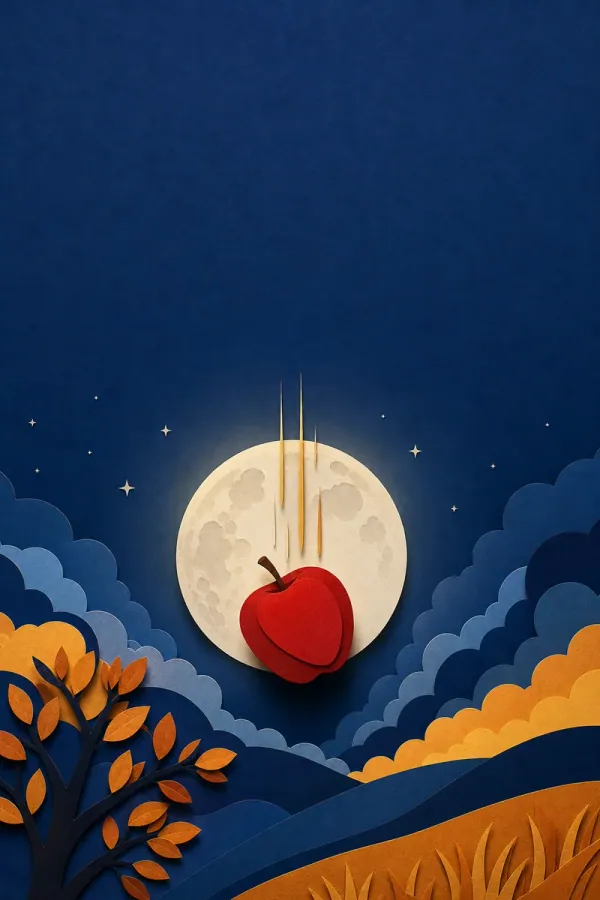
Newton himself told people that the idea of gravitation came to him on seeing an apple fall. His friend William Stukeley reported a conversation on April 15, 1726, in Kensington, under some apple trees. Newton told him he had been in the same situation when the idea came to him:
“Why should that apple always descend perpendicularly to the ground […] Why should it not go sideways, or upwards? but constantly to the earths centre? Assuredly, the reason is, that the earth draws it.”
William Stukeley, memoirs of Newton (1752 manuscript)
According to John Conduitt, the husband of Newton's niece, the scene took place in 1666, when Newton had left Cambridge to join his mother in Lincolnshire. The decisive idea was that this force does not stop at the top of the tree: why shouldn't it reach all the way to the Moon and hold it in its orbit? The apple falling on Newton's head, however, is legend.
📜 Hooke, Halley and the Principia
Newton was not alone. In 1679, his rival Robert Hooke wrote to him describing planetary motion as the result of an attraction at a distance. Hooke, the architect Christopher Wren and the astronomer Edmond Halley suspected that this attraction decreases with the square of the distance, but could not prove it for elliptical orbits. At Halley's request, Newton succeeded. In 1684, he sent him a manuscript, De motu corporum in gyrum; encouraged and funded by Halley, he published the Philosophiæ Naturalis Principia Mathematica on July 5, 1687, one of the most important books in the history of science. Hooke would claim credit for the inverse-square law.
📐 The law of universal gravitation
According to Newton, any two bodies attract each other with a force proportional to the product of their masses and inversely proportional to the square of the distance between them:
F = G\,\dfrac{m_1 m_2}{r^2}
where G is the gravitational constant, about 6.674 \times 10^{-11} in SI units. Newton himself did not write this formula; he reasoned in proportions. Doubling the distance divides the force by four; tripling it divides it by nine.
The key word is universal: the same force makes the apple fall, keeps the Moon in orbit and guides the planets. Newton checked this by comparing the fall of an object on Earth with the motion of the Moon, which is much farther from Earth's center: the pull there is weaker, exactly in the proportion predicted by the square of the distance. For the first time, the heavens and the Earth obeyed the same laws.
The rest of the course
This page publishes the first 2 parts. The full course has 9: here is what the next ones cover.
- 🔭 Newton's triumphs
What Newton's gravitation explains: orbits as perpetual falling, tides, surface gravity, Cavendish's measurement of G and Earth's mass (1798), and the discovery of Neptune by calculation (1846).
- 🧩 The cracks in Newton's theory
The problems Newton's gravitation does not solve: instantaneous action at a distance (the letter to Bentley), the advance of Mercury's perihelion and the phantom planet Vulcan, and the conflict with Einstein's special relativity (1905).
- 🛗 Einstein's idea: gravity is geometry
The equivalence principle (Einstein's “happiest thought,” 1907), the elevator thought experiment, the tests by Eötvös and the MICROSCOPE satellite, then general relativity (1915): mass curves spacetime and bodies follow that curvature.
- 🌘 Mercury and the 1919 eclipse
The first two confirmations of general relativity: the exact explanation of the advance of Mercury's perihelion (1915) and the measurement of the bending of starlight by the Sun during the eclipse of May 29, 1919 (Príncipe and Sobral), which made Einstein famous.
- ⏱️ Time slows down: relativity in everyday life
Gravitational time dilation (the stronger the gravity, the slower time passes), measured by the Pound–Rebka experiment (1959), essential to GPS (38 microseconds a day), and other confirmed effects: the Shapiro delay, gravitational lensing, frame dragging (Gravity Probe B).
- 🌊 Black holes and gravitational waves
The most extreme predictions of general relativity: black holes (Schwarzschild 1916, Cygnus X-1), then gravitational waves, detected indirectly with the Hulse–Taylor binary pulsar and directly by LIGO on September 14, 2015 (GW150914), then the neutron-star merger GW170817.
- ❓ What gravity is still hiding
The open questions: gravity and the expansion of the Universe (the cosmological constant, Friedmann, Lemaître, Hubble), dark matter and dark energy, gravity's surprising weakness, and the search for quantum gravity (string theory, loop quantum gravity).
Study “Gravity, from Newton to General Relativity” with flashcards and quizzes
In Oria, you read the full course, then practice on it: flashcards, multiple-choice quizzes, open questions or the Feynman method. Cards and questions then come back in your daily review, paced by spaced repetition.
Study this topic in OriaSources
These notes draw on the sources below. If a point seems doubtful, refer back to them.