Technology & inventions
Gutenberg's Printing Press: Summary and Study Notes
The machine that multiplied books and transformed Europe
Study this topic in OriaThe essentials
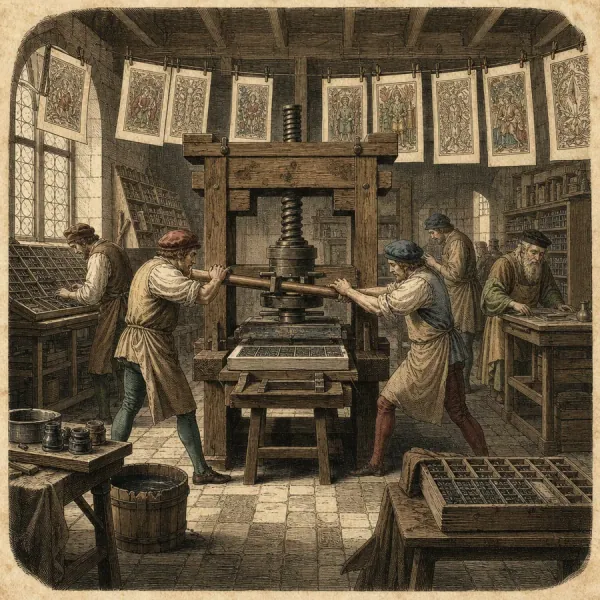
Around 1450, in Mainz, a goldsmith named Johannes Gutenberg perfected a complete system for printing books with movable metal type. First we meet his Chinese and Korean forerunners, then Gutenberg's eventful life, the workings of his press explained step by step and the making of the famous 42-line Bible. We then follow the lightning-fast spread of printing across Europe, its effects on the Renaissance, the Reformation and science, the debates among historians and its legacy all the way to the digital age.
Key dates and facts
- 868
- Diamond Sutra, the oldest dated printed book
- 1039 – 1048
- Bi Sheng invents clay movable type
- 1298
- Wang Zhen uses wooden movable type
- 1377
- Jikji, the oldest surviving book in metal type
- c. 1450
- Johann Fust finances Gutenberg's workshop
- 1454 – 1455
- The 42-line Bible is completed
- Nov. 1455
- Gutenberg loses his lawsuit against Fust
- 1468
- Gutenberg dies in Mainz
- 1462
- Sack of Mainz: the printers scatter
- 1470
- First book printed in France, at the Sorbonne
✍️ Before Gutenberg: copying books by hand
Before printing was invented in Europe, in the middle of the 15th century, every book was a one-of-a-kind object, copied by hand. Understanding this world of manuscripts shows why Gutenberg's invention was so revolutionary.
🕯️ The age of the scribes
In the Middle Ages, books were produced mainly in monasteries by monastic scribes. Other specialized monks, the illuminators, painted the illustrations, while rubricators added titles and sacred names in color. The work was enormous: copying an entire Bible took a monk about three years. Books were therefore rare, very expensive and reserved for a small elite, all the more so since few people could read.
🎓 A thirst for books
By the late Middle Ages, however, demand was exploding. Towns and trade were growing, an urban middle class was becoming wealthier and better educated, and the number of universities had been rising since the 12th century. Students, lawyers, merchants and clerics needed texts. In the 15th century, the supply of manuscripts fell far short of demand. Major scholarly gatherings, such as the Council of Basel, which opened in 1431, also produced writings that had to be copied.
📄 Paper, a cheap material
Another ingredient was falling into place: paper. Invented in China under the Han dynasty and also made in the Muslim world, it was being produced in Europe in water-powered mills by 1282. Production centers multiplied in Italy at the end of the 13th century, making paper far cheaper than parchment, which is made from animal skin. A century later, they spread to the German-speaking lands.
A printing technique using a wooden block carved in relief and in reverse: the block is inked, a sheet is pressed onto it, and the image or text is reproduced. It makes it possible to repeat a page, but each block can only be used for that one page.
From the late 14th century, woodblock printing developed in the Rhineland and in Germany: images were printed in series, sometimes with a few lines of text. But carving an entire book in wood would take forever, and a single mistake meant redoing the whole block. Everything was ready for a more flexible technique: separate letters that could be reused endlessly. That idea, however, was not born in Europe.
🏮 The Chinese and Korean forerunners
Gutenberg is often presented as “the inventor of printing.” That is inaccurate: he invented printing with movable metal type in Europe. Several centuries before him, China and then Korea had printed books, and had even invented movable type.
🪵 China and woodblock printing
In China, woodblock printing appeared around the 8th century, under the Tang dynasty. The oldest surviving dated printed book is a Buddhist text, the Diamond Sutra, dated May 11, 868, and found in 1900 in the Dunhuang caves. The technique reached its peak under the Song dynasty, but it had the same drawbacks as in Europe: carving the blocks took a great deal of time and material, storing them was cumbersome, and correcting a mistake was difficult.
🏺 Bi Sheng and clay type
Between 1039 and 1048, a Chinese craftsman named Bi Sheng invented the first known movable type, made of baked clay: one small block per Chinese character. We know of his invention only thanks to the scholar Shen Kuo, who describes it in detail in his Dream Pool Essays. Bi Sheng set his characters in an iron frame on a plate coated with resin and wax, then leveled them for printing.
“If one wished to print only two or three copies, this method would be neither simple nor easy. But for printing hundreds or thousands of copies, it was marvelously quick.”
Shen Kuo, Dream Pool Essays (11th century) (translated)
In 1298, an official of the Yuan dynasty, Wang Zhen, reinvented a method using wooden movable type: he made more than 30,000 pieces and stored them on two revolving tables to set text faster.
🔔 Korea invents metal type
Korea went further by casting type in metal, using the bronze-casting techniques employed for coins and bells. In 1234, under the Goryeo dynasty, ritual books compiled by Ch'oe Yun-ŭi were reportedly printed this way, but they have not survived. The oldest surviving book printed with movable metal type is the Jikji, an anthology of Buddhist teachings printed in 1377 at Heungdeok Temple, 78 years before the Gutenberg Bible. Only the second volume of this edition survives: it is held at the Bibliothèque nationale de France, in Paris. UNESCO added it to its Memory of the World Register in 2001.
🧮 Why the invention did not take hold in Asia
Despite these feats, woodblock printing remained the dominant method in Asia. The main reason lies in the writing system: Chinese has thousands of different characters, which makes a complete set of type very expensive. In Korea, moreover, the use of metal type was reserved for the royal foundry, for official publications. The Latin alphabet, by contrast, with its few dozen signs, would give European printing an enormous advantage. Did Gutenberg know about the Asian inventions? Historians debate it: some consider it likely that word of them reached Europe, while others stress that no text attests such knowledge before 1450.
The rest of the course
This page publishes the first 2 parts. The full course has 9: here is what the next ones cover.
- 🔨 Gutenberg, the goldsmith of Mainz
The life of Johannes Gutenberg before the invention: born in Mainz around 1400 into a patrician family, his time in Strasbourg, metalworking and his first secret experiments.
- ⚙️ The invention: how the movable-type press works
Gutenberg's invention explained simply: a combination of existing techniques and his own innovations (alloy, hand mold, oil-based ink, press), and the steps for making type and printing a page.
- 📖 The 42-line Bible and Gutenberg's ruin
The printing of the Gutenberg Bible between 1452 and 1455, its financing by Johann Fust, its price and its surviving copies, then the 1455 lawsuit that ruined Gutenberg and the end of his life.
- 🗺️ The spread of printing in Europe and the world
The rapid spread of printing after 1462: workshops in Europe's major cities, the first books printed in France, incunabula figures, the role of Venice, then the spread across the world up to the 19th century.
- 💡 Renaissance, Reformation, science: the consequences
The effects of printing on European society: the spread of ancient texts and humanism, its role in Luther's Reformation, the Scientific Revolution, national languages, newspapers and censorship.
- ⚖️ Debates: who invented it, and what really changed?
The historical debates around printing: Asian priority, the legend of Laurens Coster, criticism at the time, the discussion of Eisenstein's thesis and the place of printing among the causes of the Reformation.
- 🖨️ From hand press to digital: the legacy
How printing evolved after Gutenberg (iron press, steam, rotary press, Linotype, offset) and Gutenberg's legacy today, all the way to the comparison with the Internet.
Study “Gutenberg's Printing Press” with flashcards and quizzes
In Oria, you read the full course, then practice on it: flashcards, multiple-choice quizzes, open questions or the Feynman method. Cards and questions then come back in your daily review, paced by spaced repetition.
Study this topic in OriaSources
These notes draw on the sources below. If a point seems doubtful, refer back to them.