Entrepreneurs & innovators
Ingvar Kamprad: Biography and Study Notes
The son of Swedish farmers who furnished the planet with IKEA
Study this topic in OriaThe essentials
Ingvar Kamprad grew up on a farm in Småland, a poor region of southern Sweden, and founded IKEA at 17. He invented a model that changed the homes of hundreds of millions of households: cheap furniture, delivered in flat packs, that customers assemble themselves. You'll follow his life step by step without glossing over its dark side: his far-right involvement during the war, revealed in 1994, his empire's heavily optimized taxes and the criticism aimed at IKEA. You'll also understand why no one really knows, even now, how rich he was.
Key dates and facts
- 1942
- Joins the New Swedish Movement at 16
- 1945
- Still active in September, after the war
- 1994
- Expressen's revelations, letter of apology to employees
- 2011
- Elisabeth Åsbrink's book on deeper ties
- 1943
- Founds IKEA at 17
- 1953
- Showroom in Älmhult
- 1958
- First store, on October 28
- 1963
- First store abroad, in Norway
- 1976
- Settles in Épalinges, Switzerland
- 2013
- Leaves the Inter IKEA board
🌲 A child of Småland
Feodor Ingvar Kamprad, the future founder of IKEA, was born on March 30, 1926, in Pjätteryd, in what is now the municipality of Älmhult, in the heart of Småland. This forested province in southern Sweden was then one of the poorest in the country. The Guardian describes it as “a harsh, agricultural and punishing region” and suggests you could take the farmer's son out of Småland, but not Småland out of the boy: his taste for thrift and hard work came from there.
🇩🇪 A family from Germany
His mother, Berta Nilsson, was Swedish. His father, Feodor Kamprad, was born in the German Empire and came to Sweden as a baby with his parents. His grandfather, Achim Kamprad, from a well-off family of landowners in Thuringia, and his grandmother, Franzisca “Fanny” Glatz, born in Radonitz in Bohemia, in the Sudetenland region, had bought a forest estate near the village of Agunnaryd through a newspaper ad, and settled there in the winter of 1896. This farm, Elmtaryd, covering 449 hectares (about 1,100 acres), was the largest in the area. The grandfather died a few years after Feodor was born, and Fanny ran the estate before passing it on to her son. From the age of six, Ingvar lived at Elmtaryd with his parents, his sister and his grandmother.
🔥 The little match seller
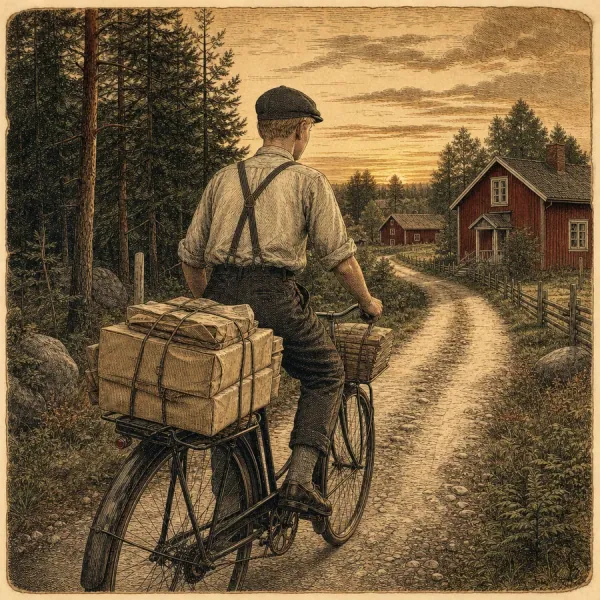
The boy had a head for business very early on. At around five according to some sources, seven according to others, he was selling matches to the neighbors. He discovered that by buying them in bulk in Stockholm, he could sell them individually at a low price and still make money: the whole logic of IKEA was already there. Then he broadened his range, delivering by bicycle: fish, Christmas decorations, garden seeds, later pens and pencils. He would say he went door to door through the whole village selling his seeds. According to The Guardian, by around eleven this trade was earning him enough to buy himself a racing bike and a typewriter.
Ingvar Kamprad was also dyslexic. This difficulty had an unexpected consequence: later, rather than product numbers he struggled to remember, he gave IKEA furniture Swedish names, often the names of Scandinavian places. That is the origin of the famous Billy, Klippan and Poäng.
⚠️ A teenager's far-right involvement
The darkest part of Ingvar Kamprad's life dates back to World War II. Sweden was neutral, but a small far right there admired Nazi Germany or Fascist Italy. The IKEA founder long kept quiet about this episode; he eventually acknowledged it himself, after the press revealed it.
📜 What the archives reveal
In 1994, the Stockholm daily Expressen published documents from the personal archives of Per Engdahl, Sweden's leading fascist, who had died that year. They showed that Ingvar Kamprad had joined Engdahl's New Swedish Movement (Nysvenska rörelsen) in 1942, at 16. This organization, which had about 8,600 members according to Swedish archives, advocated uncompromising nationalism, corporatism and anticommunism; it supported the Third Reich during the war, while claiming to draw more on Mussolini than on Nazism. Kamprad was still active in it in September 1945, after the war had ended, and remained a friend of Engdahl until at least the early 1950s. The paper published a 1950 note in which he said he was proud to have taken part in the movement. According to The Guardian, he even invited Engdahl to his second wedding, in 1963.
😔 “The greatest mistake of my life”
Faced with the revelations, Kamprad sent IKEA employees a handwritten letter by fax, headed, according to The Guardian, “Could not stop the tears.” In it he called his involvement the “greatest mistake of my life” and apologized, while saying he did not remember being a full-fledged member of a Nazi party. He attributed his teenage involvement to the influence of his father and above all of his grandmother, who came from the Sudetenland, both of whom admired Hitler. He later devoted two chapters to this period in a book written with the journalist Bertil Torekull, Leading by Design: The IKEA Story.
A Swedish newspaper then claimed that IKEA had been started with Nazi money. Kamprad firmly denied it, retorting that they could have accused him of murder, but not of borrowing money.
🔎 The 2011 revelations
In 2011, the journalist Elisabeth Åsbrink published a book that went further. According to her, the young Kamprad had also recruited members for an openly Nazi group, the Svensk Socialistisk Samling, and the Swedish security police had opened a file on him as early as 1943, the very year IKEA was founded. Åsbrink claims that his ties to these circles continued after the war, and reports that as late as 2010 he called Engdahl “a great man.” These conclusions rest on her own archival research.
The rest of the course
This page publishes the first 2 parts. The full course has 8: here is what the next ones cover.
- ✉️ 1943: IKEA is born on a kitchen table
The founding of IKEA in 1943 at 17, the meaning of the name, mail-order sales, the first furniture in 1947–1948, the catalog, dropping other products in 1951 and the Älmhult showroom in 1953.
- 📦 Boycott, flat packs and the first store
The Swedish manufacturers' boycott in the 1950s–1960s, in-house and flat-pack furniture design, Gillis Lundgren's role, the opening of the first store in Älmhult on October 28, 1958, production in Poland and the first store abroad.
- 🌍 Swiss exile and the conquest of the world
Leaving Sweden in 1973 for tax reasons, settling in Switzerland, IKEA's openings in Europe, Japan and North America, The Testament of a Furniture Dealer (1976), the foundation structure set up in 1982, family life, and criticism over Eastern European suppliers.
- 💰 The frugal billionaire with an elusive fortune
His reputation for stinginess (Volvo, economy class) versus his real lifestyle, the conflicting estimates of his fortune by Forbes and Bloomberg, tax criticism of IKEA, the purchase of Habitat, the opening in Russia and handing over to his sons until 2013.
- 🕯️ Return to Småland and final years
The death of his wife Margaretha in 2011, his return to Sweden in 2014, his death on January 27, 2018, at 91, a will favoring Norrland and an inheritance shared among his children.
- 🛋️ What IKEA changed in our homes
IKEA today (2025 sales, workforce, countries), “democratic design,” the IKEA effect, environmental and social criticism, the Malm dresser recall and Kamprad's mixed record.
Study “Ingvar Kamprad” with flashcards and quizzes
In Oria, you read the full course, then practice on it: flashcards, multiple-choice quizzes, open questions or the Feynman method. Cards and questions then come back in your daily review, paced by spaced repetition.
Study this topic in OriaSources
These notes draw on the sources below. If a point seems doubtful, refer back to them.