History
Julius Caesar: Biography and Study Notes
From a young patrician hunted by Sulla to the dictator of the Ides of March
Study this topic in OriaThe essentials
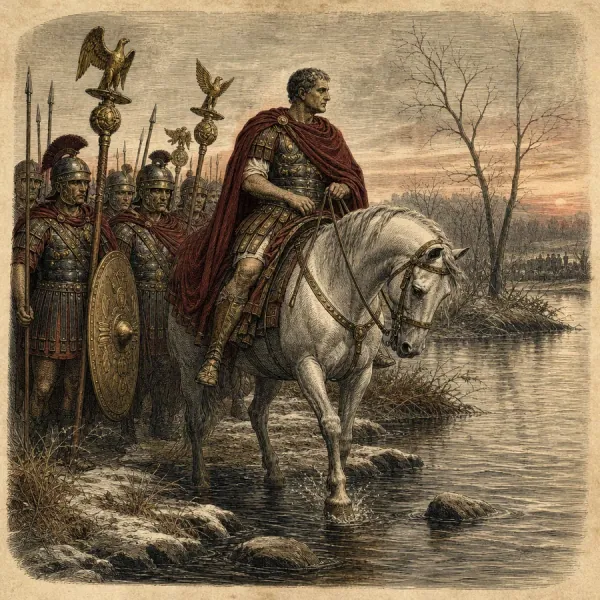
Born in Rome in 100 BC into an old but modest patrician family, Julius Caesar climbs the ladder of power step by step, allies with Pompey and Crassus, and then conquers Gaul all the way to his victory over Vercingetorix at Alesia. You will follow the crossing of the Rubicon, the civil war against Pompey, the meeting with Cleopatra in Egypt, and the reforms of the dictator, including the Julian calendar. You will finally understand why senators stabbed him on the Ides of March 44 BC, and how his name became a byword for power.
Key dates and facts
- 100 BC
- Born in Rome
- 82 BC
- Sulla's victory, the proscriptions
- 80 BC
- Military service in Asia
- 78 BC
- Sulla dies, Caesar returns to Rome
- 58 BC
- Victory over the Helvetii
- 55 BC
- Bridge over the Rhine, landing in Britain
- 52 BC
- Gergovia, then Alesia
- 51 BC
- End of Gallic resistance
- January 49 BC
- Crosses the Rubicon
- 49 BC
- Victory at Ilerda, in Spain
🏛️ A young patrician in a civil war
Caius Julius Caesar, whom we call Julius Caesar, was born in Rome on July 12 or 13, 100 BC. He belonged to the gens Julia, a very old patrician family that claimed descent from Iulus, son of the Trojan hero Aeneas, and therefore from the goddess Venus. This prestige was largely symbolic: at the start of the first century BC, the Julii did not belong to the small circle of families who shared out the consulship among themselves, and the family was rather short of money. Young Caius grew up in Subura, a rough, working-class district of Rome.
👨👩👧 A modest family with powerful connections
His father, who bore exactly the same name, had an honorable career that never rose above the praetorship; he died suddenly around 85-84 BC, when his son was about fifteen. His mother, Aurelia Cotta, came from a family that had produced several consuls, and is described by Tacitus and Plutarch as a model mother, combining devotion with discipline. Caesar had two sisters, both named Julia; the younger would become the grandmother of the future emperor Augustus. Most importantly, his aunt Julia had married Marius, the great leader of the populares. The grammarian Marcus Antonius Gnipho was his tutor, and Cicero would later credit this careful education with the elegance of Caesar's Latin.
The two great political camps of the late Roman Republic. The optimates championed a conservative, aristocratic line that placed the Senate at the heart of power; the populares relied on the people and called for social reforms, such as the redistribution of public land.
⚔️ Standing up to Sulla
Caesar grew up amid bloody violence: in 88 BC, the supporters of Marius and those of Sulla clashed in the streets of Rome, and then Sulla won in 82 and hunted down his opponents, whose names were posted on proscription lists. Now Caesar had married Cornelia, the daughter of Cinna, Marius's successor, and had been named flamen of Jupiter, a prestigious priesthood. Once master of Rome, Sulla ordered him to give up the priesthood and divorce his wife. Caesar refused and had to go into hiding, until influential relatives and the Vestal Virgins obtained his pardon: he lost the priesthood but kept his wife.
🌊 First steps as a soldier in the East
Cautious, Caesar left Italy around 80 BC to serve on the staff of Marcus Minucius Thermus, governor of the province of Asia. Sent to fetch ships from the king of Bithynia, Nicomedes IV, he stayed for a time at his court; his enemies would claim for the rest of his life that he had been the king's lover, a common slander used in Rome to humiliate a rival. At the siege of Mytilene, on the island of Lesbos, he was awarded the civic crown, a decoration given to a soldier who had saved a fellow citizen's life in battle. He went on to serve in Cilicia, then returned to Rome on learning of Sulla's death in 78 BC.
🪩 Climbing the ladder of power
Back in Rome, young Julius Caesar first sought to build a name for himself as an orator. In 77 BC, he brought a corruption charge against Cnaeus Cornelius Dolabella, a former governor of Macedonia close to Sulla; despite his speeches, the defendant was acquitted by a jury drawn entirely from the Senate. He then went after Caius Antonius Hybrida, who escaped conviction only through the intervention of a tribune of the plebs.
🏴☠️ Pirates and the school at Rhodes
Caesar then set off to refine his skills at Rhodes under the celebrated teacher of rhetoric Apollonius Molon. Along the way, he was captured by pirates. According to Plutarch, he thought their demand of twenty talents far too modest and declared himself worth a ransom of fifty; once freed, he returned with ships, captured his captors, and had them executed. Historians believe this story was considerably embellished over time.
The “course of honors”: the sequence of annually elected magistracies that a Roman aristocrat climbed in a fixed order, from the quaestorship up to the consulship, the highest office in the Republic.
🎭 Quaestor, aedile, chief priest
Caesar joined the college of pontiffs in 73 BC, then was elected military tribune. In 69, he became quaestor in Further Spain, which opened the doors of the Senate to him. That same year, he lost both his aunt Julia and his wife Cornelia, who had given him his only legitimate child, a daughter named Julia. At his aunt's funeral, he had images of Marius carried in the procession, even though Sulla had tried to erase his memory. He remarried, to Pompeia, a granddaughter of Sulla. Elected aedile in 65, he put on lavish games, including, according to Plutarch, three hundred and twenty pairs of gladiators: the people adored him, but he sank deep into debt.
In 63 BC, he won election as pontifex maximus, the highest priest in the Roman state, against two far more experienced senators, a post he would hold for life. That same year, during the Catiline conspiracy, he opposed the Senate's decision to execute the conspirators' accomplices without trial, but Cato carried the vote for death. As praetor in 62, he divorced Pompeia after a religious scandal, the affair of the Bona Dea, explaining, in a line that has since become famous, that Caesar's wife must be above suspicion.
“For my part, I would rather be the first man here than the second man in Rome!”
Plutarch, Parallel Lives, “Caesar,” XI (1st-2nd century, translated), on passing through a poor village in the Alps
🗡️ Spain and the choice of the consulship
After his praetorship, buried in debt, Caesar left to govern Further Spain. There he campaigned against peoples of the northwestern peninsula, reached the Atlantic, and brought back enough plunder to pay off his creditors. His soldiers hailed him as imperator. Returning in the summer of 60, he faced a choice: wait outside Rome to celebrate a triumph, or enter the city to stand as a candidate for the consulship. With Cato blocking any exception to the rule, Caesar gave up the triumph and chose power instead.
The rest of the course
This page publishes the first 2 parts. The full course has 9: here is what the next ones cover.
- 🤝 The triumvirate and the consulship
The secret alliance with Pompey and Crassus (the First Triumvirate), the consulship of 59 BC, the land laws, Julia's marriage to Pompey, and the award of the Gallic provinces for five years.
- 🛡️ The Gallic Wars and Alesia
The conquest of Gaul from 58 to 51 BC: the Helvetii, Ariovistus, the Belgae, the bridge over the Rhine, expeditions to Britain, Vercingetorix's revolt, the defeat at Gergovia, the siege and victory of Alesia in 52 BC, and the Commentaries.
- 🎲 The Rubicon and the war against Pompey
The break with Pompey and the Senate, the crossing of the Rubicon in January 49 BC, the swift conquest of Italy, the Spanish campaign, Caesar's clemency, and the victory at Pharsalus in 48 BC.
- 🐊 Cleopatra, Egypt, and the last battles
Pompey's death in Egypt, the Alexandrian War, the affair with Cleopatra VII and the birth of Caesarion, the lightning victory at Zela (Veni, vidi, vici), Thapsus, the quadruple triumph of 46, and Munda in 45 BC.
- 📅 The reforming dictator
Caesar's extraordinary powers and honors, his clemency, his reforms (the Julian calendar, an enlarged Senate, colonies, grain distributions, citizenship), his major building projects, and the criticism they drew.
- 🗡️ The Ides of March
Rumors of kingship, the refusal of the diadem at the Lupercalia, the conspiracy of Brutus and Cassius, Caesar's assassination in the Senate on March 15, 44 BC, his will, and his funeral.
- 🌍 A name turned into a title
What remains of Caesar: his deification, the rise of Octavian-Augustus and the end of the Republic, the name Caesar turned into a title (Kaiser, tsar), the calendar, Caesarism, and his place in literature, theater, comic books, and film.
Study “Julius Caesar” with flashcards and quizzes
In Oria, you read the full course, then practice on it: flashcards, multiple-choice quizzes, open questions or the Feynman method. Cards and questions then come back in your daily review, paced by spaced repetition.
Study this topic in OriaSources
These notes draw on the sources below. If a point seems doubtful, refer back to them.