Myths & religions
The Epic of Gilgamesh: Summary and Study Notes
The world's oldest story: a king, a friend and the fear of dying
Study this topic in OriaThe essentials
Long before Homer and the Bible, the scribes of Mesopotamia told the story of Gilgamesh, king of Uruk, his friendship with the wild man Enkidu and his desperate quest for immortality. You'll discover who the real Gilgamesh may have been, how the text was built up over a thousand years, the plot tablet by tablet, the famous Flood story, what the epic says about death and friendship, and the incredible story of its rediscovery in the 19th century.
Key dates and facts
- c. 2700 BC
- Possible reign of Gilgamesh in Uruk
- 26th century BC
- First mention as a god of the underworld
- c. 2100 BC
- The kings of Ur III call themselves his “brothers”
- c. 2100 BC
- Sumerian poems about Bilgamesh
- c. 1800 – 1600 BC
- First epic in Akkadian
- c. 1300 – 1200 BC
- Standard version attributed to Sîn-lēqi-unninni
- 7th century BC
- Copies from the Nineveh library
- 1853
- Rassam unearths the Flood tablet at Nineveh
- 1872
- George Smith reveals the Flood story
- 2003
- Andrew George's critical edition
👑 Gilgamesh, king of Uruk: from history to legend
The Epic of Gilgamesh is one of the oldest known literary works of humanity. It was written in Mesopotamia, the region between the Tigris and the Euphrates that largely corresponds to present-day Iraq, in cuneiform script (wedge-shaped signs) pressed into clay tablets. It tells the adventures of Gilgamesh, king of the city of Uruk, his friendship with the wild man Enkidu, and then his desperate quest for immortality after his friend's death. Its first known version, in Akkadian, dates from the 18th or 17th century BC: more than a millennium before the Iliad.
🏛️ A king who may have existed
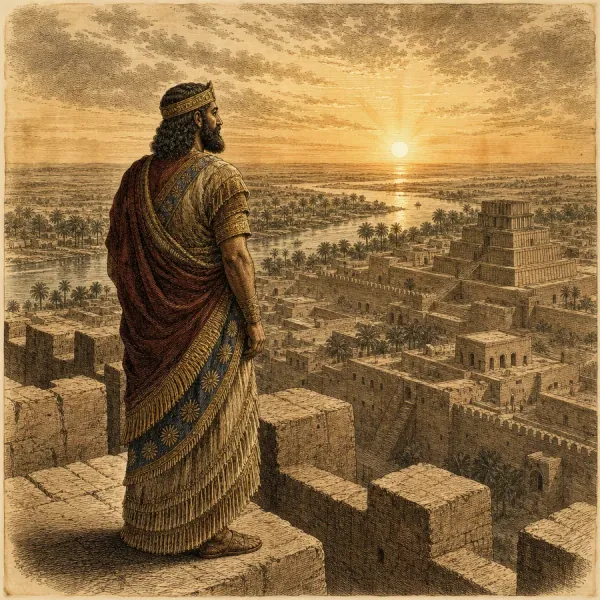
The hero of the epic is not pure invention. In the oldest texts, written in Sumerian, he bears an older form of his name, Bilgamesh. The Sumerian King List, a list of rulers compiled in antiquity, makes him a king of Uruk who dominated Mesopotamia in distant times. Many historians think he really reigned. For the specialist Stephanie Dalley, his life cannot be dated precisely, but scholars generally place it between 2800 and 2500 BC; others suggest around 2700 BC.
Several clues point that way. The stories pit him against Agga, king of the neighboring city of Kish; objects associated with Agga and Enmebaragesi, two kings of Kish mentioned in these stories, have been found, and Enmebaragesi is an attested historical figure. But there is no direct proof, such as an inscription signed by Gilgamesh himself, so the question remains open.
✨ From hero to god
Very early on, the figure changed status. A text from the 26th century BC already presents him as a deity of the underworld, a role he kept afterward: for the Mesopotamians, Gilgamesh was also a judge of the dead. Around 2100 BC, the kings of the Third Dynasty of Ur (known as Ur III), who came from Uruk, proclaimed themselves his “brothers” and placed themselves under his protection. King Shulgi of Ur even called himself the son of Lugalbanda and the goddess Ninsun, Gilgamesh's parents according to tradition.
This triple face, king, hero and god, runs through nearly 2,500 years of cuneiform literature. The epic, for its part, chooses above all to show the man: an exceptional king, “two-thirds god, one-third man,” who will nonetheless have to learn that he is mortal.
🧱 A text that grew for a thousand years
The Epic of Gilgamesh was not written in one go by a single author. It is a living text, rewritten, enriched and copied for more than a millennium. Assyriologists distinguish several major stages.
📜 The Sumerian poems
Before the epic there were five poems in Sumerian, the oldest written language of Mesopotamia, each recounting one of Gilgamesh's feats: his victory over Agga of Kish, the fight against the giant Huwawa (the future Humbaba), the Bull of Heaven, Enkidu's descent into the underworld and the hero's death. They are known from schoolboys' copies of around 1800–1700 BC, but were probably composed around 2100 BC at the court of the Ur III kings. They are not yet the chapters of a single book: they are independent stories.
🏺 The first epic, in Akkadian
The Old Babylonian version, written in Akkadian (the Semitic language of Babylon) around 1800–1600 BC, is the first to weave these adventures into a continuous narrative. It is not a mere translation of the Sumerian poems but a new work, probably drawing on oral traditions that have since vanished. Only fragments survive, now kept from Yale to Philadelphia and as far away as Norway. Its title, as always in Mesopotamia, is its first line: “Surpassing All Other Kings.”
🌍 An international success
Between 1500 and 1200 BC, Akkadian became the language of diplomacy from Egypt to present-day Iran, and the epic traveled with the scribal schools. Fragments have been found at Emar and Ugarit in Syria, at Megiddo, and at Hattusa, the capital of the Hittites in Anatolia (present-day Turkey), where the story was adapted into Hittite and Hurrian under the title “Song of Gilgamesh.”
📚 The twelve-tablet “Standard” version
Toward the end of the 2nd millennium BC appeared the form we read today: the Standard version, spread over twelve tablets. Mesopotamian tradition attributes it to an exorcist priest named Sîn-lēqi-unninni, often placed around 1300–1200 BC, without direct proof. He added a new prologue, a more reflective tone focused on wisdom, and probably the long Flood story. Its first line became “He who saw everything,” which can also be understood as “He who saw the Deep.” The twelfth tablet, a translation of a Sumerian poem with no direct link to the plot, is generally considered a later addition.
This version is known mainly from 7th-century BC tablets found at Nineveh, in the library of the Assyrian king Ashurbanipal. In his 2003 reference edition, the Assyriologist Andrew George estimated the complete text at about 3,000 lines, of which some 2,400 survive, often damaged: roughly two-thirds of the story is now well reconstructed.
The rest of the course
This page publishes the first 2 parts. The full course has 9: here is what the next ones cover.
- 🌾 The tyrant king and the wild man
Tablets I and II: Gilgamesh oppresses Uruk, the gods create Enkidu in the steppe, the courtesan Shamhat brings him from animal to human, and then the two heroes fight and become friends.
- 🌲 The Cedar Forest and the Bull of Heaven
Tablets III to VI: the expedition against Humbaba, guardian of the Cedar Forest, then the rejection of Ishtar's advances and the slaying of the Bull of Heaven.
- 🕯️ The death of Enkidu
Tablets VII and VIII: the gods condemn Enkidu, his vision of the underworld, his twelve-day agony, and then the mourning and the funeral organized by Gilgamesh.
- 🌅 To the ends of the earth: the quest for immortality
Tablets IX to XI: Gilgamesh's wanderings, the Scorpion Man, Shiduri the tavern keeper, the crossing of the Waters of Death, the sleep test, the plant of rejuvenation stolen by the snake and the return to Uruk.
- 🌊 The Flood, a story within the story
The Flood story told by Uta-napishti (Tablet XI), its source in the Atrahasis myth and its close parallels with the story of Noah in Genesis.
- 💭 Death, friendship, wisdom: what the epic says
The major themes: accepting death, the friendship of Gilgamesh and Enkidu, nature and culture, the role of the female characters, the coming-of-age story and Tablet XII.
- 🔎 Forgotten, then found again: from Nineveh to today
How the epic was forgotten, its rediscovery at Nineveh and the shock of 1872 with George Smith, the translations, new finds (2014, 2021, artificial intelligence) and its worldwide legacy.
Study “The Epic of Gilgamesh” with flashcards and quizzes
In Oria, you read the full course, then practice on it: flashcards, multiple-choice quizzes, open questions or the Feynman method. Cards and questions then come back in your daily review, paced by spaced repetition.
Study this topic in OriaSources
These notes draw on the sources below. If a point seems doubtful, refer back to them.