Law & society
The institutions of the European Union: Summary and Study Notes
Who decides what, between Brussels, Strasbourg, Luxembourg and Frankfurt
Study this topic in OriaThe essentials
The European Union is neither a state nor a simple international organization: its 27 members have pooled part of their powers in institutions unlike any others. You'll discover the role of the Commission, which proposes laws and watches over the treaties; of the Parliament, elected by more than 370 million voters; of the two Councils where governments sit; of the Court of Justice, the European Central Bank and the Court of Auditors. You'll follow step by step how a European law is made, from the GDPR to the USB-C charger, before exploring the big debates: the democratic deficit, lobbying, unanimity.
Key dates and facts
- 1952
- First ECSC institutions
- 1979
- First direct election of the Parliament
- 1998
- Creation of the European Central Bank
- 2009
- Treaty of Lisbon, today's architecture
🧩 An organization unique in the world
The European Union brings together 27 states that have chosen to pool part of their sovereignty. It is not a federal state like the United States, because the states remain masters of the treaties and keep most of their powers. Nor is it a conventional international organization like the UN: its decisions apply directly to citizens and businesses, and some of its institutions act in the name of the European interest rather than on behalf of governments. It is said to combine a supranational logic with an intergovernmental one. Its history, from the Schuman Declaration to Brexit, is told in the chapter on the building of Europe.
🏛️ Seven institutions
The Treaty on European Union lists seven: the European Parliament, the European Council, the Council of the European Union, the European Commission, the Court of Justice of the European Union, the European Central Bank and the European Court of Auditors. Each represents a different source of legitimacy:
- the European Council brings together the heads of state or government;
- the Council of the European Union represents the governments, through their ministers;
- the Parliament represents the citizens, who elect it directly;
- the Commission defends the general European interest.
This balance was not drawn up in one go. It grew in successive layers from the European Coal and Steel Community, whose High Authority, Assembly, Council of Ministers and Court of Justice foreshadowed today's institutions.
“Nobody would have deliberately designed a government as complex and as redundant as the EU.”
T. R. Reid, journalist at The Washington Post
🗺️ Four cities
There is no single capital. The Commission and the Council sit in Brussels, the Court of Justice in Luxembourg, the Parliament in Strasbourg for its plenary sessions, and the European Central Bank in Frankfurt. This arrangement was settled in 1992 and written into the Treaty of Amsterdam. Brussels, which is also home to NATO, has more journalists and ambassadors than Washington.
The European Council brings together the leaders of the 27 member states and sets the broad direction. The Council of the European Union brings together their ministers and passes laws with the Parliament. The Council of Europe, in Strasbourg, is not part of the Union: it is a separate organization founded in 1949, which has 46 member states and oversees the European Court of Human Rights.
🏢 The European Commission, engine and guardian
The European Commission is the Union's executive body. It descends from the ECSC's High Authority, chaired by Jean Monnet, which set up in Luxembourg in August 1952. Its main headquarters today is the Berlaymont building in Brussels.
👥 A college of 27 members
It has 27 commissioners, one per member state, including the president. But each swears to serve the interest of the Union as a whole, not that of their home country. Each commissioner is responsible for a policy area (competition, trade, digital, climate…) and relies on directorates-general, comparable to ministries. In all, the Commission employs about 32,000 staff.
🗳️ How is it chosen?
- After the European elections, the European Council proposes a candidate for president, by qualified majority, taking the results into account.
- The European Parliament elects that candidate by a majority of its members.
- The states put forward their commissioners in consultation with the president-elect; the candidates are questioned by MEPs, who can have some of them replaced.
- The Parliament approves the college as a whole, which can then take office.
Germany's Ursula von der Leyen, elected in 2019, was reappointed in 2024. Her second Commission, approved by the Parliament on November 27, 2024, with 51% of the vote, the weakest support since the Parliament began voting on the college, has been in office since December 1, 2024.
✍️ The monopoly on initiative
In most areas, only the Commission can propose a European law. The Parliament, the Council or a million citizens can ask it to act, but it is the Commission that drafts the text. This power of initiative makes it the “engine” of European integration.
🛡️ Guardian of the treaties
The Commission also makes sure that the states comply with European law. If it believes a country is not applying it, it first sends a reasoned opinion, then can take the country to the Court of Justice: these are infringement proceedings. It often tries to reach an amicable settlement first. Finally, it implements the Union's budget, under the Parliament's oversight.
⚠️ Accountable to the Parliament
The Parliament can bring down the Commission by passing a motion of censure by a two-thirds majority. This has never happened, but the threat was enough once: in 1999, after accusations of fraud and mismanagement and the Parliament's refusal to approve the implementation of the budget, the Commission led by Jacques Santer resigned collectively on March 15, 1999, before the vote.
The rest of the course
This page publishes the first 2 parts. The full course has 8: here is what the next ones cover.
- 🗳️ The European Parliament, the citizens' voice
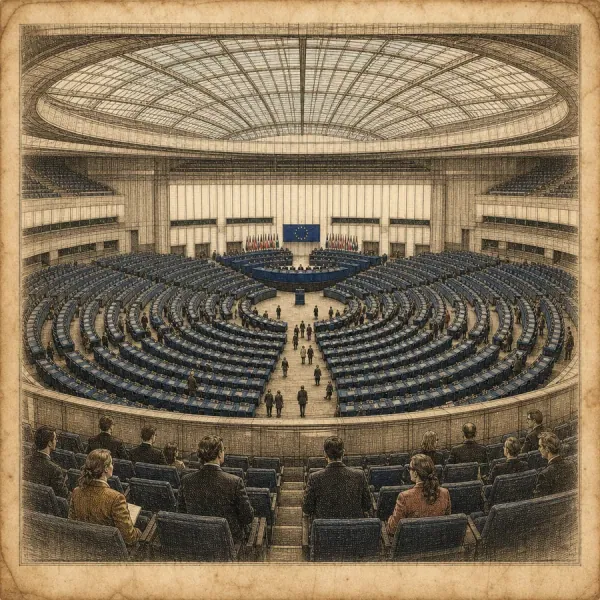
The European Parliament: direct universal suffrage since 1979, 720 MEPs elected in June 2024, transnational political groups, seats split between Strasbourg, Brussels and Luxembourg, and its legislative, budgetary and oversight powers over the Commission.
- 🤝 The two Councils: the states around the table
The Council of the European Union (ministers by configuration, six-month rotating presidency, Coreper, qualified majority of 55% of states and 65% of the population, unanimity) and the European Council (heads of state or government, summits, a standing president, appointment of the Union's leaders).
- 📜 How a European law is made
The Union's legal acts (regulation, directive, decision, recommendation) and the ordinary legislative procedure step by step: the Commission's proposal, readings in Parliament and Council, conciliation, trilogues; the examples of the GDPR and the universal USB-C charger, and the European citizens' initiative.
- ⚖️ The Court of Justice, guardian of European law
The Court of Justice of the European Union in Luxembourg: its makeup (Court of Justice and General Court), infringement proceedings, actions for annulment and preliminary references, the landmark rulings Van Gend en Loos (direct effect, 1963) and Costa v ENEL (primacy, 1964), and tensions with some national constitutional courts.
- 💶 The ECB, the Court of Auditors and the Union's money
The European Central Bank (created in 1998, based in Frankfurt, independent, focused on price stability, a 21-country euro area since 2026, the 2012 “whatever it takes” speech), the European Court of Auditors and the EU budget (2021–2027 financial framework, recovery plan, revenue).
- 🧭 Democratic deficit, lobbying, unanimity: the big debates
The main criticisms and debates about the European institutions: the democratic deficit and voter turnout, researchers' responses, transparency and lobbying, the unanimity rule, the Strasbourg seat, and the exit option under Article 50 used by the United Kingdom.
Study “The institutions of the European Union” with flashcards and quizzes
In Oria, you read the full course, then practice on it: flashcards, multiple-choice quizzes, open questions or the Feynman method. Cards and questions then come back in your daily review, paced by spaced repetition.
Study this topic in OriaSources
These notes draw on the sources below. If a point seems doubtful, refer back to them.