History
The Protestant Reformation: Summary and Study Notes
The century that tore Western Christianity apart
Study this topic in OriaThe essentials
In 1517, a German monk, Martin Luther, challenges the trade in indulgences. Thanks to the printing press, his ideas spread within months and the Western Church splits apart: Lutherans, Calvinists, and Anglicans on one side, Catholics on the other. You'll understand what worried Christians at the close of the Middle Ages, what Luther and Calvin proposed, why England broke with Rome, how the Catholic Church fought back, and how France sank into the Wars of Religion until the Edict of Nantes.
Key dates and facts
- Oct. 31, 1517
- The 95 Theses
- June 15, 1520
- The bull Exsurge Domine
- Jan. 3, 1521
- Luther's excommunication
- May 26, 1521
- Placed under the ban of the Empire
- 1521
- Henry VIII, "Defender of the Faith"
- 1534
- Act of Supremacy
- 1553
- Mary Tudor restores Catholicism
- 1559
- Elizabeth I restores the Church of England
- March 1, 1562
- Massacre of Wassy
- Aug. 24, 1572
- St. Bartholomew's Day massacre
⛪ The Church at the close of the Middle Ages
At the start of the 16th century, Western Europe is entirely Catholic, and the Church of Rome, led by the pope, shapes everyone's life from birth to death. To understand the Protestant Reformation, you first need to grasp the anxiety that gripped Christians of that time.
😨 Fear of the afterlife
Since the Great Plague of the 14th century, which killed roughly a third of Europeans, the faithful lived in fear of eternal damnation. The danses macabres painted on church walls bear witness to this. People hoped, at the very least, to shorten their soul's stay in purgatory, the place where sins are atoned for before entering heaven. Hence the rise of the cult of saints, relics, pilgrimages, and indulgences. Frederick the Wise, elector of Saxony and Luther's future protector, owned 17,443 relics said to spare him 128,000 years in purgatory.
In the Catholic Church, a full or partial remission of the punishment owed for a sin already forgiven. It is obtained through good works (pilgrimage, prayer, visiting relics, donations); by the late Middle Ages, indulgences were being sold, turning them into a genuine trade.
🗣️ Long-standing criticism
Complaints against the clergy were many: priests living with concubines, bishops living like great lords, clerics enriching themselves at the expense of the faithful. Reformers had already risen up before. Around 1170, Waldo of Lyon founded the Poor of Lyon movement and had passages of the Gospel translated into the vernacular. In England, the scholar John Wycliffe criticized the Church's abuses. In Bohemia, Jan Hus denounced the sale of indulgences as early as 1412; summoned before the Council of Constance, he refused to recant and was burned as a heretic on July 6, 1415. The councils of the 15th century, which were supposed to reform the Church, failed.
📜 Humanism and the return to the texts
At the same time, humanists wanted to return to the sources. The Italian Lorenzo Valla proved that the "Donation of Constantine," one of the founding texts of papal authority, was a medieval forgery. The Dutchman Erasmus published Latin and Greek editions of the New Testament that called certain traditional translations into question. Reading the Bible in its original text became an ideal.
👑 Kings, princes, and money
The Reformation also had political and economic causes. Rulers resented seeing their kingdoms' money flow to Rome and wanted to control the appointment of bishops. The Church often owned 20 to 30% of cultivated land, which stoked the envy of princes and nobles. Historians note, however, that the idea of a wholly "decadent" Church comes partly from the reformers themselves, who had an interest in justifying their break with Rome.
🔨 Luther and the 95 Theses
Martin Luther was born on November 10, 1483, in Eisleben, Saxony. A student at the University of Erfurt, he began studying law to obey his father, but his life changed after a storm: on July 2, 1505, lightning struck near him, and, terrified, he vowed to become a monk. On July 17, 1505, he entered the Augustinian monastery in Erfurt.
🙏 An anguish and a discovery
Ordained a priest in 1507 and a doctor of theology in 1512, Luther taught the Bible at the University of Wittenberg. But neither fasting, nor confession, nor the Mass gave him any certainty of being saved. Studying Paul's Epistle to the Romans, he found an answer in one line: "the righteous shall live by faith." For him, salvation is a free gift from God, received through faith, not a reward earned through good works. This is the doctrine of justification by faith.
📜 The 95 Theses
In 1515, Pope Leo X authorized a new sale of indulgences to fund the rebuilding of St. Peter's Basilica in Rome. In the Holy Roman Empire, the Dominican friar Johann Tetzel preached it with zeal; he is credited with a saying promising that a soul flies out of purgatory the instant a coin clinks in the box. On October 31, 1517, Luther wrote to the Archbishop of Mainz, Albert of Brandenburg, enclosing a list of propositions in Latin: the 95 Theses. In them, he challenged the idea that money could buy God's forgiveness. In thesis 86, he asked why the pope, richer than the richest of men, did not build St. Peter's with his own money rather than with that of the poor faithful.
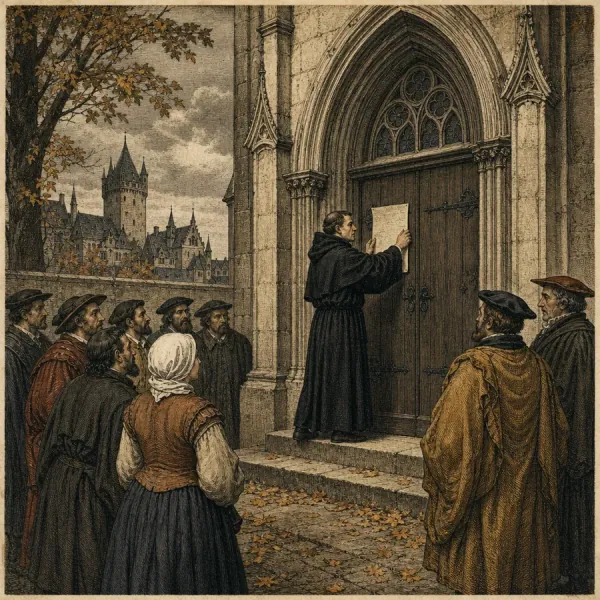
According to tradition, Luther nailed his theses to the door of Wittenberg's castle church. But this account only appears more than twenty years later, from the pen of his disciple Philip Melanchthon, who was not yet in Wittenberg in 1517. Since 1961, historians have debated whether this posting actually happened. One thing is certain: Luther wanted a debate among theologians, not a break with Rome.
⚡ The break with Rome
The dispute grew bitter. In 1519, in Leipzig, Luther debated the theologian Johann Eck. On June 15, 1520, the papal bull Exsurge Domine condemned 41 of his propositions. Luther then published his major reformist writings, and on December 10, 1520, he publicly burned the bull. He was excommunicated on January 3, 1521.
"A Christian is a free man, master of all things, subject to no one; a Christian is a dutiful servant, subject to everyone." (translated)
Martin Luther, On the Freedom of a Christian (1520)
Summoned before the Diet of Worms, in the presence of the young Emperor Charles V, Luther refused in April 1521 to renounce his writings unless shown to be in error by Scripture. On May 26, 1521, he was placed under the ban of the Empire: anyone could hand him over to the authorities. His protector, Frederick the Wise, had him "abducted" and hid him in Wartburg Castle, where he remained until March 1522 under the name Knight George.
The rest of the course
This page publishes the first 2 parts. The full course has 8: here is what the next ones cover.
- 🖨️ The printing press and the spread of Lutheranism
The role of the printing press in Luther's success, the German Bible, then the organization of Lutheranism in the Empire: the Peasants' War, the Protest of Speyer, the Augsburg Confession, and the Peace of Augsburg.
- 📖 Calvin and Geneva
The second wave of the Reformation: Zwingli in Zurich, then John Calvin, the Institutes of the Christian Religion, the organization of Geneva, predestination, and the spread of Calvinism.
- 👑 Henry VIII's England
The English Reformation: Henry VIII's refused divorce, the 1534 Act of Supremacy, the swings under Edward VI and Mary Tudor, then the Anglican compromise under Elizabeth I.
- 🕊️ The Catholic response: the Counter-Reformation
The Catholic Church's response: the Society of Jesus, the Roman Inquisition, the Council of Trent (1545–1563), its decisions, the Index, and Baroque art.
- ⚔️ The Wars of Religion in France
The eight Wars of Religion in France (1562–1598): the rise of Calvinism, the Massacre of Wassy, the St. Bartholomew's Day massacre of 1572, the Catholic League, Henry IV's conversion, and the 1598 Edict of Nantes.
- 🌍 What the Reformation changed
The consequences of the Reformation: a divided Europe, the Thirty Years' War, the fate of French Protestants up to 1787, reading and literacy, individual conscience, and historical debates.
Study “The Protestant Reformation” with flashcards and quizzes
In Oria, you read the full course, then practice on it: flashcards, multiple-choice quizzes, open questions or the Feynman method. Cards and questions then come back in your daily review, paced by spaced repetition.
Study this topic in OriaSources
These notes draw on the sources below. If a point seems doubtful, refer back to them.