The human body
The Skeleton and Bones: Summary and Study Notes
The living framework that carries us, protects us and rebuilds itself
Study this topic in OriaThe essentials
Far from being an inert framework, the skeleton is a living tissue that grows, repairs itself, stores calcium and makes blood. Here you'll discover what a bone is made of, how it grows and then constantly rebuilds itself according to the stresses it bears, and how a fracture heals. The chapter also tells the story of how we came to know the skeleton, from Vesalius to Röntgen's X-rays, presents osteoarthritis, osteoporosis and rickets, and sorts fact from myth, from Lucy to cracking your knuckles.
Key dates and facts
- 206
- Bones in an adult, by the standard count
- 270 – 300
- Bones or bone pieces in a newborn
- 2 – 3 mm
- Size of the stapes, the smallest bone
- ≈ 27%
- Share of height accounted for by the femur, the longest bone
- ≈ 10%
- Share of the adult skeleton renewed each year
- 25 – 30 years
- Age of peak bone mass
- > 1%
- Bone mass lost per month in weightlessness
- 1543
- Vesalius publishes the Fabrica
- Nov. 8, 1895
- Röntgen observes X-rays
- 1901
- First Nobel Prize in Physics, awarded to Röntgen
🦴 A living framework: how many bones, and what for?
The skeleton is the body's internal framework. We picture it dry and white, like the one in a classroom, but in a living being it is a set of very much alive organs, supplied with blood, threaded with nerves and constantly rebuilt. Together with the joints, ligaments, tendons and muscles, it forms the musculoskeletal system; muscles have their own chapter in Explorer.
🔢 206 bones… more or less
An adult has about 206 bones, half of them in the hands and feet. A newborn has more, between 270 and 300 depending on the source, because many of its bones are still in several pieces that fuse during growth: the five vertebrae of the sacrum eventually form just one, for example. The figure of 206 is a convention. Some people have extra small bones, such as the sesamoid bones embedded in tendons or tiny bones in the sutures of the skull, and fused vertebrae can be counted one by one or together. Depending on these choices, the total ranges from 204 to 224 bones. The medical treatises of ancient India counted 300, or even 360, partly because they included certain cartilages or the tooth sockets.
🧭 One axis and four limbs
Anatomists distinguish two groups. The axial skeleton, about 80 bones, forms the axis of the body: the skull, the spine and the rib cage, with its 12 pairs of ribs and the sternum. It bears the weight of the head and trunk and passes it on to the hips. The appendicular skeleton, about 126 bones, includes the four limbs and the two “girdles” that attach them to the trunk: the shoulders and the pelvis. The record for length goes to the femur, the thigh bone, which on average accounts for nearly 27% of a person's height, a proportion so stable that anthropologists use it to estimate someone's height from a single bone. The smallest is the stapes, one of the three ossicles of the middle ear, which measures 2 to 3 millimeters and passes sound vibrations to the inner ear.
🧰 Six jobs at once
Bones make up about 14% of body weight, or 10 to 11 kg for an average person; if cartilage, joints and ligaments are included, the skeletal system reaches about 20%. They carry out six major functions:
- Supporting the body and giving it its shape: without the ribs, the lungs would collapse.
- Enabling movement, by acting as levers for the muscles attached to them.
- Protecting: the skull houses the brain, the vertebrae the spinal cord, the rib cage the heart and lungs.
- Making blood: red marrow, housed inside bones, produces red blood cells, white blood cells and platelets, as Explorer's chapter “Blood” explains.
- Storing minerals, especially calcium and phosphorus, which the body draws on or deposits as needed.
- Sending hormonal messages: bone cells release osteocalcin, a hormone that helps regulate blood sugar.
⚖️ Male skeleton, female skeleton
Sex differences are modest in the human skeleton, less pronounced than in many other primates. On average, women's bones are a little smaller and less robust, and the muscle attachment points less prominent. The real difference shows in the pelvis, which is wider in women to allow childbirth. It is the most useful bone for anthropologists trying to determine the sex of an unknown skeleton: one classic method achieves 96% to 100% accuracy in some populations.
🔬 What is a bone made of?
A bone is not a block of chalk. It is a composite material, comparable to reinforced concrete: flexible fibers embedded in a hard substance. This combination makes it both strong and light.
🧵 Fibers and crystals
By mass, the non-cellular part of bone is about 30% organic material and 70% minerals. The organic material is mostly type I collagen, a fibrous protein that gives bone its tensile strength and a little elasticity. The minerals are crystals of calcium phosphate, hydroxyapatite, which give it hardness and resistance to compression. The two reinforce each other: if you dissolve the mineral out of a bone, it becomes rubbery; without collagen, it would lose its flexibility and break more easily. So bone is not made “only of calcium.”
The result: bone stands up very well to being crushed, less well to being stretched, and rather poorly to shear and twisting forces. Twisting is therefore especially dangerous for it.
🧱 Compact outside, spongy inside
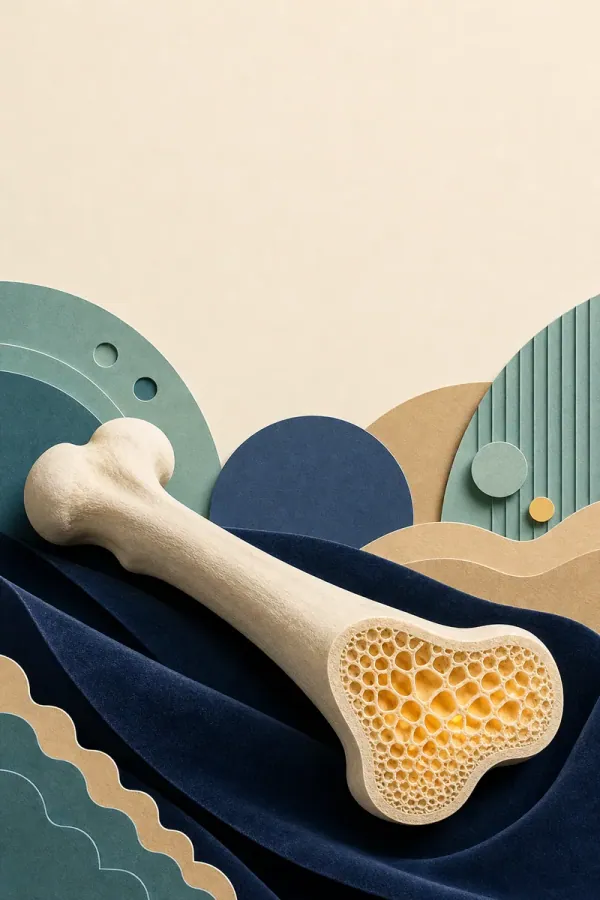
Every bone combines two architectures. On the outside, compact bone (or cortical bone), dense, smooth and white, makes up about 80% of an adult's bone mass. It is made of tiny columns, osteons, built of concentric layers around a canal carrying blood vessels and nerves; in neighboring layers, the collagen fibers run in opposite directions, as in plywood, which helps the bone resist twisting. On the inside, especially at the ends of long bones and in the vertebrae, spongy bone forms a network of thin struts, the trabeculae, aligned with the forces the bone bears. It is lighter and more active, because its large surface area makes calcium exchange easier. A membrane, the periosteum, covers the outside of the bone.
🩸 Marrow, red or yellow
The cavities of bones house the bone marrow. In a newborn, it is entirely red, meaning it produces blood cells. With age, part of it is replaced by yellow marrow, rich in fat; in adults, red marrow is found mainly in the pelvis, vertebrae, ribs, sternum and upper femur. Bones receive about 10% of the blood pumped by the heart.
👷 Three crews of cells
Bone tissue is maintained by three types of cells, which make up only a small part of its mass:
- Osteoblasts, the builders, lay down collagen fibers and then mineralize them.
- Osteocytes are former osteoblasts that remain walled up in the bone they built. Linked to one another by fine extensions, they are the most numerous cells in bone and seem to act as sensors of mechanical strain.
- Osteoclasts, the demolition crew, are large cells with several nuclei, cousins of macrophages, that dissolve old bone.
The first breaks down bone, the second rebuilds it. Their tandem work, called remodeling, allows bone to renew itself, repair itself and adapt throughout life.
The rest of the course
This page publishes the first 2 parts. The full course has 8: here is what the next ones cover.
- 🌱 Growing up: from cartilage to adult bone
How bones form in the embryo (intramembranous ossification and ossification from cartilage), the role of growth plates and when they close, peak bone mass and the influence of physical activity during childhood.
- ♻️ A bone that never stops rebuilding
Bone remodeling, which renews about 10% of the skeleton each year, its control by hormones and vitamin D, Wolff's law (bone gets stronger where it works), the example of tennis players and astronauts' bone loss.
- 🩹 Fractures: how a bone repairs itself
The causes of fractures, the natural stages of healing (hematoma, fibrous callus, bony callus, remodeling), treatments (reduction, casts, surgery), fractures specific to children and the story of Gavriil Ilizarov, the Soviet surgeon who learned how to lengthen bones.
- 📜 Seeing bones: from Vesalius to X-rays
How humanity came to know the skeleton: the anatomists of Alexandria, Galen and his errors drawn from dissecting monkeys, Andreas Vesalius and the 1543 Fabrica, then Wilhelm Röntgen and the discovery of X-rays in 1895, up to modern imaging.
- 🩺 When bones and joints suffer
Joints and cartilage, then the major diseases of the skeleton explained simply: osteoarthritis, osteoporosis, rickets and vitamin D, scoliosis and brittle bone disease, with their worldwide figures.
- ❓ What bones tell us, and common myths
Lucy and what fossil skeletons tell us about our evolution, then five common beliefs put to the test: that bones are dead, that they're made of calcium, that the femur is the strongest bone, that cracking your knuckles causes arthritis and that babies have more bones than adults.
Study “The Skeleton and Bones” with flashcards and quizzes
In Oria, you read the full course, then practice on it: flashcards, multiple-choice quizzes, open questions or the Feynman method. Cards and questions then come back in your daily review, paced by spaced repetition.
Study this topic in OriaSources
These notes draw on the sources below. If a point seems doubtful, refer back to them.