History
The Titanic: Summary and Study Notes
The night the world's largest liner went down
Study this topic in OriaThe essentials
On April 15, 1912, four days after leaving Southampton, the Titanic, the largest ship in the world, sank in the North Atlantic after striking an iceberg. About 1,500 people died, for lack of lifeboats and of rescue arriving in time. You'll discover how this giant was built, who was on board, how the night unfolded hour by hour, what the inquiries concluded, what the disaster changed in maritime law and how the wreck was found in 1985.
Key dates and facts
- 1907
- Decision to build the Olympic class
- March 31, 1909
- Keel laid in Belfast
- May 31, 1911
- Launch of the Titanic
- April 2, 1912
- Sea trials
- April 10, 1912
- Departure from Southampton
- April 14, 1912
- Collision with the iceberg at 11:40 p.m.
- April 15, 1912
- The ship sinks at 2:20 a.m.
- April 18, 1912
- The Carpathia reaches New York
- 1914
- First SOLAS convention, 13 countries
- 1929
- Second convention, 18 countries
🏗️ The largest ship in the world
The Titanic was a British ocean liner belonging to the White Star Line, designed to sail between England and New York. Before it became the symbol of a disaster, it was the symbol of an age proud of its machines: when it entered service in April 1912, it was the largest ship in the world.
⚓ A race to be the biggest
At the start of the 20th century, shipping lines were competing for North Atlantic passengers. The British company Cunard had just launched two very fast liners. In 1907, Joseph Bruce Ismay, head of the White Star Line, and Lord Pirrie, chairman of the Harland and Wolff shipyard, decided to respond differently: instead of speed, they would bet on size and luxury. They launched a series of three giants, the Olympic, the Titanic and a third ship that would become the Britannic. They are known as the Olympic class.
🔩 Three million rivets in Belfast
The plans were drawn up in Belfast, in what is now Northern Ireland, under the direction of Alexander Carlisle and then Thomas Andrews, the shipyard's naval architect. To build two ships side by side, Pirrie had a giant gantry erected, at the time the largest scaffolding structure in the world. The Titanic's keel was laid on March 31, 1909. Two years later, the hull was complete: about 2,000 steel plates held together by some 3 million rivets.
On May 31, 1911, the Titanic slid into the water in front of about 100,000 spectators. As was customary at this shipyard, it was not christened with a bottle of champagne. For ten months, more than 3,000 workers, electricians, cabinetmakers and decorators fitted it out. On April 2, 1912, it completed its sea trials, then sailed to Southampton, its port of departure.
📏 A giant in numbers
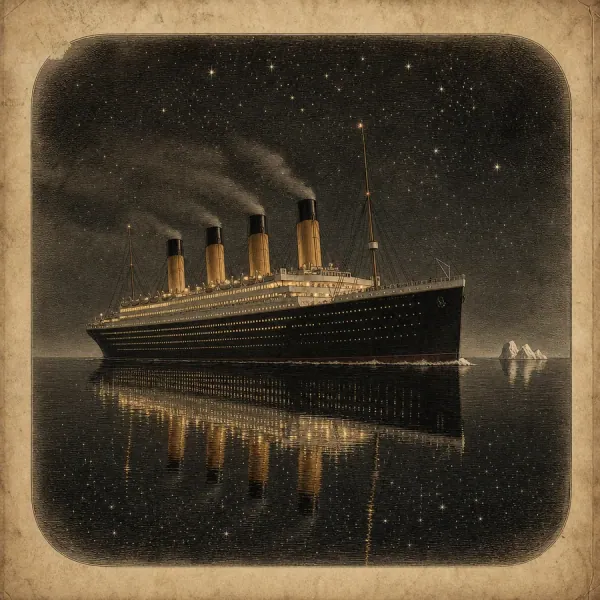
The Titanic was about 269 meters (882 feet) long and 28 meters wide, with a gross tonnage of about 46,000 tons. Twenty-nine coal-fired boilers drove three propellers. Of the four funnels, only three carried away smoke: the fourth, a dummy, served mainly for ventilation and to improve the ship's looks.
Its hull was divided into sixteen watertight compartments whose doors could be closed from the bridge. The ship could stay afloat with two compartments flooded, and up to four if they were the ones at the bow. Technical journals called it “practically unsinkable.” The word stuck, but without the “practically.”
🎩 Three classes aboard one ship
The Titanic left Southampton on April 10, 1912, shortly after noon, on its maiden voyage to New York. That same evening it called at Cherbourg, in France, then the next day at Queenstown (now Cobh), in Ireland. When it headed west, it was carrying about 1,320 passengers and nearly 900 crew members, some 2,200 people in all (the counts vary by a few people depending on the source). That was about half its capacity: it was the off-season, and a coal miners' strike had disrupted shipping.
🥂 First class: a floating palace
About 325 passengers traveled in first class. They had a gymnasium, a swimming pool, Turkish baths, a squash court, an à la carte restaurant and two grand staircases. The most expensive suites, with a private promenade, cost more than $4,350 at the time for a single crossing. On board were some of the greatest fortunes in the world: John Jacob Astor, the richest man on the ship, the industrialist Benjamin Guggenheim, Isidor Straus, co-owner of Macy's department store, and the philanthropist Margaret Brown. Bruce Ismay and Thomas Andrews were also on the voyage, to observe how the ship performed.
📚 Second class: the middle class
The roughly 285 second-class passengers were teachers, clergymen, tourists and well-off families. Their comfort matched first class on many other ships. Among them, the teacher Lawrence Beesley would write one of the most precise accounts of the sinking. A father calling himself “Hoffman” was traveling with two little boys: after the disaster it emerged that he was Michel Navratil, who had abducted his children, and the story of these “Titanic orphans” went around the world.
🧳 Third class: the emigrants' class
About 700 passengers traveled in third class. Most were emigrants from Ireland, Scandinavia, Eastern Europe, Italy, Syria or Armenia, setting out to try their luck in America, often as families, like the eleven members of the Sage family. Their comfort was better than on most ships, with plentiful food. But they were housed at the ends of the ship and kept apart from the other classes, partly because American immigration law required it: on arrival, they had to go through the health inspections at Ellis Island.
⚙️ A crew of nearly 900
The crew consisted mainly of firemen and trimmers, who fed coal into the boilers in crushing heat, and of stewards, cooks and waiters serving the passengers, including 23 women. Sailors and officers made up only about 5% of the crew. The ship was commanded by Captain Edward Smith, 62, the most senior of the company's captains. Eight musicians, led by Wallace Hartley, played for the passengers; they were officially counted as second-class passengers.
The rest of the course
This page publishes the first 2 parts. The full course has 9: here is what the next ones cover.
- 🧊 Four days at sea and ice warnings
The crossing from April 11 to 14, 1912: radio messages reporting ice, speed maintained, and the exceptional conditions on the night of the disaster.
- 🌌 The night of April 14 – 15, 1912
How the sinking unfolded: the collision at 11:40 p.m., the flooding of the compartments, the evacuation by lifeboat, the distress calls and the ship's disappearance at 2:20 a.m.
- ⚖️ The toll: how many died, and who
The numbers behind the Titanic disaster: the range of death tolls from the inquiries, the number of survivors and the inequalities in survival by sex, age and class.
- 🔎 The causes and the inquiries
The causes of the sinking and the American and British inquiries of 1912: speed, ice warnings, the lack of lifeboats, the role of the Californian, and the debate over the rivets.
- 🛟 What the disaster changed: the SOLAS convention
The disaster's consequences for maritime safety: the ice patrol, round-the-clock radio watch, lifeboats for all and the international SOLAS convention from 1914 to today.
- 🌊 1985: the wreck is found
The discovery of the Titanic wreck in 1985 by a French-American expedition, what it revealed, the controversies over recovered objects and the ship's deterioration.
- 🎬 Myths, legends and the 1997 film
The myths of the Titanic (unsinkable, the band's last tune, the curse, the “prophetic” novel) and its place in culture, all the way to James Cameron's film.
Study “The Titanic” with flashcards and quizzes
In Oria, you read the full course, then practice on it: flashcards, multiple-choice quizzes, open questions or the Feynman method. Cards and questions then come back in your daily review, paced by spaced repetition.
Study this topic in OriaSources
These notes draw on the sources below. If a point seems doubtful, refer back to them.