Geography & countries
Argentina: Summary and Study Notes
From the Andes to Tierra del Fuego, the land of silver and of crises
Study this topic in OriaThe essentials
Argentina stretches for nearly 3,700 km, from the subtropical forests of the north to the ice of Tierra del Fuego. A former Spanish viceroyalty that became one of the richest countries in the world around 1900 thanks to European immigration, it then went through Peronism, military coups, a murderous dictatorship and repeated economic crises. You'll discover its landscapes, its history, its people and culture, its farm economy and record inflation, its institutions, the Falklands question and Javier Milei's libertarian experiment.
Key dates and facts
- 1776
- Creation of the Viceroyalty of the Río de la Plata
- 1810
- May Revolution in Buenos Aires
- 1816
- Declaration of independence (July 9)
- 1853
- Adoption of the Constitution
- 1976
- Military junta's coup (March 24)
- 1982
- Falklands War (April 2 – June 14)
- 1983
- Return of democracy, election of Raúl Alfonsín
- 2001
- Financial crisis and resignation of President De la Rúa
- 2023
- Javier Milei elected president (November)
- 2025
- Milei wins the midterm elections (October 26)
🏔️ From the Andes to Tierra del Fuego
Covering about 2.78 million km², Argentina is the eighth-largest country in the world and the second-largest in South America after Brazil. It takes up most of the continent's “Southern Cone” and stretches 3,694 km from north to south, but only 1,423 km at its widest. It borders Chile to the west, along the Andes mountain range, Bolivia and Paraguay to the north, and Brazil and Uruguay to the northeast, and it opens to the east onto the Atlantic Ocean with more than 5,000 km of coastline. To the south, the Drake Passage separates it from Antarctica.
⛰️ The roof of the Americas
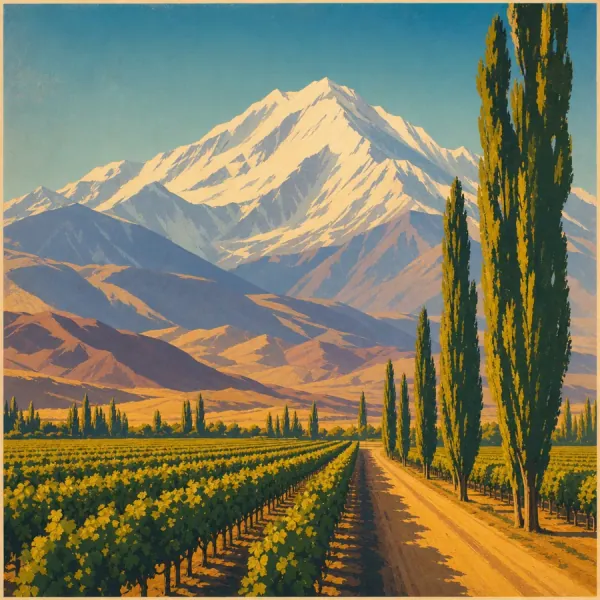
In the west, the Andes form an unbroken wall. Aconcagua (6,959 m), in Mendoza province, is the highest peak in the Americas and in the entire Southern Hemisphere. At the other extreme, Laguna del Carbón, in Patagonia, lies 105 m below sea level, the lowest point in those same hemispheres. The Andes hold nearly 17,000 glaciers and rock glaciers, precious water reserves that are melting: in the northwest, their reserves shrank by 17% in ten years, mainly because of climate change, according to Argentina's glaciology institute.
🌾 The pampas, a sea of grass
In the center-east lie the pampas, an immense, almost treeless plain whose only native tree is the ombú. Its deep black soils make it one of the most fertile farming regions on the planet, at the cost of losing much of the original ecosystem. The north is taken up by the Chaco region and, in the northeast, by the subtropical forest of Misiones, home to the Iguazú Falls, shared with Brazil. In the south, Patagonia offers windswept steppes, glacial lakes and, at the very end, Tierra del Fuego. The great rivers of the north, the Paraná and the Uruguay, meet to form the Río de la Plata, a vast estuary on whose shore Buenos Aires stands.
🌡️ From subtropical to polar
The climate ranges from subtropical in the north to almost polar in the far south. Rainfall varies from 150 mm a year in the driest parts of Patagonia to more than 2,000 mm in the northeast and in western Patagonia. Famous winds shape daily life: the cold pampero, the sudestada, which causes flooding on the Río de la Plata, and the zonda, a hot, dry wind coming down from the Andes. Its wide variety of environments makes Argentina one of the countries richest in ecosystems, with more than 1,000 bird species and 35 national parks.
🧭 Claims beyond its shores
Argentina also claims the Falkland Islands (Malvinas), South Georgia and the South Sandwich Islands, which are administered by the United Kingdom, as well as a 965,597 km² slice of Antarctica that overlaps the claims of Chile and the United Kingdom. It has kept a permanent presence there since 1904, the longest of any country; all these claims are frozen by the Antarctic Treaty, in force since 1961, whose secretariat is based in Buenos Aires.
⚔️ From viceroyalty to nation
Humans may have been living on what is now Argentine territory as long as 21,000 years ago, and the Piedra Museo site in Patagonia has yielded traces about 11,000 years old. In the Cueva de las Manos, the “Cave of the Hands,” hunter-gatherers painted stenciled hands and hunting scenes between 7300 BC and AD 700. Before the Europeans arrived, the territory was sparsely populated by very diverse societies: nomadic hunters such as the Selk'nam of Tierra del Fuego or the Tehuelche of Patagonia, and farmers such as the Guaraní in the northeast or the Diaguita in the northwest, the latter conquered by the Inca Empire around 1480.
🇪🇸 A long-neglected Spanish colony
The navigators Juan Díaz de Solís and Sebastian Cabot explored the region in 1516 and 1526. Europeans then believed they would find a mountain of silver there: that is the origin of the river's name, the Río de la Plata (“River of Silver”), and of the country's own name, from the Latin argentum, “silver.” In 1536, Pedro de Mendoza founded a first Buenos Aires, abandoned in 1541, then refounded in 1580 by Juan de Garay. For Spain, the region mattered little next to the silver and gold mines of Peru and Bolivia, on which it depended administratively. It was not until 1776 that the Viceroyalty of the Río de la Plata was created, with Buenos Aires as its capital. In 1806 and 1807, the city fought off two British invasions.
🌅 Independence
In May 1810, while Spain was occupied by Napoleon's troops, the May Revolution replaced the viceroy with a local junta in Buenos Aires. The independence of the “United Provinces of the Río de la Plata” was proclaimed on July 9, 1816 by the Congress of Tucumán, a date that is now the national holiday. General José de San Martín then crossed the Andes with his army to liberate Chile, alongside Bernardo O'Higgins, before proclaiming the independence of Peru. Some heroes of independence, including San Martín and Manuel Belgrano, even proposed in 1816 to make the country a monarchy ruled by a descendant of the Incas, an idea that was eventually dropped.
🐴 Unitarians versus Federalists
The first decades were marked by a long civil war between the Unitarians, who wanted power centralized in Buenos Aires, and the Federalists, who defended the autonomy of the provinces. The Federalist caudillo Juan Manuel de Rosas dominated the country from 1831 to 1852 and held out against French and British blockades. After his fall, Justo José de Urquiza had a liberal, federal Constitution adopted in 1853, which is still in force after many amendments. Its preamble invites the whole world to come and settle.
“… and to secure the blessings of liberty, for ourselves, for our posterity, and for all the people of the world who wish to dwell on Argentine soil.”
Preamble to the Constitution of the Argentine Confederation (1853) (translated)
Buenos Aires, which had first seceded, rejoined the Confederation. After his victory at the Battle of Pavón in 1861, Bartolomé Mitre became the first president of the reunified country; with his successors Domingo Faustino Sarmiento and Nicolás Avellaneda, he laid the foundations of the modern Argentine state.
The rest of the course
This page publishes the first 2 parts. The full course has 8: here is what the next ones cover.
- 🚢 The golden age, then Perón
Argentina from 1880 to 1955: mass European immigration, agricultural export boom, the Conquest of the Desert, universal male suffrage, the 1930 coup, Juan and Eva Perón.
- 🕯️ Dictatorship, the Falklands and the return of democracy
Argentina from 1955 to 2023: instability and coups, Perón's return, the 1976–1983 dictatorship and the disappeared, the Falklands War, the democratic transition, economic crises, Kirchnerism and changes of government.
- 💃 A nation of immigrants, a culture that shines
Argentina's population: demographics, origins, language and religions, and a very rich culture (tango, literature, film, food, soccer and other sports).
- 🐄 A farming giant undermined by inflation
Argentina's economy: agriculture, livestock, lithium and Vaca Muerta, industry, chronic inflation, debt defaults, the IMF, and Javier Milei's shock therapy with its results and its critics.
- 🗳️ A federal presidential republic
Argentina's institutions: the Constitution, the president, Congress, the provinces, compulsory voting, the courts, the main political forces, the 2025 midterm elections and democracy indexes.
- 🌐 Place in the world and today's challenges
Argentina's foreign policy (Mercosur, the G20, alignment with Trump's United States), the Falklands dispute with the United Kingdom and the country's challenges in 2026.
Study “Argentina” with flashcards and quizzes
In Oria, you read the full course, then practice on it: flashcards, multiple-choice quizzes, open questions or the Feynman method. Cards and questions then come back in your daily review, paced by spaced repetition.
Study this topic in OriaSources
These notes draw on the sources below. If a point seems doubtful, refer back to them.