Economics
Capital in the Twenty-First Century by Thomas Piketty: Summary and Study Notes
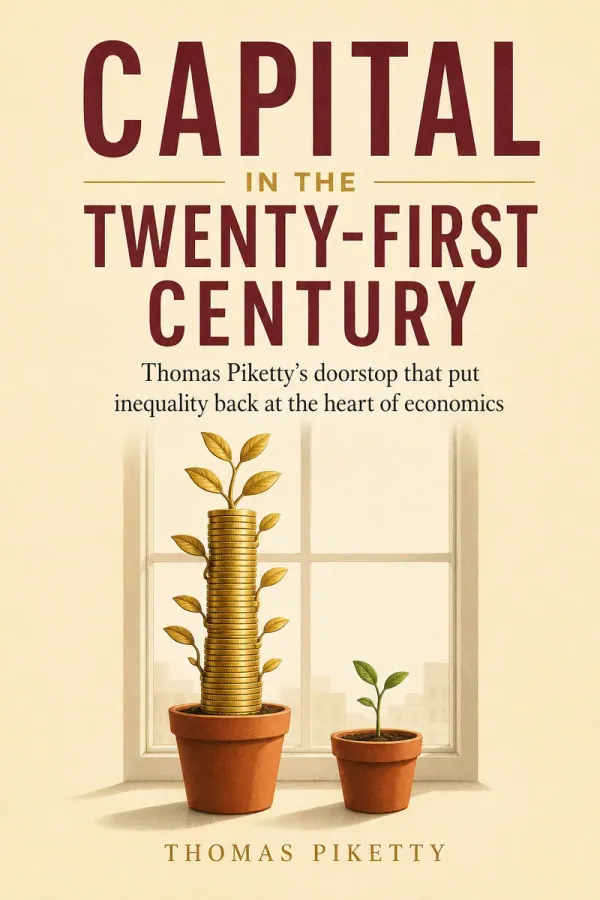
Thomas Piketty's doorstop that put inequality back at the heart of economics
Study this topic in OriaThe essentials
Published in 2013, French economist Thomas Piketty's Capital in the Twenty-First Century traces three centuries of change in income and wealth using tax records. His thesis: when the return on capital durably exceeds growth, wealth concentrates and heirs regain the upper hand. You'll discover his data, his two "fundamental laws," the famous r > g inequality, the twentieth century's egalitarian parenthesis, his plan for a global tax on capital, the author himself, and the fierce debates the book has sparked.
Key dates and facts
- 2013
- Published by Seuil
- 2014
- English translation, No. 1 best-seller in the US
- 2017
- 2.5 million copies sold
- 2020
- Documentary film released
- 1914
- Peak of the society of heirs in Europe
- 1914 – 1945
- Wars and crisis destroy much of private wealth
- 1945 – 1975
- Postwar boom: growth outpaces the return on capital
- 1950s
- Kuznets believes in a natural decline in inequality
- 1971
- Born in Clichy
- 2001
- Top Incomes in France in the Twentieth Century
📚 A 976-page doorstop that became a world best-seller
Capital in the Twenty-First Century is a work of economics by Thomas Piketty, published in France by Éditions du Seuil at the end of summer 2013. At 976 pages, it looks more like a textbook than a best-seller. It examines how income and wealth have been shared out in rich countries, mainly in Europe and the United States, since the eighteenth century.
❓ A political question tackled with numbers
For Piketty, the distribution of wealth is one of the great political questions of our time, essential to the stability of democracies. Yet it is too often debated through ready-made ideas, without hard numbers. His book sets out to change that by drawing on historical data gathered over many years, in particular tax records. The title inevitably recalls Karl Marx's Capital: Piketty himself says he is extending the tradition of nineteenth-century economists, such as David Ricardo and Marx, who placed the distribution of wealth at the heart of their analysis, but with far more historical data than they had.
📰 "Pikettymania"
The book first did well in France. Then its English translation by Arthur Goldhammer, rushed forward because of the curiosity sparked by early reviews, appeared in spring 2014 from Harvard University Press under the title Capital in the Twenty-First Century. It was a tidal wave: on May 18, 2014, it reached the top of the New York Times best-seller list and became the biggest success in that university press's history. The press spoke of "Pikettymania"; Bloomberg Businessweek devoted its May 29, 2014 cover to the phenomenon, parodying teen magazines.
The Economist summed up the reason for its success: the book talked about the right subject at the right time. The Occupy movement and its slogan "We are the 99%" had already put inequality at the center of public debate. In 2014, the book won the Financial Times and McKinsey Business Book of the Year Award, as well as the British Academy Medal.
📦 Record sales for an academic essay
By the end of June 2014, about 450,000 copies had already sold in English and 150,000 in French. Depending on the source, sales reached at least 1.5 million copies by 2015-2016, then 2.5 million by the end of 2017. The publisher signed around forty translation deals, a record for such a hefty essay. In 2020, a documentary film adapted from the book, co-directed by New Zealander Justin Pemberton and Thomas Piketty, was released in theaters.
🗂️ Three centuries of tax data
The great strength of Thomas Piketty's Capital in the Twenty-First Century is its sheer mass of data. The book builds on more than ten years of research by the author and his colleagues into the history of inequality.
🧾 Making tax records talk
As early as 2001, Piketty published Les Hauts Revenus en France au XXe siècle (Top Incomes in France in the Twentieth Century), built from tax returns held by the French tax administration. Tax data have one precious advantage: unlike surveys, they let you observe the very top incomes, which had long been poorly understood. With other economists, in particular Emmanuel Saez, he then applied the same method to the United States and other countries. For wealth, he also used estate tax records, which show what each person leaves behind at death.
According to the author, the resulting database spans three centuries and more than twenty countries, making it the largest ever assembled on the evolution of income and wealth. Piketty posted his spreadsheets online so that anyone could check them. The economist Paul Krugman points to one simple but decisive innovation: looking at the share of income going to the top 1%, rather than broader indicators that hide what is happening at the very top.
In the book, the term covers all non-human assets that can be owned and traded on a market: land, housing, businesses, stocks, financial investments, and so on. Piketty uses the word as a synonym for wealth.
📖 Balzac and Jane Austen as witnesses
To convey what a society of heirs once felt like, Piketty cites nineteenth-century novels, those of Honoré de Balzac, Jane Austen, and Henry James. These stories depict the rigid class society, built on accumulated capital, that existed in France and England in the early nineteenth century.
📉 The Kuznets curve challenged
In the 1950s, the American economist Simon Kuznets had observed a decline in income inequality. From this he drew an optimistic idea: after rising in the early stages of industrialization, inequality would naturally fall as development continued. Piketty disputes this conclusion. In his view, the decline Kuznets observed did not stem from deep economic forces but from shocks and political choices: wars, crises, the creation of income tax. Nothing guaranteed it would continue, and indeed inequality has risen sharply again in the United States over the past thirty years or so.
Piketty makes no secret of his impatience with part of his own discipline, which he sees as too absorbed in minor mathematical puzzles.
"To put it bluntly, the discipline of economics has yet to get over its childish passion for mathematics."
Thomas Piketty, Capital in the Twenty-First Century (2013), trans. Arthur Goldhammer (2014)
The rest of the course
This page publishes the first 2 parts. The full course has 9: here is what the next ones cover.
- ⚙️ Capitalism's two fundamental laws
Thomas Piketty's two "fundamental laws" in Capital in the Twenty-First Century: α = r × β and β = s / g, explained with examples, and how the capital/income ratio has evolved.
- 📈 r > g: when the past devours the future
The r > g inequality at the heart of Capital in the Twenty-First Century: capital returns outpacing growth, the concentration of wealth, the weight of inheritance, and the nuance Piketty added in 2014.
- 🏚️ The twentieth century, an egalitarian parenthesis
Why inequality fell sharply between 1914 and 1975 according to Capital in the Twenty-First Century: wars, the 1929 crisis, highly progressive taxes, inflation, and strong growth.
- 👑 The return of patrimonial capitalism
The rise in inequality since the 1970s-1980s described in Capital in the Twenty-First Century: falling taxes, "supermanagers," concentration in the United States, and the risk of a new society of heirs.
- 🌐 A global tax on capital
The solutions Thomas Piketty proposes in Capital in the Twenty-First Century: a global progressive tax on capital, highly progressive taxation of top incomes and inheritances, financial transparency, and their legacy.
- 🎓 Thomas Piketty, the author
Who is Thomas Piketty, the author of Capital in the Twenty-First Century: his training at the ENS, a PhD at 22, MIT, EHESS, the Paris School of Economics, his political involvements, and his later books.
- ⚖️ Praise, criticism, and limits
The reception of Capital in the Twenty-First Century: praise from Krugman and Milanović, the Financial Times data controversy, criticism of the concept of capital, the role of real estate, the second law, and institutions.
Study “Capital in the Twenty-First Century” with flashcards and quizzes
In Oria, you read the full course, then practice on it: flashcards, multiple-choice quizzes, open questions or the Feynman method. Cards and questions then come back in your daily review, paced by spaced repetition.
Study this topic in OriaSources
These notes draw on the sources below. If a point seems doubtful, refer back to them.