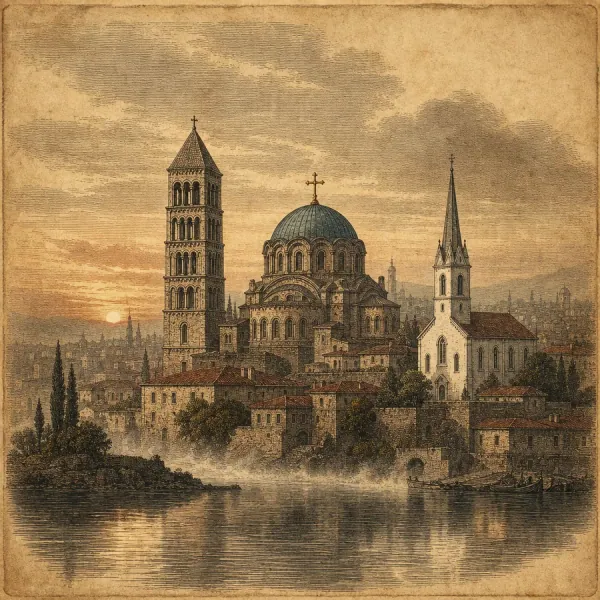
Myths & religions
Catholics, Orthodox, Protestants: Summary and Study Notes
The great branches of Christianity: what unites them, what divides them
Study this topic in OriaThe essentials
Christianity is the largest religion in the world, but it has never been a single bloc. We follow the great separations: the ancient Churches of the East after the councils of Ephesus and Chalcedon, the break between Rome and Constantinople in 1054, and then the Protestant Reformation launched by Luther in 1517. Then we look at each branch, Catholic, Orthodox and Protestant, with its beliefs, rites and organization, before seeing how the Churches have been trying to come closer for a century, while Christianity's center of gravity has shifted to Africa.
Key dates and facts
- 1054
- Mutual excommunications in Constantinople
- 1204
- Sack of Constantinople by the crusaders
- 1439
- Union of Florence, rejected in the East
- 1965
- Lifting of the anathemas of 1054
- 1415
- Jan Hus is burned at Constance
- 1517
- Luther's 95 Theses
- 1521
- Luther's excommunication and the Diet of Worms
- 1534
- Act of Supremacy in England
- 1545
- Opening of the Council of Trent
- 1948
- First assembly of the World Council of Churches
✝️ One Christ, many Churches
All Christians claim Jesus of Nazareth, whom they recognize as the Christ, and read the Bible. The great majority also share beliefs formulated in the first centuries: the Trinity (one God, Father, Son and Holy Spirit), the incarnation and resurrection of Jesus, baptism. The different Churches often recognize one another as Christian, at least to the extent that they accept each other's baptisms. Yet Christianity has never formed a single bloc: it is divided into Churches that differ in their history, organization, theology and way of praying.
📊 The largest religion in the world
According to the Pew Research Center, which analyzed more than 2,700 censuses and surveys, there were about 2.3 billion Christians in 2020, or 28.8% of the world's population. They remain the largest religious group, but their share fell by 1.8 percentage points in ten years. In its 2011 study, the same institute estimated that about half of Christians are Catholic, 37% Protestant in the broad sense, 12% Orthodox and 1% other groups, such as Mormons and Jehovah's Witnesses.
🌍 A religion gone global
In 1910, about two-thirds of Christians lived in Europe. That is no longer the case. According to the Pew Research Center, in 2020 30.7% of Christians lived in sub-Saharan Africa, compared with 22.3% in Europe: Africa has become the continent with the most Christians. This shift is explained by high birth rates in Africa and by many Western Europeans leaving religion behind. As early as 2010, Brazil had more than twice as many Catholics as Italy, and Nigeria more than twice as many Protestants as Germany, the cradle of the Reformation.
A distinct group within Christianity, recognizable by its name, history, organization, leaders and doctrine. The term is neutral; the Catholic Church and the Orthodox Church nonetheless reject it for themselves, since each considers itself the original Church founded by Christ.
🌳 Six great families
Specialists generally distinguish six great families: the Church of the East, the Oriental Orthodox Churches, the Eastern Orthodox Church, the Catholic Church, Protestantism and the so-called “Restorationist” movements, such as the Latter-day Saints (Mormons) or Jehovah's Witnesses, which formed later. Their successive separations, traced in the following sections, each have a date and a reason: debates over the nature of Christ in the 5th century, the authority of the pope in the 11th century, salvation and the place of the Bible in the 16th century.
🏛️ 431 and 451: the oldest Churches of the East
The first divisions still visible today date from the 5th century. They were not about the pope or the Bible, but about a question that then gripped the whole Christian world: how can Jesus be both God and man? At the time, Western Christians spoke Latin and Eastern Christians mostly Greek or Aramaic, which made it hard to translate the debates from one language to another.
🕯️ Ephesus, 431: the Church of the East
In the Persian Empire, a Church had organized itself in 410 at the Council of Seleucia-Ctesiphon, then declared itself independent of the Church of the Roman Empire in 424. In 431, the Council of Ephesus condemned Bishop Nestorius, accused of separating the divine and human natures in Jesus too sharply. The Church of Persia refused this condemnation: for a long time it would be called, wrongly according to today's historians, the “Nestorian Church.” This Church of the East, Syriac-speaking, underwent a spectacular missionary expansion: between the 9th and the 14th century, it was the most geographically widespread Christian denomination, with dioceses and communities from present-day Iraq and Iran to India, Central Asia and Tang dynasty China. Its heirs today are the Assyrian Church of the East and the Ancient Church of the East, as well as two Churches in communion with Rome, the Chaldean Church in Iraq and the Syro-Malabar Church in India.
📜 Chalcedon, 451: “two natures”
Twenty years later, more than 520 bishops met at Chalcedon, now a district of Istanbul. The council defined that Christ is a single person in two natures, divine and human.
“Acknowledged in two natures, without confusion, without change, without division, without separation.”
Definition of the Council of Chalcedon (451) (translated)
Some Christians, a majority in Egypt, rejected this formula. For them, the union of the divine and the human in Christ forms a single nature: this is miaphysitism. They were long called “non-Chalcedonian” or “Monophysite.” These Churches recognize only the first three ecumenical councils.
🌍 The Oriental Orthodox Churches today
Today they form the communion of the Oriental Orthodox Churches, which had about 72 million faithful in 2020. It includes six autocephalous Churches: the Coptic Orthodox Church of Alexandria, the largest Christian Church in Egypt and the Middle East; the Syriac Orthodox Church of Antioch; the Armenian Apostolic Church; the Malankara Orthodox Syrian Church, in India; the Ethiopian Orthodox Tewahedo Church, the largest of them all; and the Eritrean Orthodox Tewahedo Church. They are in communion with one another, but not with the Eastern Orthodox or with Rome.
Tensions have nonetheless eased. Pope John Paul II signed joint declarations on Christ with the patriarch of the Assyrian Church of the East, Mar Dinkha IV, and with the Syriac Orthodox patriarch Ignatius Zakka I. In 2017, the Coptic Church and the Catholic Church restored mutual recognition of their baptisms.
The rest of the course
This page publishes the first 2 parts. The full course has 8: here is what the next ones cover.
- ⚡ 1054: Rome and Constantinople part ways
The great schism between the Latin Church of the West and the Greek Church of the East: its causes (the filioque, papal authority, differences of rite and language), the excommunications of 1054, the sack of Constantinople in 1204, the failed Union of Florence in 1439 and the lifting of the anathemas in 1965.
- ☦️ The Orthodox: a communion of sister Churches
The Eastern Orthodox Church: about 220 million faithful, a communion of autocephalous Churches with no single head, the patriarch of Constantinople as “first among equals,” the mission to the Slavs, icons, the Divine Liturgy, married priests and the rift between Moscow and Constantinople since 2018.
- ⛪ The Catholics: the universal Church around the pope
The Catholic Church: about 1.4 billion baptized members, the pope as successor of Saint Peter, the magisterium, the seven sacraments, the place of Mary, the celibacy of Latin priests and the Eastern Catholic Churches, the councils of Trent and Vatican II, and Pope Leo XIV, elected in 2025.
- 📜 1517: the Protestant Reformation
The origins of the Reformation: forerunners (the Waldensians, Hus), Luther and the 95 Theses against indulgences (1517), his excommunication and the Diet of Worms (1521), the role of printing, Zwingli in Zurich, the Anabaptists, Calvin in Geneva and Henry VIII's English break (1534).
- 📖 The Protestant galaxy, from Lutherans to Pentecostals
What unites Protestants (the Bible alone, salvation by faith and grace, the priesthood of all believers) and their great families: Lutherans, Reformed, Anglicans, Baptists, Methodists, then Pentecostalism, born in Los Angeles in 1906, and the Protestant boom in the Global South.
- 🤝 What sets them apart, what brings them together
A comparison table of the three great branches (authority, sacraments, clergy, Mary and the saints, worship) and the history of the ecumenical movement: the World Council of Churches (1948), Vatican II's decree on ecumenism (1964), the Lutheran-Catholic declaration on justification (1999), the Lund commemoration (2016).
Study “Catholics, Orthodox, Protestants” with flashcards and quizzes
In Oria, you read the full course, then practice on it: flashcards, multiple-choice quizzes, open questions or the Feynman method. Cards and questions then come back in your daily review, paced by spaced repetition.
Study this topic in OriaSources
These notes draw on the sources below. If a point seems doubtful, refer back to them.