Myths & religions
Egyptian Mythology: Summary and Study Notes
Ra, Osiris, Isis and the weighing of the heart: the stories that held the world together
Study this topic in OriaThe essentials
For nearly three thousand years, the Egyptians told how the world emerged from the waters of chaos, how the sun god Ra crossed the world of the dead every night, and how Osiris, murdered by his brother Set, was brought back to life by Isis. You'll discover where these often fragmentary stories come from, then the great myths: the creation, the journey of the sun, the murder of Osiris, the battle between Horus and Set, and the judgment of the dead before the feather of Maat. You'll also see how these beliefs were lived in temples and homes, how they died out, and what remains of them today.
Key dates and facts
- c. 2350 BC
- Pyramid Texts of King Unas
- c. 1550 BC
- The Book of the Dead appears
- 5th century BC
- Herodotus describes Egyptian religion
- early 2nd c.
- Plutarch writes On Isis and Osiris
- c. 3100 BC
- Anubis already protects tombs
- c. 1550 BC
- First Books of the Dead
- 63
- Most recent known Book of the Dead
- 1842
- Lepsius coins the name “Book of the Dead”
- 14th century BC
- Akhenaten imposes the cult of the Aten
- 30 BC
- Egypt becomes a Roman province
📜 Myths in fragments
Egyptian mythology is the body of stories through which the ancient Egyptians explained the world by the actions of their gods. It went hand in hand with a religion that lasted about 3,500 years and for which nearly 1,500 deities are known. Yet anyone looking for “the” great book of Egyptian myths is in for a surprise: it does not exist. The sources rarely tell a story in full. Most of the time they settle for allusions, as if everyone already knew the story. Most Egyptians could not read, and the myths probably circulated mainly by word of mouth; almost nothing of that oral tradition has come down to us.
🔺 Spells carved for eternity
The first great mythological texts are the Pyramid Texts, hundreds of spells carved on the walls of royal burial chambers, starting with the pyramid of King Unas, around 2350 BC. They were meant to ensure the dead king safe passage into the afterlife, and so they often allude to the creation and to the myth of Osiris. In the Middle Kingdom, these spells moved onto the coffins of officials and notables: these are the Coffin Texts. Then, from around 1550 BC, the Book of the Dead made them available to an even wider public.
🏛️ Temples, hymns and tales
Temples kept libraries of papyrus, of which only scraps survive. Their walls, especially those of the well-preserved great sanctuaries of the Greco-Roman period, are covered with mythological scenes and hymns. Finally, literature took up the myths as entertainment: in the New Kingdom, the story known as The Contendings of Horus and Set tells of the two gods' quarrel in an often comic tone.
Some things were never written down. The Egyptians believed that words and images could act on reality: the murder of Osiris, for example, is never described explicitly, for fear of making it real a second time.
🏺 Through Greek eyes
Greek and Roman authors fill in the picture. In the 5th century BC, the historian Herodotus described Egypt and the great age of its religion.
“The Egyptians were also the first to use particular names for the twelve gods [...], the first to dedicate altars, statues and temples to them, and to carve animals in stone.”
Herodotus, Histories (5th century BC) (translated)
At the beginning of the 2nd century AD, Plutarch wrote On Isis and Osiris, the most complete ancient account of the Osiris myth. His version is still the one most often told today, but it is steeped in Greek philosophy and contains episodes with no known equivalent in Egyptian sources. These authors, kept away from many religious practices, saw Egypt through their own preconceptions.
🔀 A mythology with no official version
Egyptian myths often contradict one another, and that bothered no one. Each major city honored its own gods and readily credited them with creating the world. The goddess Hathor could be called the mother, wife or daughter of the sun god Ra, and two gods could merge into one, as Amun and Ra did in Amun-Ra: this is called syncretism. In the 1940s, the Egyptologist Henri Frankfort argued that these contradictions were not mistakes but part of the “multiplicity of approaches” the Egyptians used to grasp a divine world they considered mysterious. Each version sheds light on a different facet of the same reality.
🌊 Rising from the waters of chaos
The Egyptians developed many creation stories, which differ greatly by place and period. Every city and every priesthood wanted to glorify its own god by crediting it with the origin of the world. But these versions were not seen as rivals: creation was a many-sided phenomenon involving many divine forces.
💧 The ocean before the world
All the stories share the same starting image: before the world, there was an endless ocean, dark and inert, personified by the god Nun. Creation is the appearance of a space of light and dry land in the middle of these waters. Often, the sun is born on a primeval mound, the first land to emerge: an image probably inspired by the mounds of silt that reappeared every year when the Nile flood receded. The pyramid itself may represent this original mound and the first sunrise.
☀️ Heliopolis and the nine gods
The most widespread story comes from Heliopolis, the city of the sun, and goes back at least to the Old Kingdom. The god Atum, who contains within himself all the elements of the world, first exists in the waters as a mere possibility. At the moment of creation, he emerges and brings forth the other gods. Together they form the Ennead, a group of nine deities:
- Atum, the creator;
- his children Shu, the air, and Tefnut;
- their children Geb, the earth, and Nut, the sky;
- and their children in turn: Osiris, Isis, Set and Nephthys.
The world drawn this way is a bubble of air in the middle of the ocean: Geb, the flat earth, is separated from Nut, the vault of the sky, by Shu, the air. Beyond stretch the endless waters of Nun.
🔢 Other creators
At Hermopolis, people told how eight gods, the Ogdoad, embodied the properties of the primordial water; their action brought the sun into being. At Memphis, an inscription from the Third Intermediate Period, perhaps older, credits creation to the god Ptah, patron of craftsmen: he conceives the world in his mind, then gives it physical form. The Ennead merely carries out his orders: a way, according to many scholars, of asserting the superiority of the god of Memphis over those of Heliopolis. In the New Kingdom, the hymns of Thebes made Amun, the hidden power behind all the gods, the ultimate source of creation.
😢 And humans?
The origin of humanity takes up little space in these stories, which focus on putting the cosmos in order. According to some texts, the first humans were born from the tears shed by the creator god in a moment of distress, which foreshadows their imperfect nature and painful lives; the Egyptians in fact called themselves the “cattle of Ra.” Other texts say that the god Khnum shaped them from clay.
🌀 A world that will end
The created world is not eternal. The texts rarely mention its end, as if to avoid bringing it about, but a passage of the Book of the Dead has Atum speak: one day he will dissolve the ordered world and return, inert, to the waters of chaos. Only Osiris will survive with him. With the creator and the god of renewal together in the primordial waters, a new creation remains possible.
The rest of the course
This page publishes the first 2 parts. The full course has 8: here is what the next ones cover.
- ☀️ Ra and the journey of the sun
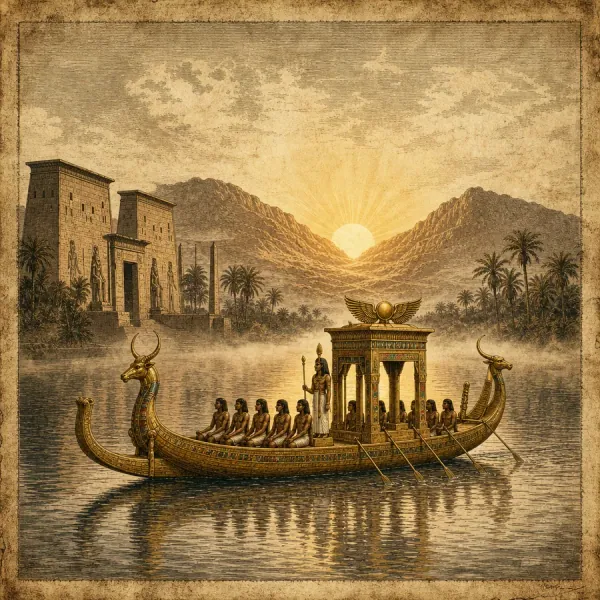
The sun god Ra: his forms (Khepri, Ra, Atum), his reign on earth, the anger of the Eye of Ra and the destruction of humankind, then his daily journey by boat across the sky and through the Duat, his battles against the serpent Apophis and his rebirth at dawn.
- ⚰️ Osiris, Isis and Set: murder and resurrection
The Osiris myth, the most elaborate and popular of the Egyptian myths: King Osiris killed by his brother Set, the search by Isis and Nephthys, the reassembled body that becomes the first mummy, the conception of Horus, Osiris's kingship in the Duat, and Plutarch's Greek version.
- 🦅 Horus versus Set: the battle for the throne
The continuation of the Osiris myth: the hidden childhood of Horus protected by Isis, healing magic, the long trial and the battles of Horus and Set, the Eye of Horus torn out and then healed, the two possible endings of the conflict, and the ambiguous role of Set, between disorder and protector of the sun.
- ⚖️ Anubis, Maat and the weighing of the heart
Maat, the order of the world and justice; the gods of the passage to the afterlife, Anubis and Thoth; the Book of the Dead, its Spell 125 and the negative confession; the weighing of the heart against the feather of Maat, the Devourer, and the Field of Reeds promised to the righteous.
- 🏛️ Believing and practicing: temples, festivals and amulets
Egyptian religion as it was lived: temples as houses of the gods and the daily ritual, festivals and processions, oracles, animal cults, popular piety and magic, the episode of Akhenaten and the Aten, then Isis in the Greco-Roman period and the end of the cults at Philae.
- 🔭 The legacy: from the Greeks to Egyptology
The afterlife of Egyptian mythology: the fascination of Greeks and Romans, borrowed symbols, possible influences on ideas of Elysium and hell, the debate over Isis and the Virgin Mary, Hermeticism, Napoleon's Egyptian campaign, Champollion's decipherment, Egyptology and popular culture, Kemetism.
Study “Egyptian Mythology” with flashcards and quizzes
In Oria, you read the full course, then practice on it: flashcards, multiple-choice quizzes, open questions or the Feynman method. Cards and questions then come back in your daily review, paced by spaced repetition.
Study this topic in OriaSources
These notes draw on the sources below. If a point seems doubtful, refer back to them.