Myths & religions
Shinto: Summary and Study Notes
The way of the kami, Japan's religion of shrines
Study this topic in OriaThe essentials
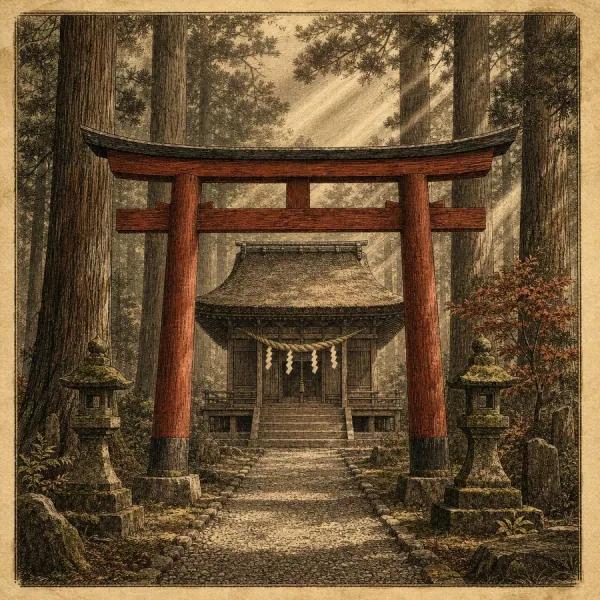
In Japan, people walk under a torii, rinse their hands and clap twice in front of a shrine: this is Shinto, the “way of the kami.” You'll discover what the kami are, the great myths of the Kojiki, the obsession with purity, the life of shrines and festivals, and then a turbulent history: the blending with Buddhism, State Shinto until 1945, and today's debates.
Key dates and facts
- 712
- The Kojiki is presented to the empress
- 713
- Order to compile the provincial records (fudoki)
- 720
- Completion of the Nihon Shoki
- 927
- The Engishiki collection of rites
- 692
- First ritual rebuilding of Ise
- 2013
- 62nd rebuilding, funded by donations
- 2033
- Next rebuilding scheduled
- 538
- Arrival of Buddhism according to tradition
- 1868
- Separation of kami and buddhas
- 1906
- Merger of thousands of shrines
⛩️ What is Shinto?
Shintoism, or Shinto, is the religion that grew up in Japan around the worship of the kami, supernatural powers believed to be present in mountains, trees, rivers, the wind or the sun. The word is written with two Chinese characters meaning “divinity” and “way”: it is often translated as “the way of the kami,” in Japanese kami no michi. There are around 100,000 public shrines across the archipelago, from remote forests to the centers of big cities.
🧭 A religion with no founder and no creed
Unlike Christianity or Islam, Shinto has no known founder, no single sacred book and no central authority deciding what must be believed. It exists in a multitude of local and regional forms. Scholars describe it as a ritual tradition before it is a doctrinal one: the philosopher Stuart Picken sums it up by saying it cares less about the things one must believe than about the things one must do. It places little emphasis on a detailed moral code or on the afterlife, and a great deal on purity and on a good relationship between humans and the kami.
Practitioners themselves rarely use the word “Shintoist.” Many Japanese people visit both Shinto shrines and Buddhist temples without seeing any contradiction: in Japan, practicing several religions at once has long been accepted. Shinto has also absorbed elements from the mainland, such as Buddhism, Confucianism, Taoism and Chinese divination techniques.
🔍 A very ancient tradition… or a modern invention?
The worship of the kami goes back at least to the Yayoi period (around 300 BC – AD 250). But historians debate when one can speak of a distinct religion called “Shinto.” For the Japanese historian Kuroda Toshio, Shinto did not exist as an independent religion before the modern era; other scholars argue that it was largely “invented” in the 19th century, when the Meiji government separated it from Buddhism to turn it into a national cult. The idea of Shinto as Japan's eternal “indigenous religion” itself developed alongside modern nationalism, between the Edo and Meiji periods.
Today, some practitioners prefer to present it as a “way,” a custom rather than a religion, and, since the early 21st century, increasingly as a nature religion. Critics see this as a way of glossing over Shinto's past links with militarism. Like the word “Hinduism” in South Asia, “Shinto” is ultimately a convenient label grouping together very diverse traditions.
🌳 The kami, a myriad of presences
At the heart of Shinto are the kami. The word has no exact equivalent: it is translated as “god” or “spirit,” but the historian of religions Joseph Kitagawa considered these translations misleading. In Japanese, the same word refers to a single kami and to the kami as a whole. They are said to number “eight million”: the expression is not a count, it means an endless multitude.
“Anything whatsoever which possesses some eminent quality out of the ordinary, and which inspires awe, is called kami.”
Motoori Norinaga, Kojiki-den (18th century) (translated)
🏔️ Powers attached to places
Kami can dwell in the living and the dead, in organic or inert matter, and even in disasters such as earthquakes or epidemics. They are perceived in the wind, the rain, fire, sunlight. That is why Shinto is often described as animist. A kami is usually linked to a specific place: a waterfall, a mountain such as Mount Fuji, a large boulder, a tree. These places are often encircled with a rice-straw rope (shimenawa) decorated with strips of paper folded into zigzags, which signals the sacred presence.
During the Yayoi period, kami were thought of as formless and invisible; it was under the influence of Buddhism that people began to depict them with human features. In a shrine, the kami resides in an object called the shintai, the “body of the kami”: a mirror, a sword, a stone, beads, a tablet. This object is hidden from visitors, sometimes shut away in a box, so that even the priests do not know what it looks like.
⚖️ Neither all-powerful nor always kind
Kami are neither omnipotent nor omniscient, nor necessarily immortal. They can bless as well as punish: if warnings are ignored, a kami may send illness or sudden death, a punishment called tatari. Some are even considered malevolent. So people make offerings and prayers to win their favor and turn aside their anger. The aim of worship is a harmonious relationship between humans, the kami and, through them, the natural world.
👤 Humans who became kami
There is no uncrossable boundary between humans and kami: ancestors or important figures can be venerated as protective kami. Emperor Ōjin, for instance, was deified after his death as Hachiman, protector of Japan. Some kami have only one shrine, others thousands: there are around 25,000 shrines dedicated to Hachiman and 40,000 to Inari, the kami of rice. A kami's spirit can indeed be “divided” to install it in a new place without its power diminishing. Many kami also have an animal messenger: the fox for Inari, the dove for Hachiman.
The rest of the course
This page publishes the first 2 parts. The full course has 8: here is what the next ones cover.
- 🌅 Origin myths: the Kojiki and the Nihon Shoki
The two 8th-century chronicles and their stories: Izanagi and Izanami, the birth of Amaterasu, the cave, the descent of Ninigi and the three imperial regalia.
- 💧 Purity and pollution: purifying yourself to approach the kami
The notions of kegare (pollution) and harae (purification), rites of water and salt, and the place of purity in Japanese culture.
- 🏯 The shrine, its rituals and its keepers
How a shrine is laid out (torii, buildings, forest), priests and miko, the steps of a visit, votive objects, the household altar, and the great shrine of Ise rebuilt every twenty years.
- 🎎 Matsuri, New Year and rites of life
Seasonal festivals and mikoshi processions, the first shrine visit of the year, rites of childhood and marriage, and the division of labor with Buddhism for funerals.
- 📜 From the Yamato clans to State Shinto
The history of kami worship: Yayoi origins, fusion with Buddhism, organization by the court, the nationalist revival of the Edo period, State Shinto from the Meiji era to 1945, and the separation of religion and state.
- 🗾 Shinto today, in Japan and around the world
Practice and affiliation in contemporary Japan, the Yasukuni Shrine controversy, the place of women, the ecological image, popular culture and the spread of Shinto beyond Japan.
Study “Shinto” with flashcards and quizzes
In Oria, you read the full course, then practice on it: flashcards, multiple-choice quizzes, open questions or the Feynman method. Cards and questions then come back in your daily review, paced by spaced repetition.
Study this topic in OriaSources
These notes draw on the sources below. If a point seems doubtful, refer back to them.