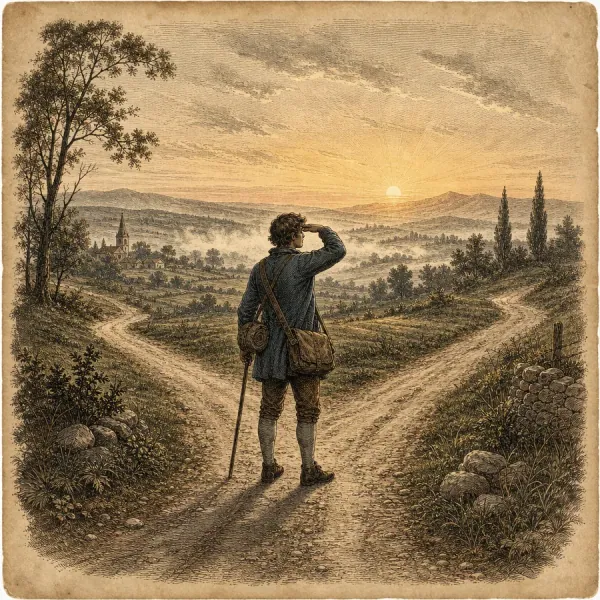
Philosophy
Freedom: Summary and Study Notes
Free will, determinism, autonomy: philosophy's great answers
Study this topic in OriaThe essentials
Is being free a matter of doing everything you want, or, on the contrary, of being able to set your own rules? You'll start with the basic definitions (freedom, free will, constraint), then meet the strongest objection to it all: determinism, pushed to its limit by Spinoza. You'll then discover the syllabus's great answers: Rousseau and the law we prescribe to ourselves, Kant and autonomy, Sartre and the man "condemned to be free," Mill and political liberty. Finally, you'll see what neuroscience and present-day philosophy have to say about free will.
Key dates and facts
- 1641
- Descartes, Meditations on First Philosophy
- 1677
- Spinoza, Ethics (posthumous)
- 1762
- Rousseau, The Social Contract
- 1859
- Mill, On Liberty
- 1781
- Critique of Pure Reason
- 1785
- Groundwork of the Metaphysics of Morals
- 1788
- Critique of Practical Reason
- 1943
- Being and Nothingness
- Oct. 29, 1945
- Lecture, "Is Existentialism a Humanism?"
- 1946
- The text is published by Nagel
🧭 What does it mean to be free?
In everyday usage, being free means being able to do what one wants, without being stopped. The word comes from the Latin libertas, the status of the liber man, that is, one who is not a slave. Dictionaries first define freedom as a state in which one is not subject to constraint. But this simple definition quickly runs into a problem: constraint is everywhere. Society imposes laws, morality imposes duties, and nature imposes physical laws that no one escapes.
🔀 Two different questions
To see this clearly, two senses of the word must be told apart. The freedom to act concerns what I am able to do: a prisoner does not have the freedom to come and go. The freedom to will concerns the origin of my choices: even locked up, am I the author of my decisions, or are they produced by causes I do not control? The first question is mainly political and legal; the second is metaphysical.
The capacity of a human being to determine themselves freely and by themselves alone, in order to act and think. The phrase comes from the Latin liberum arbitrium. It stands opposed to determinism, for which the will is entirely produced by a chain of causes.
The notion of free will was first worked out by Christian theology. In his treatise On Free Choice of the Will, Augustine of Hippo sought to understand where evil comes from: if God is good, it must be that humans have received the capacity to choose, and so also the capacity to do wrong. Free will thus grounds responsibility: we neither blame nor punish a falling stone, but we do blame and punish a person who could have acted otherwise.
🫏 Buridan's donkey and the liberty of indifference
An old thought experiment puts free will to the test. A hungry donkey is placed exactly halfway between two identical bales of hay. Nothing pulls it more toward one side than the other: if it has no free will, it will stand still and starve to death. This power to choose with no reason whatsoever to prefer one option over the other is called the liberty of indifference. For some, it is the purest proof of freedom.
Descartes thinks the opposite. For him, the human will is immense and makes us feel our resemblance to God, but choosing at random is not the height of freedom. The more clearly I see what is true and good, the more freely I am drawn toward it: true freedom is one guided by reason.
"This indifference which I feel when no reason moves me more to one side than to the other is the lowest degree of liberty, and marks a defect in knowledge rather than a perfection of the will."
René Descartes, Meditations on First Philosophy, Fourth Meditation (1641), translated
As we can already see: freedom is not self-evident from the start, but a puzzle. Philosophy's great answers can each be read as a different way of solving it.
⚙️ Determinism: what if freedom were an illusion?
Determinism rests on two ideas: there is no effect without a cause, and the world obeys laws that make events necessary. If this is true, each of our choices is itself the effect of prior causes (our body, our upbringing, our desires, our circumstances), which are themselves the effects of other causes, and so on endlessly. The feeling that we could have done otherwise would then be nothing but an illusion born of our own ignorance.
👁️ Laplace's demon
In 1812, in his Philosophical Essay on Probabilities, the scientist Pierre-Simon de Laplace imagined an intelligence that, at a given instant, would know every force at work in nature and the position of every being. For such an intelligence, nothing would be uncertain: the future, like the past, would be laid out before its eyes. Laplace adds that even the freest will cannot act without a determining motive; believing otherwise is, in his view, an illusion of a mind that has lost sight of the reasons behind its own choices. This thought experiment has become famous under the name of Laplace's demon.
A few decades earlier, Baron d'Holbach, in his System of Nature (around 1770), had defended an uncompromising determinism: in a dust storm, no particle is placed at random, and man, a physical being among others, is subject to the same necessary laws. "Our life is a line that nature commands us to trace upon the surface of the earth," he writes.
🔍 Spinoza: an illusion born of ignorance
It is Spinoza (1632-1677) who gives determinism its most radical philosophical form. In the Ethics, published after his death in 1677, he states that man is not "an empire within an empire": he is part of Nature, which Spinoza identifies with God, and he is subject, like everything else, to the necessary chain of causes. Free will is therefore an illusion arising from the fact that humans are conscious of their actions, but not of the causes that drive them to act.
"Such is that human freedom which all men boast of possessing, and which consists solely in this, that men are conscious of their desire and unaware of the causes by which that desire is determined. Thus, a child believes that it freely desires milk."
Spinoza, letter to Schuller, translated
Spinoza's examples speak for themselves: an angry boy believes he freely wants revenge, a drunkard believes he is freely saying things he will later regret. Each feels like the author of something that, in truth, simply runs through him.
🔓 Another kind of freedom: free necessity
Yet Spinoza does not give up on the idea of freedom: he redefines it. Being free is not escaping causes, which is impossible, but acting according to the necessity of one's own nature, instead of being tossed about by external causes and by one's passions. He speaks of "free necessity" rather than free decree. The more I understand what determines me, the more active I become: according to the Ethics, the free person is one who is guided by reason alone. Knowledge thus becomes the path to freedom.
This position opens onto a debate that is still alive today: must we choose between determinism and freedom, or can the two be thought together?
The rest of the course
This page publishes the first 2 parts. The full course has 8: here is what the next ones cover.
- 🏛️ Freedom and constraint: from the Stoic sage to the citizen
The Stoics' inner freedom, Hobbes's definition (not being prevented from acting), and the idea that law can itself be a condition of freedom (the 1789 Declaration).
- 📜 Rousseau: obeying the law one has prescribed for oneself
The Social Contract (1762): man born free yet everywhere in chains, the shift from natural liberty to civil liberty, the general will, and moral liberty.
- ⚖️ Kant: freedom as autonomy
Kant distinguishes autonomy from heteronomy, defines the free will as one that gives itself its own law (the categorical imperative), and makes freedom a condition of morality.
- 🔥 Sartre: condemned to be free
Sartre's existentialism: existence precedes essence, man condemned to be free, anguish, bad faith (the café waiter), and the example of the student forced to choose.
- 🗳️ Political liberty: Mill and the harm principle
John Stuart Mill, On Liberty (1859): the harm principle, the tyranny of the majority, freedom of opinion and individuality, and the distinction between formal and substantive liberties.
- 🧠 Today's debates: neuroscience and compatibilism
The Libet experiment and its interpretations, determinisms in the social sciences, the compatibilist position held by most philosophers (Strawson, Frankfurt), and Bergson.
Study “Freedom” with flashcards and quizzes
In Oria, you read the full course, then practice on it: flashcards, multiple-choice quizzes, open questions or the Feynman method. Cards and questions then come back in your daily review, paced by spaced repetition.
Study this topic in OriaSources
These notes draw on the sources below. If a point seems doubtful, refer back to them.