Philosophy
Truth: Summary and Study Notes
Opinion, doubt, science, relativism: how can we know what is true?
Study this topic in OriaThe essentials
How do you tell what is true from what you merely believe is true? First you'll see what “true” means and why opinion isn't enough, with Plato's allegory of the cave. Then you'll follow Descartes, who doubts everything to find one certainty, and Popper, for whom a scientific theory is one that can be refuted. Finally, you'll ask whether truth is relative, what the age of “post-truth” means, and how to tackle the classic essay questions on the topic.
Key dates and facts
- 1637
- Descartes, Discourse on the Method
- 1641
- Descartes, Meditations on First Philosophy
- 1934
- Popper, The Logic of Scientific Discovery
- 2016
- “Post-truth” named Oxford Dictionaries' Word of the Year
- 1986
- Harry Frankfurt's essay on bullshit
- 1992
- Steve Tesich uses “post-truth”
- 2016
- Brexit and Oxford's Word of the Year
- 2017
- The phrase “alternative facts”
🔎 What is truth?
Everyone thinks they know what truth is, right up until they have to defend it. Is something true because I see it? Because everyone says so? Because a scientist says so? And if two sincere people contradict each other, does one of them have to be wrong? These very concrete questions have occupied philosophy since antiquity: how do we tell what is true from what we believe is true, and why does it matter so much?
🧩 The true and the real
First, a confusion to avoid. Things themselves are neither true nor false: they either exist or they don't. An apple on the table is real; what can be true or false is the sentence “there is an apple on the table.” Truth is therefore a property of our judgments, our sentences and our beliefs. Aristotle had already noticed this: a proposition, meaning a sentence that affirms or denies something, is the part of speech that can be true or false.
The classic definition of truth: a statement is true if it corresponds to the reality it refers to. “Snow is white” is true if and only if snow is white.
📏 Three ways to define the true
Defining truth as correspondence seems obvious, but it raises a problem: to check that an idea matches reality, we would have to step outside our ideas and compare. So philosophers have proposed other theories.
- Correspondence theory: what is true is what matches the facts.
- Coherence theory: what is true is what fits without contradiction into a coherent system of statements, like a theorem in mathematics.
- Pragmatism, defended by Charles Sanders Peirce and William James: a belief is true if it proves satisfactory, if it “works,” at the end of inquiry.
Each theory captures something: a judge asks whether a witness's account matches the facts, a mathematician checks that a proof is coherent, an engineer judges a theory by its results.
🗣️ Truth, sincerity, accuracy
The opposite of the truth is not always a lie. Someone who is mistaken says something false without meaning to: that is error. Someone who lies says what they believe is false in order to deceive. The philosopher Bernard Williams thus distinguishes two virtues of truthfulness: accuracy, the effort to find out what is true, and sincerity, the effort to say what you believe is true. You can be sincere and wrong, or accurate and still lie by omission.
That leaves the central question of the whole tradition: how do we get from opinion, which thinks it knows, to genuine knowledge? Plato, Descartes and Popper offer three great ways of answering it.
🕯️ Opinion and truth: Plato and the cave
Plato makes the search for truth the heart of philosophy. He was writing in a troubled Athens: the democracy had sentenced his teacher Socrates to death in 399 BC, and the Sophists, teachers of rhetoric, taught the art of persuading rather than the art of seeking what is true. Against them, Plato raises the question of “true discourse.”
Doxa is opinion: a judgment made without grounds, shaped by the senses, habit and prejudice. Episteme is science, genuine knowledge, built on true definitions and on reasoning that can give an account of itself.
🔥 Prisoners facing the shadows
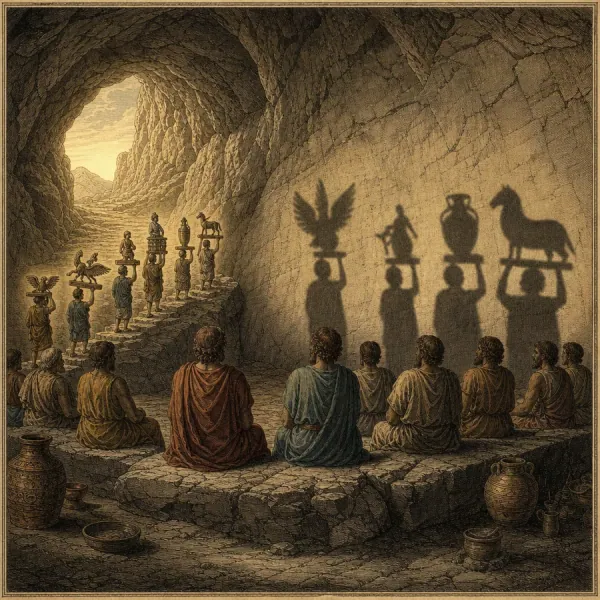
To show what this passage from opinion to knowledge looks like, Plato imagines a famous scene in Book VII of the Republic. Men have been chained since childhood deep inside an underground dwelling, their backs to the entrance. Behind them a fire is burning; between the fire and the prisoners, people walk past carrying objects whose shadows are cast on the wall. The prisoners have never seen anything else: they take these shadows for reality itself, and the echo of voices for the speech of the shadows.
Socrates, who tells the story, immediately adds that these strange prisoners are like us. If one of them is freed and forced to turn around, the firelight dazzles him and hurts: at first he believes the shadows were truer than what he is now being shown. Dragged outside, he can see nothing, then slowly adjusts: reflections in water, the objects themselves, the night sky, and finally the sun, which he understands to be the source of everything visible.
↩️ The return to the cave
The story doesn't end there. The freed prisoner, happy with his new state, goes back down to free his companions. But his eyes, used to the light, can no longer make out the shadows, and the others mock him.
“Won't they say that he went up there and came back with his eyes ruined; that it isn't worth even trying to leave the place where they are; and that if anyone takes it into his head to free them and lead them up, they must seize him and kill him, if they can?”
Plato, Republic, Book VII (translated)
The allegory teaches several things: our senses and habits give us appearances; truth demands a painful effort, a real turning around of the gaze; and those who seek it disturb people who prefer their certainties. For Plato, the visible world is only an imperfect copy of an intelligible world, the world of the Forms (or Ideas), which reason alone can reach through dialectic.
🧪 A modern critique of opinion
Aristotle, Plato's student, would refuse to separate the Forms from things: for him, we must study the world of the senses to discover its causes. But distrust of opinion would run through the centuries. In 1938, in The Formation of the Scientific Mind, the philosopher Gaston Bachelard wrote that “opinion thinks badly; it does not think”: it turns needs into knowledge and names objects by their usefulness. Science must first overcome it, because for a scientific mind “nothing is self-evident.” Still, it would be wrong to conclude that every opinion is false: an opinion can be right, but without knowing why.
The rest of the course
This page publishes the first 2 parts. The full course has 7: here is what the next ones cover.
- 🤔 Descartes: doubting everything to find one certainty
Descartes's methodical doubt (the senses, dreams, the evil demon), the discovery of the cogito in the Discourse on the Method (1637) and the Meditations (1641), the criterion of clear and distinct ideas, and his explanation of error.
- 🔬 Scientific truth: Popper and falsifiability
The problem of induction (the white swans), Karl Popper's criterion of falsifiability (1934), the contrast between Einstein's relativity and theories that explain everything, and Thomas Kuhn's paradigms.
- 🌍 Is truth relative?
Protagoras's relativism (“man is the measure of all things”), Plato's refutation of it in the Theaetetus, the self-refutation argument, the difference between cultural relativism and relativism about truth, and Nietzsche's critique.
- 📱 The age of “post-truth”
The word “post-truth” (Tesich 1992, Oxford Word of the Year 2016), Brexit and “alternative facts,” bullshit according to Harry Frankfurt, the fragility of factual truths according to Hannah Arendt, and the value of truth according to Bernard Williams.
- ✍️ Essay questions and leads
Six typical essay questions about truth, each with the problem to bring out and leads on authors and examples, without writing the essay for you.
Study “Truth” with flashcards and quizzes
In Oria, you read the full course, then practice on it: flashcards, multiple-choice quizzes, open questions or the Feynman method. Cards and questions then come back in your daily review, paced by spaced repetition.
Study this topic in OriaSources
These notes draw on the sources below. If a point seems doubtful, refer back to them.