History
Genghis Khan: Biography and Study Notes
From abandoned child to founder of the Mongol Empire
Study this topic in OriaThe essentials
Born Temüjin into a family of Mongol chiefs, he knows poverty after his father's death, then rises through the loyalty of his companions and sheer cunning. Proclaimed Genghis Khan in 1206, he reorganizes his entire people and launches conquests stretching from northern China to Central Asia, at the cost of immense destruction. You'll discover his youth, his rise, his reforms, his campaigns, his mysterious death, and the sharply contrasting image he left on the world.
Key dates and facts
- c. 1187
- Defeat against Jamukha
- 1202
- Victory over the Tatars
- 1203
- Toghrul's betrayal, oath of Baljuna
- 1204
- Defeat of the Naiman
- 1218
- Massacre of the Otrar caravan
- 1220
- Capture of Bukhara and Samarkand
- 1221
- Battle of the Indus
- 1222
- Withdrawal from Khorasan
- 1225
- Return to Mongolia
- 1226
- Campaign against the Western Xia
🐎 Temüjin, the child of the steppe
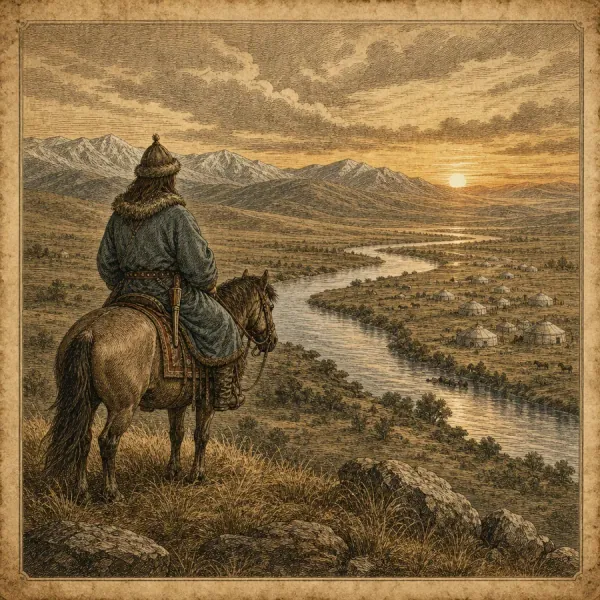
Genghis Khan is born under the name Temüjin, on the banks of the Onon River, in present-day Mongolia. The year is debated: 1155, 1162, or 1167. Historians most often settle on 1162, and one of them, Paul Ratchnevsky, notes that Temüjin himself may not have known the exact date.
📜 A life known from few sources
Everything known about his youth comes from two Mongol texts, only one of which survives: The Secret History of the Mongols, written by an anonymous author. Its chronology is shaky, but historians consider it precious, since its author dares to show his hero's weaknesses, his hesitations, and even his fear of dogs. Chinese and Persian chronicles fill out this account, each with its own biases.
👨👩👦 The son of a chief
At this time, the name "Mongols" still refers to just one tribe among others in the northeast of the country. Temüjin belongs to its aristocratic clan, the Borjigin. His father, Yesugei, is a war chief; his mother, Hoelun, had been abducted by Yesugei from her first fiancé, a Merkit. According to tradition, the child was given the name of a Tatar enemy captured by his father. Legends surround his birth: he is said to have come into the world clutching a blood clot in his fist, a sign, in Asian folklore, of a future warrior. He grows up with several brothers and half-brothers, learning very early to ride and to shoot a bow.
☠️ The fall of a family
When Temüjin is eight, his father betroths him to Borte, daughter of a chief of the Onggirat tribe, and leaves him to work for his future wife's family. On the way back, Yesugei shares a meal with some Tatars he meets on the road, as the hospitality of the steppe requires. But they recognize their old enemy and poison him; he dies shortly after. His followers rally to another clan, the Tayichiud, and abandon the widow and her children. Reduced to poverty, the family survives by gathering roots, hunting small game, and fishing.
Tensions rise between Temüjin and his elder half-brother Behter, who could also claim their father's inheritance. With his brother Qasar, Temüjin eventually kills him. This killing, passed over in silence by the official chronicles, is recounted by The Secret History, which reports their mother's fury.
🤝 Friends and escapes
Around the age of eleven, Temüjin bonds with another boy from a noble family, Jamukha: they exchange gifts and swear the oath of anda, blood brotherhood. Without allies, Temüjin is captured several times. Taken prisoner by the Tayichiud, he escapes during a feast, hides in the river, then at the home of a man, Sorkan-Shira, who shelters him for three days at the risk of his own life. Another time, a teenager named Bo'orchu helps him recover stolen horses and becomes his first nökor, or personal companion. These stories already show what historians consider his great strength: a charisma that drew others to follow him.
🏹 A rise strewn with obstacles
Around the age of fifteen, Temüjin, the future Genghis Khan, returns to the Onggirat to marry Borte, around 1178. The bride's father, who had thought him dead, consents with joy. Borte's mother gives Temüjin's mother a precious sable coat.
🧥 A coat for a protector
Temüjin needs a powerful protector. He offers the coat to Toghrul, khan of the Kereit tribe, who ruled over a large part of central Mongolia and had been his father's blood brother. Delighted by the gift, Toghrul takes him under his protection. Loyal companions begin to gather around Temüjin.
💔 The abduction of Borte
Shortly after, to avenge the old abduction of Hoelun, around three hundred Merkits attack the camp. Temüjin and his brothers take refuge on Mount Burkhan Khaldun, but Borte is abducted and given in marriage to a relative of Hoelun's first fiancé. Temüjin calls on Toghrul and his blood brother Jamukha, by now a tribal chief, for help: each gathers, according to the sources, twenty thousand warriors, and the campaign, led by Jamukha, is soon won. Borte, freed, is pregnant; she gives birth to a son, Jochi. Temüjin raises him as his own, but doubt about his paternity would follow him his whole life. With Borte, he would have three more sons, Chagatai, Ogedei, and Tolui, and several daughters.
⚔️ Blood brothers turned rivals
Temüjin and Jamukha camp together for a year and a half and renew their oath. Then they part ways, and Temüjin, on his mother's and wife's advice, builds his own camp. The great chiefs stay with Jamukha, but forty-one chiefs and many ordinary people join Temüjin, drawn by his reputation as a just and generous lord. His followers proclaim him khan of the Mongols. Jamukha takes offense, and around 1187 the two former friends clash at Dalan Baljut: Temüjin is soundly beaten.
🏯 A decade in the shadows
What does he do next? The Mongol sources fall silent. A Chinese diplomat, Zhao Hong, claims he spent several years as a slave of the Jin, the dynasty of Jurchen origin that dominates northern China. The historians Ratchnevsky and Timothy May consider it very likely that he lived in Jin service, a common refuge for disgraced steppe chiefs. This episode, humiliating for the future conqueror of China, may have been erased from Mongol accounts.
Temüjin reappears in 1196, taking part with the Jin in a campaign against the Tatars. He receives an honorary title that probably means "commander of hundreds" and helps Toghrul reclaim the Kereit throne, which a relative had usurped from him. Still officially Toghrul's vassal, he is now in fact his equal ally.
The rest of the course
This page publishes the first 2 parts. The full course has 8: here is what the next ones cover.
- 🌄 Master of the steppe
The wars that make Temüjin the sole master of the Mongol steppe between 1196 and 1205: victories over the Tatars, Toghrul's betrayal, the Baljuna oath, the defeat of the Kereit and the Naiman, and the death of Jamukha.
- 👑 1206: the birth of the Mongol Empire
The 1206 khuriltai where Temüjin takes the title Genghis Khan, the meaning of this title, his major reforms (decimal system, meritocracy, keshig guard, writing, justice), the affair of the shaman Kokochu, and the submission of the Western Xia.
- 🏯 Northern China and Central Asia
The war against the Jin dynasty from 1211 to 1215 (reasons, campaigns, the siege and capture of Zhongdu, future Beijing), then the conquest of the Qara Khitai state in 1218.
- 🐪 The Khwarezmian campaign
The invasion of the Khwarezmian Empire from 1219 to 1223: the massacre of the Otrar caravan, the capture of Bukhara and Samarkand, the shah's flight, the destruction of the cities of Khorasan, a debated human toll, Jebe and Subutai's raid, and the meeting with the Taoist master Changchun.
- 🕯️ Last campaign and death
The choice of Ogedei as successor, the final campaign against the Western Xia, the fall from a horse, and the death of Genghis Khan in August 1227, theories about his death, his untraceable tomb, and the transfer of power through 1229.
- 🌍 A disputed legacy
Genghis Khan's legacy: personality, the largest contiguous empire ever, trade routes and destruction, the division of the empire, and the opposing images of him in Mongolia, China, Russia, the Muslim world, and the West.
Study “Genghis Khan” with flashcards and quizzes
In Oria, you read the full course, then practice on it: flashcards, multiple-choice quizzes, open questions or the Feynman method. Cards and questions then come back in your daily review, paced by spaced repetition.
Study this topic in OriaSources
These notes draw on the sources below. If a point seems doubtful, refer back to them.