History
The Age of Discovery: Summary and Study Notes
When European ships linked the continents
Study this topic in OriaThe essentials
In the 15th century, the Portuguese and the Spanish set out across unknown oceans to reach the riches of Asia. Within a century, Dias rounded Africa, Columbus reached America, Vasco da Gama arrived in India, and Magellan's expedition sailed around the Earth. You'll learn why the Europeans set sail, with what ships and instruments, how the world was divided up at Tordesillas, and how the Aztec and Inca empires collapsed. You'll also see the dark side of this “first globalization”: microbial shock, the Atlantic slave trade, and a debate that still continues today over the very word “discovery.”
Key dates and facts
- 1415
- Capture of Ceuta
- 1434
- Gil Eanes passes Cape Bojador
- 1488
- Dias rounds the Cape of Good Hope
- 1498
- Vasco da Gama reaches Calicut
- 1500
- Cabral lands in Brazil
- 1513
- Balboa sights the Pacific
- Aug. 10, 1519
- Departure from Seville
- Apr. 27, 1521
- Magellan's death at Mactan
- Sept. 6, 1522
- Return of the Victoria
- 1519
- Cortés lands in Mexico
🌶️ Why set sail? Spices, gold, and the Ottomans
The Age of Discovery refers to the maritime explorations launched by European powers from the 15th century onward to reach Africa, Asia, and then America directly. Before following the navigators, it helps to understand why they took such risks.
🗺️ A world still poorly known
At the start of the 15th century, Europeans knew Europe and the Mediterranean well but had only a hazy idea of the rest of Africa and Asia. Scholars knew the Earth was round, but they did not know its exact size. America, Australia, and the interior of Africa were completely unknown to them.
🌶️ Spice fever
Pepper, cinnamon, nutmeg, and cloves were among the most expensive goods of the Middle Ages. They were used in cooking, but also in medicine, religious rituals, perfume-making, and food preservation. They came from Asia and passed through many middlemen: Muslim merchants carried them across the Indian Ocean to Indian ports such as Calicut, then on to the Persian Gulf and the Red Sea, from where they reached the Mediterranean overland. There, Italian merchants, Venetians above all, distributed them across Europe. Every middleman took a cut.
🏰 The shock of 1453
On May 29, 1453, the Ottomans of Sultan Mehmed II captured Constantinople: it was the end of the Byzantine Empire and a shock to Christendom. The rise of Ottoman power and higher taxes made the eastern trade routes harder to reach. Historians nuance this effect, however: some argue that spice prices in Europe did not really rise. But the idea of bypassing the middlemen by fetching the spices by sea became appealing.
💰 Gold and souls
Europeans also lacked precious metals: their gold and silver coins flowed east to pay for silk and spices, and many European mines were running dry. Finding gold in Africa or elsewhere became a major goal. A religious motive was added to this: spreading the Christian faith and finding the legendary Christian kingdom of Prester John, imagined to lie in Africa or Asia, in order to outflank the Muslim world. For Spain, the end of the Reconquista, with the capture of Granada in 1492, finally freed up resources for maritime adventure.
🧭 The navigators' tools
Sailing far from the coasts, on what was then called the “Sea of Darkness,” required ships able to handle the open ocean and instruments to know one's position. The Age of Discovery rested on techniques that were often ancient, but combined and refined in the 15th century.
🧭 The compass and portolan charts
The compass was developed in China. In Europe, the first mention of a magnetized needle used by sailors dates to 1190, in the writing of Alexander Neckam. For a long time, sailors practiced coastal navigation: they sailed close to shore, guided by portolan charts, sea charts that showed ports, the safest routes, and the dangers. Sailors set out from a known point, followed a compass heading, and found their way using the chart's markings.
A sea chart from the Middle Ages and the Renaissance that shows coastlines and ports, and marks the safest routes as well as the dangers of navigation.
⭐ Reading the sky
To venture onto the open sea, sailors needed to find their position without any landmark. Advances in astronomy spread the use of the astrolabe and the quadrant, which measured the height of the stars. Around the turn of the 16th century, the Portuguese developed a navigation system that determined latitude from the height of the North Star or the Sun at noon, using astronomical tables. In the Southern Hemisphere, where the North Star disappears, sailors used the Southern Cross as a reference. Longitude, however—the east-west position—remained impossible to calculate precisely, which caused major errors on maps.
⛵ The caravel
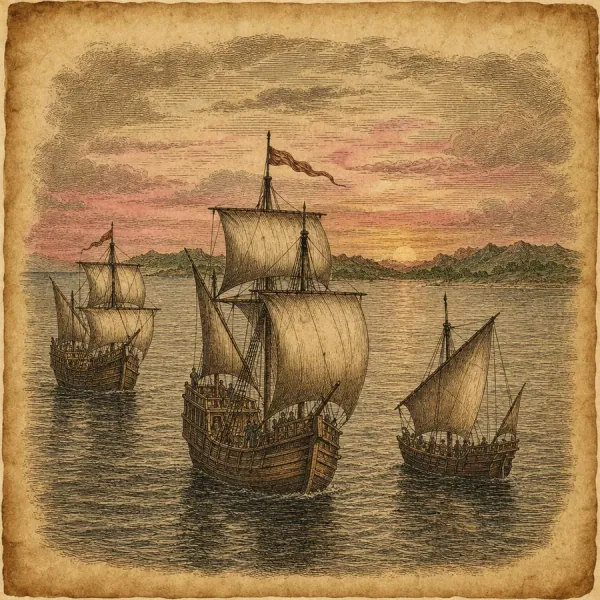
The great naval innovation was the caravel, which spread in the mid-15th century. Derived from fishing boats, it sailed closer to the wind than any other ship of its time. It was one of the first vessels able to sail the open sea, far from coastal reefs. Sailors also used the carrack, a three-masted ship: Columbus's Santa María was one.
Finally, the printing press, which appeared in the mid-15th century, played a quiet but essential role: it rapidly spread travel accounts and new maps, which fueled the rise of humanism and scientific curiosity.
The rest of the course
This page publishes the first 2 parts. The full course has 9: here is what the next ones cover.
- ⛵ Portugal opens the route to India
Portuguese exploration: Ceuta (1415), Henry the Navigator, Madeira and the Azores, Cape Bojador, Bartolomeu Dias at the Cape of Good Hope (1488), Vasco da Gama at Calicut (1498), Cabral in Brazil, and the trading-post empire.
- 🌎 Christopher Columbus and the “New World”
Christopher Columbus: his plan to reach Asia by sailing west, the 1492 voyage, the arrival in the Bahamas on October 12, his four voyages, his death in 1506, and the name “America” given in 1507.
- 📜 The Treaty of Tordesillas: dividing up the world
The division of the world between Spain and Portugal: the 1493 bull Inter caetera, the Treaty of Tordesillas of June 7, 1494, its consequences for Brazil and other powers, and the Treaty of Zaragoza in 1529.
- 🌐 Magellan, Elcano, and the first voyage around the world
The first circumnavigation: Balboa discovers the Pacific (1513), Magellan's expedition departs in 1519, the Strait of Magellan, Magellan's death at Mactan (1521), and Elcano's return in 1522.
- ⚔️ Conquistadors: the fall of the Aztecs and the Incas
The conquest of the Native American empires: Cortés and the fall of Tenochtitlan (1519–1521), Pizarro and the capture of Atahualpa at Cajamarca (1532), the reasons for the Spanish victory, and the silver of Potosí.
- 🔄 The Columbian Exchange, microbial shock, and the slave trade
The consequences of the Age of Discovery: the Columbian Exchange of plants and animals, the demographic collapse of Native Americans, the Atlantic slave trade, and the shift of the European economy toward the Atlantic.
- 🗣️ Memory and debate: discovery or encounter?
The debates over the Age of Discovery: the Valladolid debate and Las Casas, the questioning of the word “discovery” since 1992, and controversies around Columbus Day and colonial memory.
Study “The Age of Discovery” with flashcards and quizzes
In Oria, you read the full course, then practice on it: flashcards, multiple-choice quizzes, open questions or the Feynman method. Cards and questions then come back in your daily review, paced by spaced repetition.
Study this topic in OriaSources
These notes draw on the sources below. If a point seems doubtful, refer back to them.