Entrepreneurs & innovators
Google: Summary and Study Notes
The search engine that became one of the most powerful companies in the world
Study this topic in OriaThe essentials
Google was born in 1996 from a research project by two Stanford students, Larry Page and Sergey Brin, who had the idea of ranking web pages the way you measure the influence of a scientific paper: by the citations it receives. You'll understand how PageRank works, how a free service became a gigantic advertising business, how Google bought YouTube and made Android dominant, and then why American and European judges found it guilty of abusing its dominant position. Finally, you'll see how the company threw itself into the artificial intelligence race.
Key dates and facts
- 1995
- Page and Brin meet at Stanford
- 1996
- The BackRub research project
- 1997
- google.com is registered
- 1998
- Google is founded in a garage
- 2004
- Gmail launch and IPO
- 2006
- Acquisition of YouTube
- 2008
- Launch of Android and Chrome
- 2010
- End of censorship and withdrawal from China
- $402.8B
- Alphabet's revenue in 2025
- $132.2B
- Alphabet's net income in 2025
🎓 Two PhD students at Stanford
Google, today one of the most powerful companies in the world, was born from a doctoral thesis. Its two founders were born in the same year, 1973, but into two very different worlds.
👦 Larry Page, child of computers
Larry Page was born on March 26, 1973, in Lansing, Michigan. Both of his parents taught computer science at Michigan State University; his father was a pioneer of artificial intelligence. The family home overflowed with computers and science magazines. At six, in 1979, Larry was already using the computer his father had brought home to do his homework.
🧳 Sergey Brin, child of exile
Sergey Brin was born on August 21, 1973, in Moscow, in the Soviet Union, into a Jewish family of mathematicians. In 1977, his father decided to emigrate because of antisemitism; as soon as he applied for an exit visa, he was fired from his job. The family was finally allowed to leave in May 1979 and settled in the United States, where his father taught mathematics at the University of Maryland. Sergey studied mathematics and computer science there, then began a PhD at Stanford, in California, in 1993.
🔍 BackRub, a thesis project
The two young men met in the summer of 1995: Brin, as a volunteer, was showing a group of prospective students around campus, and Page was one of them. Looking for a thesis topic, Page became interested in the structure of the Web seen as an immense graph: which pages link to a given page? His adviser, Terry Winograd, encouraged him down this path, which Page later called “the best advice I ever got.” He compared these incoming links to citations in scientific publications. The programmer Scott Hassan wrote the code, and Brin joined the project, nicknamed BackRub (a nod to backlinks, incoming links). In March 1996, their crawler began exploring the Web starting from Page's personal home page alone. The first version, put online in August 1996 on Stanford's website, used up nearly half of the university's bandwidth.
🔢 A misspelled name
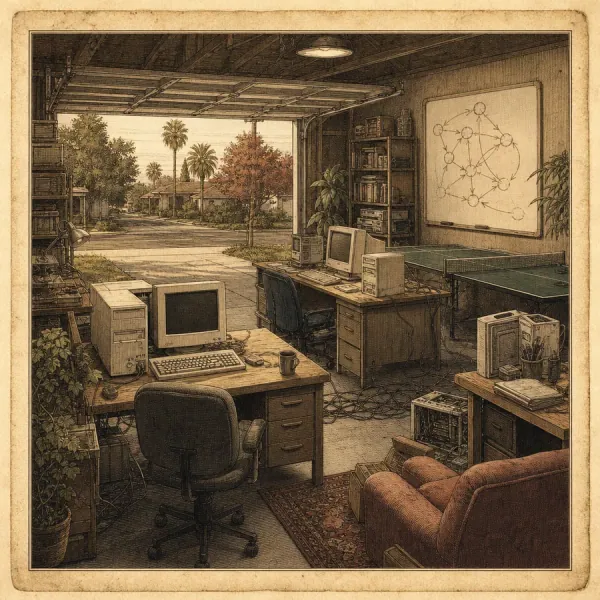
The search engine was renamed Google, a play on googol, the number 1 followed by a hundred zeros, to signal the ambition of handling an immense amount of information. The domain google.com was registered on September 15, 1997. In August 1998, Andy Bechtolsheim, cofounder of Sun Microsystems, wrote them a $100,000 check made out to a company that did not yet exist. So it had to be created: Google was officially founded on September 4, 1998, in the Menlo Park garage of their friend Susan Wojcicki, who would later run YouTube.
A delicious detail: in early 1999, Page and Brin offered to sell Google to the portal Excite for one million dollars, then $750,000. Its boss said no.
🔗 PageRank: ranking the Web by its links
In the mid-1990s, search engines such as AltaVista or Excite ranked pages mainly by the number of times the search term appeared on them. All you had to do to climb the results was repeat a word, and the answers were often poor. Larry Page and Sergey Brin, the founders of Google, had a different idea: measure a page's importance by the links it receives.
🗳️ A link is a vote
The principle of PageRank, whose name plays on “web page” and on Larry Page's surname, is simple: every link from a page A to a page B counts as a vote for B. But not all votes carry the same weight. A link from a page that is itself widely cited is worth much more than a link from an unknown page. This is exactly what happens in scientific research: a paper cited by influential work is judged more important than one cited by obscure publications.
A link analysis algorithm that gives every page an importance score. A page's score depends on the number and scores of the pages that link to it, and on how many links those pages hand out. The definition is therefore “circular”: it is computed by successive approximations.
🎲 The random surfer
To picture the calculation, imagine a web user who clicks at random from link to link. Every so often, they get bored and jump to a page picked at random. After millions of clicks, a page's PageRank corresponds to the probability that this surfer is on it. The pages you “land” on often are the ones that many paths lead to. The probability of continuing to click is called the damping factor, written d and generally set at around 0.85.
In its most common form, the formula is written: PR(A)=(1-d)/N + d × sum of PR(B)/L(B), where N is the total number of pages, the sum runs over all the pages B that link to A, and L(B) is the number of outgoing links from B. A page that hands out a hundred links therefore gives each of them a smaller share of its importance than a page that hands out just one.
✨ Why Google won
In April 1998, Page and Brin described their engine in a now-famous paper, The Anatomy of a Large-Scale Hypertextual Web Search Engine. To PageRank they added analysis of link text and, from 1998, short snippets showing where the search terms appear in each result. By the end of 1998, Google indexed about 60 million pages; the website Salon.com already judged its results better than those of its competitors. Its stripped-down home page stood out from the cluttered portals of the day, such as Yahoo!.
Google did not invent everything on its own: PageRank was partly inspired by RankDex, a comparable algorithm developed in 1996 by Robin Li, which Page's patent actually cites. Robin Li would go on to found the Chinese search engine Baidu in 2000. The PageRank patent belonged to Stanford University; all the related patents expired in 2019. Today, PageRank is just one criterion among hundreds of others, and the race between Google and those trying to game its rankings, by manufacturing fake links for example, has never stopped.
The rest of the course
This page publishes the first 2 parts. The full course has 8: here is what the next ones cover.
- 💰 The advertising machine
How Google makes money: the founders' initial reluctance, the launch of AdWords in 2000, cost-per-click auctions in 2002, AdSense in 2003, the arrival of Eric Schmidt, the 2004 IPO, multiple-voting-rights shares and the motto “Don't be evil.”
- 📱 Gmail, YouTube, Android: the empire expands
Google's expansion after 2004: Gmail, Maps, the acquisitions of YouTube in 2006 and DoubleClick, the creation of Android and Chrome, the conquest of smartphones, and the exit from China in 2010 after years of censorship.
- 🔤 Alphabet, Sundar Pichai and angry employees
The 2015 reorganization into the Alphabet holding company, Sundar Pichai's arrival at the head of Google, Page and Brin's withdrawal in 2019, and internal tensions: the 2018 global walkout over the handling of sexual harassment, the military Project Maven, the firing of James Damore.
- ⚖️ Google in court
The antitrust cases against Google, with dates: European Commission fines (Google Shopping 2017, Android 2018 upheld in 2026, AdSense annulled in 2024), the U.S. Justice Department cases over search (2020, 2024 ruling, 2025 remedies) and online advertising (2023, 2025 ruling), taxes and privacy.
- 🤖 The turn to artificial intelligence
Google and AI: the acquisition of DeepMind in 2014, AlphaGo's victory in 2016, AlphaFold, the invention of transformers in 2017, the ChatGPT shock, the launch of Bard and then Gemini, controversies and AI-generated summaries in search.
- 🌍 Google today
Google's position today: Alphabet's 2025 figures (official sources), the weight of advertising, the founders' control, dated fortunes, its dominance of its markets and its main challenges.
Study “Google” with flashcards and quizzes
In Oria, you read the full course, then practice on it: flashcards, multiple-choice quizzes, open questions or the Feynman method. Cards and questions then come back in your daily review, paced by spaced repetition.
Study this topic in OriaSources
These notes draw on the sources below. If a point seems doubtful, refer back to them.