History
Joan of Arc: Biography and Study Notes
The peasant girl from Domrémy who crowned a king
Study this topic in OriaThe essentials
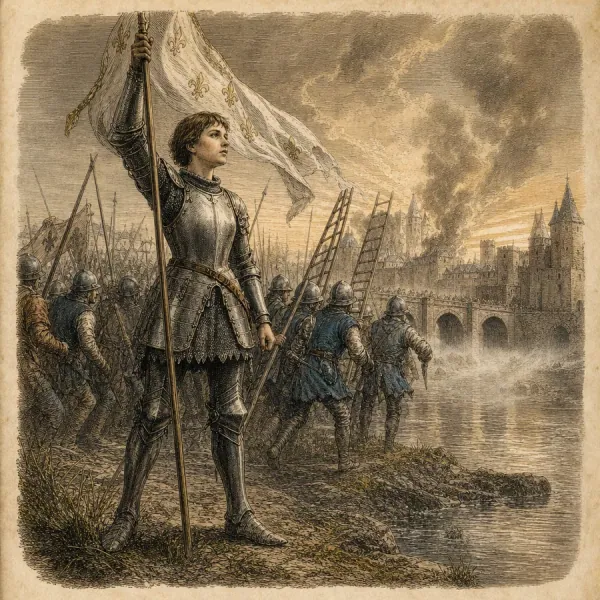
In 1429, a young peasant girl from Lorraine claimed that heavenly voices ordered her to save the kingdom of France. Within months she helped relieve Orléans and led Charles VII to his coronation at Reims, before being captured, tried for heresy, and burned at Rouen in 1431. You'll follow her life at the heart of the Hundred Years' War, her trial, her rehabilitation in 1456, her canonization in 1920, and the countless political uses made of her figure.
Key dates and facts
- 1407
- Assassination of Louis of Orléans, start of the civil war
- 1415
- French defeat at Agincourt
- 1420
- Treaty of Troyes, the dauphin disinherited
- 1428
- Siege of Orléans begins
- April 29, 1429
- Joan enters Orléans
- May 8, 1429
- Siege of Orléans lifted
- June 18, 1429
- Victory at Patay
- July 17, 1429
- Coronation of Charles VII at Reims
- Feb. 21, 1431
- First public hearing
- May 24, 1431
- Abjuration at the Saint-Ouen cemetery
⚔️ A kingdom torn apart: the Hundred Years' War
To understand Joan of Arc, one must first understand the chaos she grew up in. In the early 15th century, the Hundred Years' War, which had pitted the kings of France and England against each other for decades, was compounded by an outright civil war inside the kingdom of France.
👑 A mad king and rival princes
Since 1392, King Charles VI, nicknamed "the Mad," had suffered from bouts of insanity. Power passed to his Council, where his brother, Duke Louis of Orléans, clashed with his cousin John the Fearless, Duke of Burgundy. In November 1407, John the Fearless had Louis of Orléans assassinated. This was the start of a war between the supporters of Burgundy, the Burgundians, and those of the House of Orléans, called Armagnacs because the Count of Armagnac backed the murdered duke's son.
🏹 England exploits the divisions
The young English king Henry V seized the opportunity. In 1415, he landed in Normandy and crushed the French chivalry at Agincourt. From 1417 on, he methodically conquered Normandy and took Rouen in 1419. That same year, the dauphin Charles, heir to the throne, met John the Fearless on the bridge at Montereau to reconcile with him: the duke was assassinated there, perhaps on the dauphin's order or that of his advisors. The new Duke of Burgundy, Philip the Good, then allied himself with the English.
On December 1, 1420, the Treaty of Troyes disinherited the dauphin. Henry V married Catherine, Charles VI's daughter, and was to receive the crown of France upon the mad king's death. Historians speak of a "dual monarchy": a single sovereign for both kingdoms.
🗺️ Three Frances in 1429
In 1422, Henry V and Charles VI both died the same year. The English proclaimed a nine-month-old baby, Henry VI, king of France and England, with his uncle the Duke of Bedford as regent in France. For his part, the dauphin proclaimed himself king under the name Charles VII. His enemies contemptuously called him the "king of Bourges."
The kingdom was then split in three: the North, Paris and Guyenne belonged to the English; the Duke of Burgundy held his own lands; Charles VII ruled south of the Loire. Above all, the dauphin had never been crowned: and the coronation city, Reims, lay in Burgundian territory. In July 1428, the English began encircling Orléans, the last stronghold on the Loire before Charles VII's lands. If the city fell, the whole South was threatened. It was at this desperate moment that Joan appeared.
🌾 Domrémy: a peasant childhood and "voices"
Joan was born around 1412 in Domrémy, a village on the banks of the Meuse, at the meeting point of Champagne, the Barrois and Lorraine. The village was split between several authorities: one part belonged to the Duchy of Bar, the other to the castellany of Vaucouleurs, which answered directly to the king of France. Domrémy thus stood on land loyal to Charles VII, surrounded by Burgundian territory.
📅 An uncertain birth date
No parish register from Domrémy survives from that time. The year 1412 is arrived at by cross-checking: at her trial, Joan stated she was "about 19," and witnesses agree on a similar age. The date of January 6, the night of Epiphany, appears only in a 1429 letter, and historians see it mainly as symbolic: the birth of a "savior" for the kingdom.
Her name was Jeanne, "Jeannette" in the village. Her family name is most often spelled Darc, without an apostrophe, which did not yet exist. In the village, she was most likely known by her mother's name, as was the custom: "Jeannette, daughter of Romée."
👨👩👧 A family of farmers
Daughter of Jacques d'Arc and Isabelle Romée, she had four siblings. Her father was a laboureur, meaning a fairly well-off farmer who owned land and livestock and sometimes represented the village community. At her trial, Joan said she had learned to sew and spin, and that she feared "no woman in Rouen" at such work. She helped with the harvest and sometimes watched the animals. The image of the little shepherdess is thus exaggerated: it was built up later by Charles VII's camp for its symbolic value, that of a simple commoner's daughter guided by God.
All witnesses describe her as deeply devout. She went every Sunday to pray at the chapel of Bermont. War was never far away: in 1428, armed bands burned Domrémy, and the villagers had to take refuge for a few days in Neufchâteau. That same year, a young man claimed she had promised to marry him; she denied it before the court of the bishopric of Toul, and the case was dismissed.
🔔 The "voices"
According to what she would tell her judges in 1431, Joan was thirteen when she first heard, in her father's garden, a voice from God teaching her to behave well. At first frightened, she later identified the archangel Saint Michael, then Saint Catherine and Saint Margaret. These voices asked her to be devout, then to free the kingdom and lead the dauphin to his coronation.
What should we make of these voices? Catholics see them as divine intervention; in the 19th century, doctors proposed psychiatric explanations. Modern historians prefer a cultural reading: in the Middle Ages, it was widely accepted that God could speak to human beings. The historian Olivier Bouzy stresses that Joan was sincerely convinced, and that her contemporaries did not ask her whether she truly heard voices, but whether they came from God or from the devil.
The rest of the course
This page publishes the first 2 parts. The full course has 8: here is what the next ones cover.
- 🐎 From Vaucouleurs to Chinon
Joan's departure in 1428–1429, her meeting with Robert de Baudricourt at Vaucouleurs, her journey to the dauphin at Chinon, and the examination at Poitiers.
- 🏰 Orléans and the coronation at Reims
The lifting of the siege of Orléans in May 1429, the Loire campaign up to Patay, then the march on Reims and Charles VII's coronation on July 17, 1429.
- 🛡️ Paris, setbacks and the capture at Compiègne
The failed attack on Paris in September 1429, Joan's declining influence at court, then her capture at Compiègne on May 23, 1430, and her sale to the English.
- 🔥 The trial at Rouen and the stake
The heresy trial led by Pierre Cauchon in 1431, its irregularities, the abjuration, the conviction for relapse, and the execution on May 30, 1431, at Rouen.
- ⚖️ From the nullity trial to sainthood
The end of the Hundred Years' War, the nullity trial that rehabilitated Joan in 1456, then her beatification in 1909, canonization in 1920, and the national holiday.
- 🎭 Myths, appropriations and memory
What is really known about Joan, the false Joans and fanciful theories, and how artists and political parties have claimed her figure up to today.
Study “Joan of Arc” with flashcards and quizzes
In Oria, you read the full course, then practice on it: flashcards, multiple-choice quizzes, open questions or the Feynman method. Cards and questions then come back in your daily review, paced by spaced repetition.
Study this topic in OriaSources
These notes draw on the sources below. If a point seems doubtful, refer back to them.