Arts
Leonardo da Vinci: Biography and Study Notes
The painter who wanted to understand everything
Study this topic in OriaThe essentials
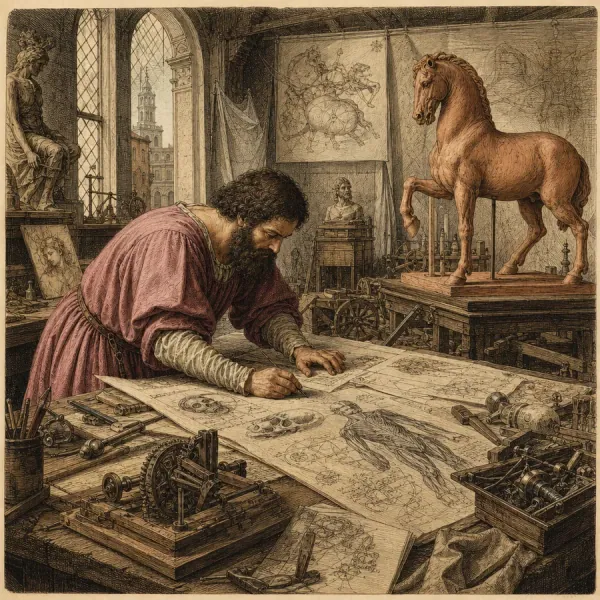
Born out of wedlock in a village in Tuscany, Leonardo da Vinci learns his trade in Verrocchio's workshop in Florence before becoming the artist-engineer of Ludovico Sforza in Milan, where he paints The Last Supper. By turns painter, military engineer, anatomist, and party planner, he begins the Mona Lisa in Florence, passes through Rome, and ends his life in France, at the side of Francis I. You will follow his life step by step, dive into his notebooks written in mirror writing, and understand how a man who left his works unfinished became a legend.
Key dates and facts
- 1452
- Born near Vinci
- 1457
- Joins his father's house in Vinci
- c. 1462
- Joins his father in Florence
- 1464
- Death of his stepmother Albiera
- 1482
- Arrives in Milan
- 1490
- Salai joins the workshop
- 1493
- Clay model of the Sforza horse
- 1495
- Begins The Last Supper, finished in 1498
- 1499
- The French take Milan
- 1500
- Returns to Florence
🌿 A childhood in Vinci
Leonardo da Vinci was born on the night of April 14, 1452, between nine and ten thirty in the evening. Tradition places his birth in a small house in the hamlet of Anchiano, close to the small Tuscan town of Vinci, but he may have been born in Vinci itself.
👨👩👦 A child born out of wedlock
His father, Piero da Vinci, was a notary of about twenty-five, from a family of notaries for at least four generations. Settled in Florence around 1451, he worked for monasteries, religious orders, and even the Medici. Of his mother, only her first name is known with certainty: Caterina. A 1458 tax declaration mentions "Lionardo," the illegitimate son of ser Piero and Caterina, by then married to a peasant from Vinci nicknamed Accattabriga, "the brawler."
Caterina's identity remains a mystery. In 2017, historians suggested she might have been a young local orphan, but further archival research has contradicted this idea. In 2023, the specialist Carlo Vecce published a 1452 deed written by Piero, freeing an enslaved woman named Caterina, originally from Circassia, in the Caucasus. But no document clearly links this woman to the child, and Vecce himself acknowledges the hypothesis remains uncertain.
👴 Opening one's eyes
The baby probably stayed with his mother until he was weaned, then was entrusted to his father's family. Piero mostly lived in Florence, and Caterina raised the five children she would have with her husband. So it was his grandfather Antonio, his grandmother Lucia, and his young uncle Francesco, fifteen years his senior, who raised him in the family house in Vinci. His grandfather, a great lover of observing nature, constantly told him "Po l'occhio!"—"Open your eyes!" His grandmother, a potter, may have been the first to introduce him to the arts.
Piero married Albiera degli Amadori, the daughter of a wealthy Florentine shoemaker, who was very affectionate toward the child; she died in childbirth in 1464. The notary would marry four more times and have ten legitimate sons and two daughters. Leonardo seems to have kept good relations with his successive stepmothers.
✏️ An education without Latin
Around 1462, Leonardo joined his father in Florence. Piero regarded him as his son but never legitimized him: Leonardo could therefore never become a notary. Nor did he have access to the Latin schools reserved for the children of professionals and great merchants. At ten, he entered a scuola d'abaco, an "arithmetic school" for the sons of merchants and craftsmen, where he learned to read, write, and above all to count.
He learned neither Greek nor Latin, the languages of the science of his time. He would only take up Latin, imperfectly and on his own, around the age of forty, and his spelling would remain highly erratic. Later, facing scholars who looked down on him, he would proudly call himself a "man without letters," a disciple of experience rather than of books.
🎨 Verrocchio's apprentice
Around 1464, by 1465 at the latest, Leonardo, about twelve years old, was placed by his father as an apprentice with Andrea del Verrocchio, one of the most celebrated artists in Florence. According to the biographer Giorgio Vasari, Piero showed some of his son's drawings to Verrocchio, who was struck by this promising start.
🏪 A workshop, not quite a studio
Verrocchio could do it all: trained as a goldsmith, he was also a painter, sculptor, bronze caster, architect, and engineer. His main client was Lorenzo de' Medici, the master of Florence. His workshop, the bottega, was more like a shop where works of art were made and sold as a team effort: pieces were almost never signed. People there also talked about mathematics, anatomy, music, and philosophy. Leonardo rubbed shoulders with other future great names there, such as Botticelli, Perugino, and Domenico Ghirlandaio.
Like every beginner, he started with the humblest tasks: cleaning brushes, sweeping, grinding pigments, watching over the boiling of varnishes and glues. He was then allowed to transfer the master's sketches onto panels, paint backgrounds and landscapes, and eventually entire parts of paintings.
🔧 Lessons from a building site
The workshop received all kinds of commissions. In 1468, Verrocchio was tasked with making the huge copper ball meant to crown the dome of the Santa Maria del Fiore cathedral; it was installed in May 1472. This project introduced Leonardo to mechanics, metallurgy, and hoisting machines. There he also learned chiaroscuro, the art of suggesting depth through contrasts of light and shadow, and experimented with highly diluted, transparent colors. This was the origin of his famous sfumato, those soft, hazy outlines that would become his signature.
👼 The pupil who surpasses the master
In the 1470s, Leonardo painted the angel on the left of The Baptism of Christ, a painting by Verrocchio. Vasari tells us this angel was so superior to the rest that the master, "ashamed to be outdone by a child," never touched his brushes again. The anecdote is famous, but historians do not agree on whether it is true.
In 1472, at twenty, Leonardo was registered with the Company of Saint Luke, the painters' guild of Florence: he was now a master. Yet he stayed on with Verrocchio, still mentioned there in 1476. He designed sets and costumes for the festivities of Lorenzo de' Medici. On August 5, 1473, he dated a pen drawing of the Arno valley: it is the oldest dated drawing known from his hand, and a rare landscape painted for its own sake.
In 1476, an anonymous accusation charged him, along with three other young men, with sodomy, then illegal in Florence; all were acquitted. In these same years, he painted an Annunciation, two Madonna and Child paintings, and the portrait of Ginevra de' Benci, growing ever more skilled with oil paint. In 1481, he received a commission for an Adoration of the Magi, which he left unfinished: an early example of a habit that would follow him all his life.
The rest of the course
This page publishes the first 2 parts. The full course has 8: here is what the next ones cover.
- 🏰 Milan, Ludovico Sforza, and The Last Supper
Leonardo's seventeen years at the court of Ludovico Sforza in Milan: engineer, party planner, the giant horse that was never cast, and the painting of The Last Supper.
- 📓 The engineer and his notebooks
Leonardo's notebooks written in mirror writing, his anatomical studies, his flying and military machines, and historians' views of his genius as an inventor.
- 🖼️ Back to Florence: the Mona Lisa
After the fall of Milan, Leonardo's wanderings (Mantua, Venice, Cesare Borgia), then his return to Florence, where he begins the Mona Lisa and The Battle of Anghiari.
- 🏛️ From Milan to Rome
The second Milanese period in the service of King Louis XII, his meeting with Francesco Melzi, his anatomical research, then a disappointing stay in Rome with the Medici.
- ⚜️ The final years at Amboise
Leonardo's move to France, to the Manoir du Cloux, under Francis I, his final activities, his will, and his death on May 2, 1519.
- 🌍 Leonardo's legacy
The fate of Leonardo's notebooks and paintings after his death, the building of the myth of the universal genius, its reassessment, and the fame of the Mona Lisa.
Study “Leonardo da Vinci” with flashcards and quizzes
In Oria, you read the full course, then practice on it: flashcards, multiple-choice quizzes, open questions or the Feynman method. Cards and questions then come back in your daily review, paced by spaced repetition.
Study this topic in OriaSources
These notes draw on the sources below. If a point seems doubtful, refer back to them.