Arts
Michelangelo: Biography and Study Notes
The sculptor who painted the Sistine Chapel and designed the dome of Saint Peter's
Study this topic in OriaThe essentials
Born in 1475 near Arezzo and raised among stonecutters, Michelangelo becomes, before he is 30, the creator of the Pietà and the David. He calls himself a sculptor above all, yet paints the Sistine Chapel ceiling and later the Last Judgment, before directing, past 70, the building of St. Peter's Basilica. You'll follow his life step by step, from Ghirlandaio's workshop to the popes who fought over his genius, his working methods, his poems, and the immense legacy of the man his contemporaries called "the divine one."
Key dates and facts
- 1475
- Born at Caprese, March 6
- 1488
- Apprenticed to Ghirlandaio
- 1499
- Completion of the Pietà
- 1504
- Unveiling of the David in Florence
- 1512
- Unveiling of the Sistine ceiling
- 1541
- Completion of the Last Judgment
- 1546
- Named architect of St. Peter's
- 1564
- Dies in Rome, February 18
🪨 A childhood among stonecutters
Michelangelo di Lodovico Buonarroti Simoni is born on March 6, 1475, at Caprese, a small Tuscan town near Arezzo that today bears the name Caprese Michelangelo. His father, Ludovico, is only passing through: he holds, for six months, the office of podestà, a kind of local magistrate. The family is Florentine, proud of its origins (it claims descent from Countess Matilda of Canossa, though nothing proves this), but it is cash-poor: its small banking business had failed.
🏡 Milk and marble dust
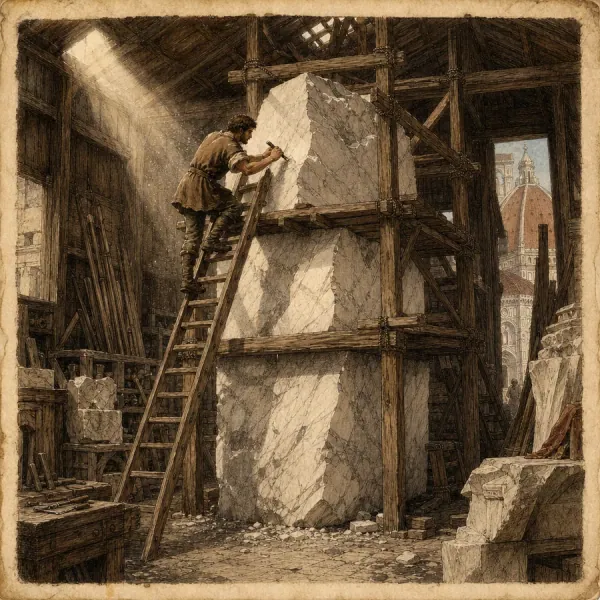
A few months after his birth, the family returns near Florence. The baby is placed with a wet nurse at Settignano, a quarrying village where the grey stone used in Florence's great buildings is cut; she is the daughter and wife of stonecutters, and Michelangelo's father owns a small quarry and farm there. Once famous, the artist would say he drank in, with his nurse's milk, "the skill of the chisel and the hammer": this is how he explained his preference for sculpture. His mother, Francesca, dies in 1481, when he is six; he is the second of five brothers.
✏️ A schoolboy who prefers drawing
Sent to Florence to learn grammar under the humanist Francesco da Urbino, the boy shows little interest in school. He prefers copying the frescoes of churches and keeping company with painters, encouraged by his friend Francesco Granacci. Florence is then the greatest artistic center in Italy: one can see Brunelleschi's churches, Ghiberti's bronze baptistery doors (which Michelangelo would call "the gates of Paradise"), and the frescoes of Giotto and Masaccio, which he copies tirelessly.
His biographers, above all Ascanio Condivi, who wrote at his dictation, describe a father hostile to a calling judged unworthy of a patrician family. Historians instead think poverty played a larger part: an apprentice brought in a little money. On April 1, 1488, a contract binds the boy for three years to the workshop of Domenico Ghirlandaio, the greatest in Florence, a master of fresco who had helped decorate the walls of the Sistine Chapel. Unusually for so young a pupil, Michelangelo is paid. There he likely learns the basics of fresco, a technique he would return to twenty years later on the Sistine scaffolding.
🌿 At the court of Lorenzo the Magnificent
In 1489, Lorenzo de' Medici, called the Magnificent, the de facto ruler of Florence, asks Ghirlandaio for his two best students. Michelangelo and Granacci join the garden of San Marco, a kind of academy where young talents copy the antique sculptures of the Medici collections under the old sculptor Bertoldo di Giovanni, a former pupil of Donatello. According to a famous anecdote, Lorenzo notices a faun's head carved by the teenager and remarks that an old man never has all his teeth; before the visit is over, Michelangelo has knocked one out.
🏛️ An adopted son of the Medici palace
From 1490 to 1492, the young man lodges at the Medici palace and is treated almost as a son. There he mingles with the leading humanist thinkers of the day, Marsilio Ficino, Pico della Mirandola, and the poet Poliziano, who dream of reconciling Plato with Christianity: this Neoplatonism would mark his entire body of work. He also meets the young Medici who would become his great patrons, including the future popes Leo X and Clement VII. On an idea from Poliziano, he carves the Battle of the Centaurs, a crowded relief, and the Madonna of the Stairs, a very flat relief in the manner of Donatello: his two oldest known works.
This is also the time of a now-famous brawl: another student, Pietro Torrigiano, jealous of his talent and stung by his mockery, punches him and breaks his nose. Michelangelo's face bears the mark for life, visible in his portraits.
🌨️ Years of upheaval
Lorenzo dies on April 8, 1492. Michelangelo returns to his father's house. Thanks to the prior of Santo Spirito, he is able to study anatomy by dissecting cadavers from the convent hospital, and carves a wooden crucifix in thanks. On January 20, 1494, after heavy snowfall, the new master of Florence, Piero de' Medici, commissions him to make... a snow statue in the courtyard of the palace.
But Florence is on the brink: the preacher Savonarola thunders against luxury, and the armies of the French king Charles VIII invade Italy. In October 1494, fearing he might be targeted as a Medici protégé, Michelangelo flees to Venice and then to Bologna, shortly before the family's expulsion. In Bologna, he carves three small statues for the tomb of Saint Dominic and discovers the powerful reliefs of Jacopo della Quercia, which he would remember on the Sistine ceiling.
Back in Florence at the end of 1495, he carves a Sleeping Cupid that is passed off, perhaps without his knowledge, as an antique. A Roman cardinal, Raffaele Riario, buys it for about two hundred ducats; Michelangelo had received only about thirty. On discovering the trick, the cardinal is furious, but so impressed that he wants to meet the sculptor: it is the young man's ticket to Rome.
The rest of the course
This page publishes the first 2 parts. The full course has 9: here is what the next ones cover.
- ✝️ Rome and the Pietà
Michelangelo's first stay in Rome (1496-1501): the Bacchus for Cardinal Riario, then the Pietà for St. Peter's, commissioned by a French cardinal, his only signed work, which makes him famous at 24.
- 🗿 Florence and the Giant
Michelangelo's return to Florence (1501-1505): the David carved from an abandoned block, which becomes a symbol of the Florentine Republic, his rivalry with Leonardo da Vinci over the Palazzo Vecchio battle murals, and the Doni Tondo.
- 🎨 The Sistine Chapel ceiling
The meeting with Pope Julius II, the tomb project, the 1506 flight, then the four years of work (1508-1512) on the Sistine Chapel vault: program, scaffolding, working conditions, and its unveiling.
- 🏛️ In the service of the Medici popes
The years 1513-1534: the tomb of Julius II and the Moses, the Medici funerary chapel and the Laurentian Library in Florence, the 1529-1530 siege where Michelangelo directs the fortifications, then his final departure for Rome.
- ⚖️ The Last Judgment
The Last Judgment fresco painted on the Sistine altar wall (1536-1541), the scandal over its nudity and its censorship, and Michelangelo's Roman friendships with Tommaso dei Cavalieri and Vittoria Colonna.
- ⛪ The architect of St. Peter's
Michelangelo's last decades (1546-1564): architect of St. Peter's Basilica and its dome, his other Roman projects, his last Pietàs, his death in Rome at nearly 89, and his funeral in Florence.
- 🌍 Method, poetry, and legend
How Michelangelo worked (sculpture by subtraction, the unfinished), his personality, his poetry, the first biographies published in his lifetime, and his immense influence on sculpture, painting, and architecture to this day.
Study “Michelangelo” with flashcards and quizzes
In Oria, you read the full course, then practice on it: flashcards, multiple-choice quizzes, open questions or the Feynman method. Cards and questions then come back in your daily review, paced by spaced repetition.
Study this topic in OriaSources
These notes draw on the sources below. If a point seems doubtful, refer back to them.