Arts
Salvador Dalí and Surrealism: Biography and Study Notes
The painter of dreams, melting clocks and provocation
Study this topic in OriaThe essentials
Born in Catalonia in 1904, Salvador Dalí became the most famous figure of Surrealism, the movement that set out to free the unconscious. You'll discover his childhood haunted by a dead brother, his meeting with Gala, his paranoiac-critical method, The Persistence of Memory, his showman's provocations, his controversial political choices, and the legacy of an artist who came before Warhol in the cult of the celebrity artist.
Key dates and facts
- 1904
- Born in Figueres
- 1916
- Discovers modern painting in Cadaqués
- 1921
- Death of his mother
- 1929
- Meets Gala
- 1930
- The hut at Portlligat
- 1934
- Civil marriage in Paris
- 1958
- Church wedding
- 1974
- The Figueres Theatre-Museum opens
- 1982
- Death of Gala
- 1989
- Dalí dies in Figueres
🌊 A childhood between Figueres and Cadaqués
Salvador Dalí was born on May 11, 1904, in Figueres, Catalonia, in the Empordà region, very close to the French border. His father, Salvador Dalí i Cusí, was a notary, an atheist and a supporter of a federal Catalonia; he has been described sometimes as authoritarian, sometimes as liberal. His mother, Felipa Domènech i Ferrés, encouraged her son's artistic gifts from an early age. His full name, Salvador Domingo Felipe Jacinto Dalí i Domènech, mixes Spanish and Catalan: at the time, the Catalan language was banned from official documents.
👻 The dead brother
Nine months before he was born, a first son, also named Salvador, had died of gastroenteritis before the age of two. According to Dalí's own account, his parents took him to this brother's grave when he was five and told him he was his reincarnation. He said he was left with the feeling of being a copy, and an obsessive desire to prove that he was unique. The theme of the double would run through his whole life and work, all the way to Portrait of My Dead Brother (1963).
🎨 The revelation of Cadaqués
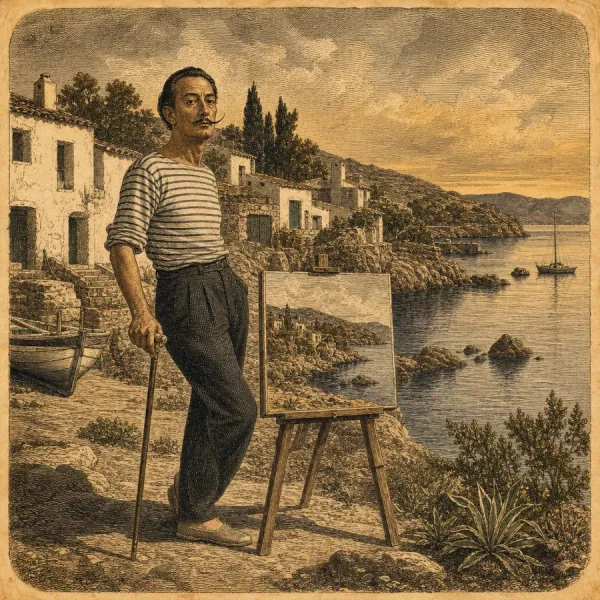
The family spent its holidays in Cadaqués, a fishing village on the Costa Brava whose rocks and light would become the backdrop of his paintings. It was there, in 1916, that he discovered modern painting through the family of the painter Ramon Pichot, a Catalan Impressionist close to Picasso who often traveled to Paris. On his advice, Dalí's father enrolled him in the municipal drawing school in Figueres, then organized an exhibition of his drawings at home. Around 1918–1919, still a teenager, Dalí exhibited at the municipal theater of Figueres: the very building that, half a century later, would become his museum. His first canvases were Impressionist; around 1921, he discovered Futurism and Cubism in the books and magazines sent to him by an uncle who was a bookseller in Barcelona.
🖤 His mother's death
On February 6, 1921, his mother died of cancer. Dalí was sixteen. His father would later marry his late wife's sister. The following year, the young man left to study fine arts in Madrid. Dalí would later describe her death as the hardest blow of his life: he adored his mother, and could not resign himself to losing the one person through whom he had hoped to make the stains of his soul invisible.
🎓 Madrid: Lorca, Buñuel and the avant-garde
In 1922, Dalí moved into the Residencia de Estudiantes in Madrid and enrolled at the Royal Academy of Fine Arts of San Fernando. Tall and thin (1.72 m, about 5 ft 8 in), with long hair and sideburns, a coat, stockings and knee breeches in the style of the English aesthetes of the late 19th century, he immediately stood out as an eccentric dandy.
🤝 Lorca and Buñuel
At the Residencia, he became friends with the poet Federico García Lorca and the future filmmaker Luis Buñuel. His friendship with Lorca was one of the most intense relationships of his life; the poet dedicated an ode to him, and Dalí would later claim he had rejected his advances. Together they read Freud: Dalí would consider psychoanalysis one of the most important discoveries of his life. Every Sunday morning, he went to the Prado to analyze the great masters, pencil in hand: Raphael, Zurbarán, Vermeer and above all Velázquez, from whom he would later borrow his famous upturned moustache.
🚔 Prison, success and expulsion
The young man then called himself a communist, an anti-monarchist and an anticlerical. Suspended from the Academy, he was even briefly jailed in 1924 under the dictatorship of Primo de Rivera. His Cubist canvases impressed his fellow students, since there were no Cubist painters in Madrid at the time. In November 1925, his first solo exhibition, at the Dalmau gallery in Barcelona, was a critical and commercial success. In 1926, he made his first trip to Paris and met Picasso, whom he revered and who would remain both a model and a rival for him. That same year, he was expelled from the Academy shortly before his final exams for declaring that no one there was qualified to examine him. Yet his Basket of Bread (1926), meticulously realistic, proves he had fully mastered classical technique.
🐜 Toward the dream
From 1927 onward, his paintings filled with dream images: rotting donkeys, fragmented bodies, Catalan landscapes under a merciless light, all painted with a watchmaker's precision. He described Honey Is Sweeter Than Blood (1927) as lying “equidistant between Cubism and Surrealism.” In 1928, one of his canvases, loaded with sexual imagery inspired by his reading of Freud, was rejected by the Barcelona Autumn Salon: the scandal was widely covered in the press.
The rest of the course
This page publishes the first 2 parts. The full course has 9: here is what the next ones cover.
- 🌀 Surrealism: freeing the unconscious
What Surrealism is: André Breton's manifesto (1924), automatic writing, the exquisite corpse, the movement's painters, then Un Chien Andalou and Dalí's entry into the group in 1929.
- ❤️ Gala, the muse, and the break with his father
His meeting with Gala in 1929, her role as muse and business manager, Dalí's break with his father, and the move into a fisherman's hut in Portlligat.
- 👁️ The paranoiac-critical method
The method Dalí devised from 1930 onward to organize delirium in a controlled way, his double images, his exchanges with Lacan, and Breton's changing opinion.
- ⏱️ The Persistence of Memory
The story, description and interpretations of Dalí's most famous painting, The Persistence of Memory (1931), known as the Melting Clocks.
- 🎩 The showman, the war and the American exile
Dalí's fame in the United States, his provocations, the Spanish Civil War, his expulsion from the Surrealist group in 1939, and his eight years in America.
- ⚛️ Back in Spain: nuclear mysticism and Francoism
Dalí's return to Catalonia in 1948, his support for Franco's regime, his return to Catholicism, his “nuclear mysticism” blending science and religion, and his many other activities.
- 🏛️ The Theatre-Museum, the end and the legacy
The Theatre-Museum in Figueres, Dalí's last years after Gala's death, the suspicions surrounding his late works, his death in 1989, and his lasting influence.
Study “Salvador Dalí and Surrealism” with flashcards and quizzes
In Oria, you read the full course, then practice on it: flashcards, multiple-choice quizzes, open questions or the Feynman method. Cards and questions then come back in your daily review, paced by spaced repetition.
Study this topic in OriaSources
These notes draw on the sources below. If a point seems doubtful, refer back to them.