Geography & countries
Nigeria: Summary and Study Notes
The Giant of Africa, between oil, Nollywood and immense challenges
Study this topic in OriaThe essentials
Nigeria is the most populous country in Africa and one of the youngest in the world: more than four in ten people are under 15. Heir to prestigious kingdoms such as Ife, Benin and Kano, and a British colony until 1960, it went through a civil war and thirty years of military rule before returning to democracy in 1999. You'll discover its geography, its history, its peoples and religions, a culture that has gone global with Nollywood and Afrobeats, an economy built on oil, its institutions, its role in West Africa and the major challenges it faces today.
Key dates and facts
- c. 550 BC
- Iron smelting in the Nok culture
- 10th century
- Igbo kingdom of Nri and Hausa city-states
- 1804
- Founding of the Sokoto Caliphate
- 1897
- The British capture Benin City
- 1967
- Biafra secedes and the civil war begins
- 1970
- End of the war
- 1993
- Presidential election annulled
- 1999
- Lasting return to democracy
🌍 From the Gulf of Guinea to the Sahel
Nigeria (officially the Federal Republic of Nigeria) is a country in West Africa, opening to the south onto the Gulf of Guinea, in the Atlantic Ocean, and bordered to the north by the Sahel. It shares borders with Benin to the west, Niger to the north, Chad to the northeast and Cameroon to the east. At about 924,000 km² (357,000 square miles), it covers roughly the area of mainland France and Germany combined, or nearly four times the size of the United Kingdom.
🏞️ A country shaped by two rivers
Its name comes from the Niger River: it was suggested on January 8, 1897, by the British journalist Flora Shaw. The Niger enters from the northwest and, in the middle of the country, receives its great tributary, the Benue, which flows in from Cameroon. The two valleys form a large “Y” that structures the territory. The river then empties into the Atlantic through the Niger Delta, one of the largest deltas in the world, covered in mangroves and swamps and today the heart of oil production. The highest point, Chappal Waddi (2,419 m), lies in the highlands along the Cameroonian border.
🌦️ From rainforest to Sahel
The country stretches from 4° to 14° north latitude, and the climate changes as you move north:
- in the south, a coast of lagoons and mangroves, then a very wet tropical rainforest, largely cleared for farming and urban growth;
- in the center, vast savannas where tall grasses alternate with scattered trees;
- in the far northeast, the dry Sahel, where the desert is advancing, and Lake Chad, shared with Niger, Chad and Cameroon, whose surface area has shrunk sharply in recent decades.
These contrasts have human consequences: desertification in the north is pushing herders south, where they compete with farmers for land and water.
🏙️ Lagos, Abuja and 36 states
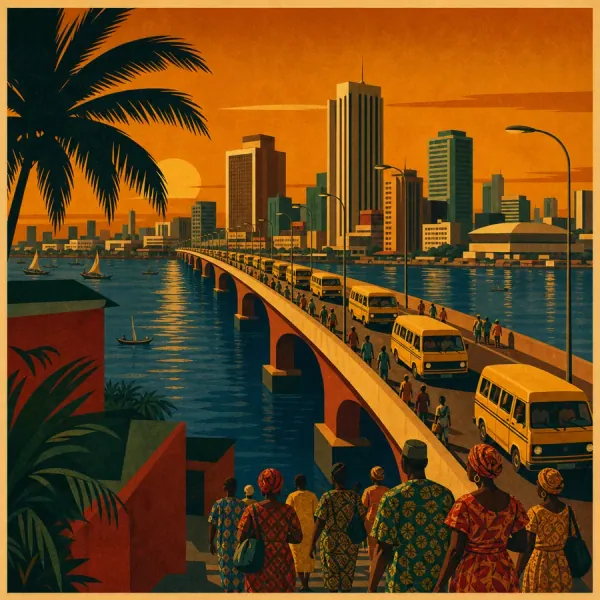
Nigeria is a federation of 36 states and one federal territory, divided into 774 local government areas. Its capital is Abuja, a new city built at the geographic center of the country, at the foot of the Aso Rock monolith, which replaced Lagos as capital on December 12, 1991. But the economic heart remains Lagos, on the coast: a metropolis of lagoons and islands that grew from about 300,000 people in 1950 to more than 13 million by 2017, according to estimates, making it one of the largest urban areas in Africa. Kano, Ibadan, Benin City and Port Harcourt also have more than a million inhabitants each.
🗿 From Nok terracottas to great kingdoms
Long before Nigeria existed as a state, its territory was home to some of the oldest and most brilliant cultures of sub-Saharan Africa.
🏺 Nok and the first ironworkers
The Nok culture, which flourished in the center of the country between about 1500 BC and AD 200, left remarkable terracotta heads and statues, among the oldest known sculptures in Africa. Its people were smelting iron by about 550 BC, perhaps earlier, and sites in the southeast have yielded traces of even older metalworking. Recent research suggests that Africa developed ironworking independently, without going through a Bronze Age.
👑 Bronzes, city-states and kingdoms
In the southeast, the Igbo kingdom of Nri, consolidated in the 10th century, is considered the cradle of Igbo culture; the nearby town of Igbo-Ukwu has yielded the oldest bronzes in West Africa cast using the lost-wax technique. In the southwest, the Yoruba founded the city of Ife, famous for its terracotta and bronze heads, then the Oyo Empire, which at its height (late 17th – early 18th century) dominated a region extending as far as present-day Togo. Farther east, the Kingdom of Benin (not to be confused with the neighboring country of the same name), founded by the Edo people, was a major power from the 15th to the 19th century. Its artists produced the famous Benin Bronzes, brass plaques and heads that adorned the royal palace.
In the north, Hausa city-states such as Kano, Katsina and Zaria have written histories going back to the 10th century and lived off the trans-Saharan trade. East of Lake Chad, the Kanem-Bornu Empire, a long-lasting Muslim power, kept up diplomatic ties with North Africa: in the 1390s, one of its rulers was already writing to the sultan of Egypt.
⛓️ The slave trade and the Sokoto Caliphate
From the 16th century, the Portuguese traded directly with the coast, at Lagos and Calabar. This trade marked the beginning of the Atlantic slave trade: Calabar, Bonny, Badagry and Lagos became major ports of departure for captives, often seized in raids and wars, and several inland kingdoms took part (see the chapter “The Atlantic Slave Trade and Slavery”). In the north, the Hausa states and Bornu were tied to the trans-Saharan slave trade instead.
In the early 19th century, the Fulani preacher Usman dan Fodio launched a jihad against the Hausa kings, whom he accused of practicing Islam improperly, and in 1804 founded the Sokoto Caliphate. A federation of some thirty emirates with 10 to 20 million inhabitants, it was one of the largest states in Africa at the time, but also one of its largest slave societies. The title of Sultan of Sokoto still exists and remains a major religious authority for the country's Muslims.
The rest of the course
This page publishes the first 2 parts. The full course has 9: here is what the next ones cover.
- 🇬🇧 From British colony to independence
The British conquest, the 1914 amalgamation, indirect rule, nationalism and independence on October 1, 1960.
- ⚔️ The Biafran War and the generals' years
The coups of 1966, the Biafran civil war (1967–1970), the oil boom, military regimes and the return to democracy in 1999.
- 👥 250 peoples, 500 languages, two major religions
Nigeria's population: very young demographics, major ethnic groups, English and local languages, Islam and Christianity, the diaspora.
- 🎬 Nollywood, Afrobeats and a Nobel Prize
Nigerian culture and its global reach: literature (Soyinka, Achebe, Adichie), music (Fela Kuti, Afrobeats), Nollywood cinema, sports.
- 🛢️ Oil, start-ups and the cost of living: a giant, fragile economy
Nigeria's economy: dependence on oil, pollution in the delta, agriculture, the 2023 reforms, inflation, Lagos start-ups and fintech, poverty.
- 🏛️ A federal republic and West African power
Nigeria's political system (presidency, federalism, elections), how international indexes rate it and its place in Africa and the world.
- ⚠️ Today's challenges
Nigeria's major challenges: insecurity (Boko Haram, banditry, kidnappings, herder-farmer conflicts), health, education and the future of a very young population.
Study “Nigeria” with flashcards and quizzes
In Oria, you read the full course, then practice on it: flashcards, multiple-choice quizzes, open questions or the Feynman method. Cards and questions then come back in your daily review, paced by spaced repetition.
Study this topic in OriaSources
These notes draw on the sources below. If a point seems doubtful, refer back to them.