Geography & countries
Peru: Summary and Study Notes
From the Incas to ceviche, a country of desert, Andes and Amazon
Study this topic in OriaThe essentials
Peru brings together, within a single territory, a coastal desert that is among the driest in the world, the snowy peaks of the Andes and the Amazon rainforest. You'll discover five thousand years of civilizations up to the Inca Empire, the Spanish conquest and three centuries of viceroyalty, a republic shaken by wars and political violence, a mixed people with many languages, a cuisine that has gone global, a mining economy, a democracy that keeps changing presidents, and the challenges of a country whose glaciers are melting.
Key dates and facts
- c. 3000 BC
- Rise of Caral, the oldest city in the Americas
- 1438
- Start of the Inca expansion under Pachacuti
- c. 1450
- Construction of Machu Picchu
- 1532
- Capture of Atahualpa at Cajamarca
- 1535
- Founding of Lima
- 1780
- Rebellion of Túpac Amaru II
- July 28, 1821
- Proclamation of independence
- December 9, 1824
- Battle of Ayacucho
- 1879 – 1884
- War of the Pacific against Chile
- 1968
- Velasco's coup and land reform
🏔️ Desert, Andes and Amazon
Peru lies on the west coast of South America, facing the Pacific Ocean, entirely in the Southern Hemisphere, just below the equator. Its neighbors are Ecuador and Colombia to the north, Brazil to the east, Bolivia to the southeast and Chile to the south. At 1,285,216 km², it is the world's 19th largest country by area, more than twice the size of France or Spain. Its capital is Lima, on the coast.
🗺️ Three countries in one
The Andes mountain range, running parallel to the Pacific, divides the country into three main regions, which Peruvians call the costa, the sierra and the selva. The coast is a narrow strip of desert, broken by fertile valleys where rivers come down from the mountains; it covers only about 10% of the territory but is home to most of the population. The sierra is the mountains: high plateaus, deep valleys and snowy peaks, including Huascarán (6,768 m), the country's highest point. To the east stretches the selva, the Amazon rainforest, which covers nearly 60% of the territory but is home to only a small share of the inhabitants.
🌫️ A desert by the ocean
Why a desert in the tropics, right by the sea? Because of the Humboldt Current, a cold ocean current that flows up the coast from south to north. The cold water chills the air above it and prevents rain clouds from forming: it almost never rains on the coast, where the moisture mostly takes the form of fog. The same current is rich in plankton, which makes Peruvian waters one of the most abundant fishing grounds in the world, especially for anchovies. Every few years, the El Niño phenomenon reverses the situation: the waters warm up, fish become scarce, and torrential rains cause floods and mudslides on the northern coast.
💧 Lake Titicaca and the source of the Amazon
The country holds about 4% of the planet's fresh water. In the south, shared with Bolivia, Lake Titicaca, perched at more than 3,600 meters, is the largest lake in South America and one of the highest navigable lakes in the world. But most of the water flows east: the Marañón and Ucayali rivers join to form the Amazon, whose basin covers about three-quarters of Peruvian territory. The coastal rivers, by contrast, are short, steep and often dry for part of the year: Lima's water supply remains a chronic problem.
🌋 A land that shakes
Peru lies in a highly seismic zone and has active volcanoes in the south, such as El Misti and Ubinas. The 1970 earthquake that destroyed the town of Yungay killed between 66,000 and 70,000 people. Evacuation drills are part of school life.
🦙 A megadiverse country
Thanks to this variety of climates, Peru is one of the most species-rich countries in the world: more than 1,800 bird species, more than 500 mammal species, such as the puma, the jaguar and the spectacled bear, and thousands of plants, including the giant Puya raimondii of the high plateaus. The Andes are also the realm of camelids, such as llamas and alpacas, raised for thousands of years. About 22% of the territory is designated as protected natural areas.
☀️ Five thousand years of civilizations, up to the Incas
Long before the Incas, the land of Peru gave rise to one of the oldest civilizations in the world, and to a succession of brilliant cultures on the coast and in the mountains alike.
🏛️ Caral, the oldest city in the Americas
The earliest human traces date back to about 12,500 BC, at the site of Huaca Prieta. Between roughly 3000 and 1800 BC, according to estimates, the Caral-Supe civilization, also called Norte Chico, flourished on the coast: its city of Caral, with its truncated pyramids, is considered the oldest city in the Americas. Andean societies were based on farming, camelid herding and fishing; they knew neither money nor markets, and were organized around reciprocity and the redistribution of harvests.
🗿 One culture after another
The Chavín culture (about 1500 to 300 BC), more religious than political, spread its influence from its great temple at Chavín de Huántar, decorated with gods inspired by the jaguar or the serpent. Then came a series of regional cultures: Paracas, famous for its textiles; Nazca, on the southern coast; the Moche of the northern coast, masters of irrigation, pottery and metalwork; the Wari, near Ayacucho, and Tiwanaku, near Lake Titicaca, who built large urban centers between AD 500 and 1000. Finally, the Chimú built Chan Chan, near Trujillo, the largest adobe city in the world.
🌱 The art of farming the mountains
To farm steep slopes, Andean peoples invented agricultural terraces, the andenes: steps of earth held up by low stone walls and linked by irrigation channels. They hold water and soil in place and make it possible to farm slopes that could not be farmed before. Andean farmers grew maize, potatoes, quinoa and many other plants on them.
☀️ The Inca Empire
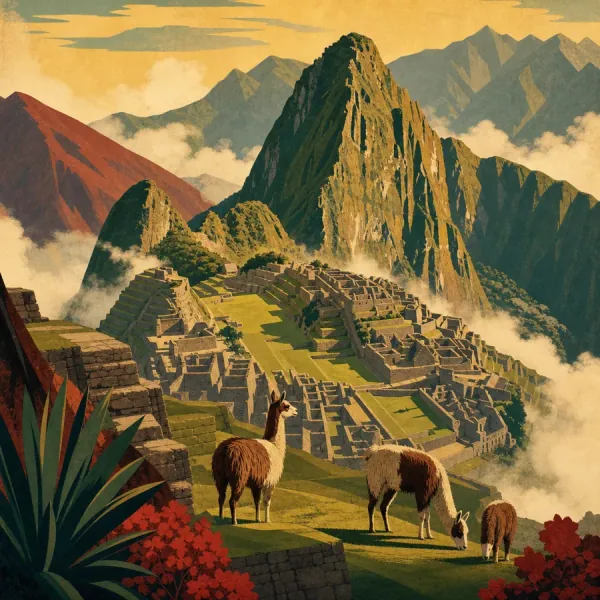
The Incas were at first just a small Quechua-speaking people settled in the valley of Cusco. Starting in 1438, under the emperor Pachacuti and then his son Túpac Inca Yupanqui, they conquered in less than a century the largest empire of pre-Columbian America, stretching from what is now southern Colombia to northern Chile, with 9 to 16 million inhabitants. They called it Tawantinsuyu, “the four united regions.” Pachacuti unified the empire with an immense network of roads, traveled by relay runners, the chasquis, imposed Quechua as the official language and centralized power. The emperor, the Sapa Inca, was considered the “son of the Sun,” the god Inti. Around 1450, on an Andean ridge 2,430 meters high, Machu Picchu was built, probably as an estate for Pachacuti. The site was revealed to the world in 1911 by the American historian Hiram Bingham, although people in the area already knew it.
The rest of the course
This page publishes the first 2 parts. The full course has 9: here is what the next ones cover.
- ⛪ Conquest, viceroyalty and independence
From the Spanish conquest to independence: Atahualpa and Pizarro, demographic collapse, the Viceroyalty of Peru, silver mines, Christianization, the rebellion of Túpac Amaru II, San Martín and Bolívar.
- 🇵🇪 Two centuries of a turbulent republic
Republican Peru from 1824 to 2000: guano, the War of the Pacific, coups, Velasco's land reform, the crisis of the 1980s, the Shining Path, Alberto Fujimori.
- 👥 A mixed people with many languages
The Peruvian population: the 2025 census, Lima, mixed ancestry and identities, official languages (Spanish, Quechua, Aymara), religions and syncretism, emigration and Venezuelan immigration.
- 🍲 Ceviche, charango and a Nobel Prize
Peruvian culture: cuisine and world-class gastronomy, the potato, music and dance, colonial art, literature from the Inca Garcilaso to Vargas Llosa, sport.
- ⛏️ Copper, gold and avocados
The Peruvian economy: growth and 2025 figures, mining (copper, gold, silver, zinc), agricultural exports, fishing, the informal economy, poverty, the port of Chancay.
- 🏛️ A democracy of short-lived presidents
Peru's political system and its instability: the 1993 Constitution, Congress and presidential vacancy, presidents removed or convicted, the 2022 crisis, the election of Keiko Fujimori in 2026, international indexes.
- 🌎 Between the Pacific and climate challenges
Peru's place in the world and its challenges: regional organizations, relations with the United States, China and Chile, drugs and crime, melting glaciers, El Niño, the environment.
Study “Peru” with flashcards and quizzes
In Oria, you read the full course, then practice on it: flashcards, multiple-choice quizzes, open questions or the Feynman method. Cards and questions then come back in your daily review, paced by spaced repetition.
Study this topic in OriaSources
These notes draw on the sources below. If a point seems doubtful, refer back to them.