Geography & countries
Vietnam: Summary and Study Notes
Southeast Asia's dragon, from war to takeoff
Study this topic in OriaThe essentials
Stretched in an S-shape over more than 1,600 kilometers, Vietnam has gone in forty years from a country ruined by war to the workshop of Asia. You'll discover its geography of deltas and mountains, a thousand years of Chinese rule followed by independence, the wars of the 20th century in brief, a people with blended beliefs, a cuisine famous the world over, the Đổi mới economy, a one-party state, and a country balancing between China and the United States.
Key dates and facts
- 111 BC
- Annexation by China's Han dynasty
- 939
- Independence after the victory at Bạch Đằng
- 1428
- Lê Lợi drives out the Ming
- 1802
- Gia Long unifies the country
- 1887
- Creation of French Indochina
- September 2, 1945
- Proclamation of independence
- July 21, 1954
- Geneva Accords, partition at the 17th parallel
- April 30, 1975
- Fall of Saigon
- July 2, 1976
- Official reunification
🌾 A long S between mountains and sea
Vietnam occupies the eastern edge of the Indochinese Peninsula, in Southeast Asia. It borders China to the north and Laos and Cambodia to the west, and opens onto the Gulf of Tonkin, the South China Sea (which the Vietnamese call the “East Sea”) and the Gulf of Thailand. Its capital is Hanoi, in the north; its largest city, Ho Chi Minh City, formerly Saigon, lies in the south.
🗺️ An S-shaped country
At about 331,000 km², Vietnam is a little smaller than Germany or Japan. But its shape is unique: a long S stretching some 1,650 kilometers from north to south, about 600 kilometers wide in the north, and narrowing to barely 50 kilometers in the center, in Quảng Trị province. Traditionally, three main regions are distinguished: the North (Bắc Bộ, the former Tonkin), the Center (Trung Bộ, the former Annam) and the South (Nam Bộ, the former Cochinchina).
⛰️ Two deltas joined by a spine of mountains
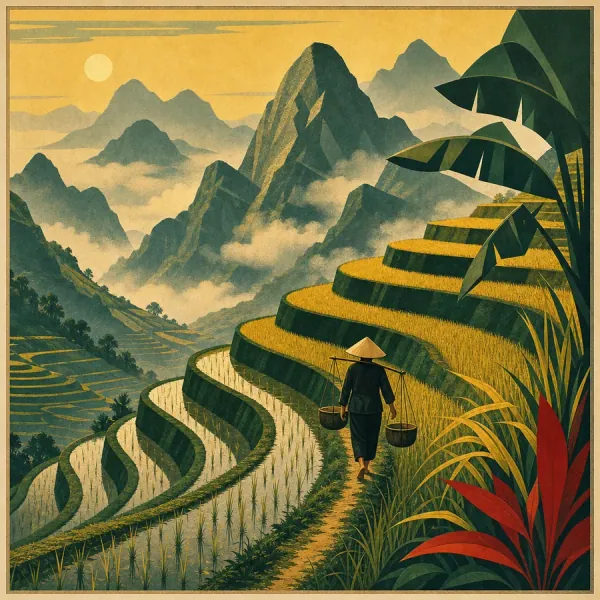
Mountains and plateaus cover about two-thirds of the country; plains make up little more than 20%. In the northwest rises Fansipan (3,143 m), the highest peak on the entire Indochinese Peninsula. The Annamite Range, or Trường Sơn, runs along the border with Laos and Cambodia like a backbone. At either end spread two vast, fertile plains: the Red River Delta in the north, around Hanoi, and the Mekong Delta in the south. These deltas carry so much sediment that they push several dozen meters further into the sea every year. They are the country's rice bowls and its most populated regions: the Red River Delta, the smallest of the major regions, is also the most densely inhabited.
🏞️ Limestone landscapes
The north of the country is famous for its karst landscapes: ancient limestone plateaus, eaten away by water, have left dizzying pinnacles behind. In Hạ Long Bay, a UNESCO World Heritage Site, the plateau has sunk into the sea, and hundreds of peaks now rise straight out of the water. Further south, Phong Nha-Kẻ Bàng National Park is home to Sơn Đoòng, one of the largest caves in the world, scientifically explored in 2009: some of its chambers could hold a forty-story building.
🌧️ Monsoons and typhoons
The climate varies greatly from north to south. The North has a humid subtropical climate with four seasons and cool winters: in Hanoi, temperatures range from about 15 to 33 °C. The Center and South have a tropical monsoon climate with two seasons, dry and wet; around Ho Chi Minh City, it is 21 to 35 °C all year round. Monsoon rains, often 1,500 to 2,000 mm a year, regularly cause flooding. The central coast is exposed to typhoons, especially from September to December.
🐒 A threatened biodiversity sanctuary
Vietnam is one of the most species-rich countries in the world: nearly 16,000 plant species, some 840 bird species and 310 mammal species have been recorded there. Mammals unknown to science have been discovered there recently, such as the saola and the giant muntjac. But this wealth is shrinking: deforestation, poaching and urbanization threaten many species, and the country's last Javan rhinoceros was killed in 2010.
📜 A thousand years under China, then independence
The history of Vietnam is the story of a people, the Viet (or Kinh), born in the Red River Delta, who spent two thousand years defending their independence against their giant Chinese neighbor before expanding southward.
🥁 The bronze drums
The land has been inhabited since prehistoric times. Around 1000 BC, wet-rice farming in the plains of the Red River and the Mã River allowed the rise of the Đông Sơn culture, famous for its large decorated bronze drums, found all over Southeast Asia. According to legend, the first kingdom, Văn Lang, was founded by the Hùng kings, still honored as the ancestors of the nation. In the 3rd century BC, King An Dương Vương founded the kingdom of Âu Lạc, whose citadel, Cổ Loa, stands near Hanoi.
🐉 A millennium of Chinese rule
In 179 BC, the Chinese general Zhao Tuo (Triệu Đà in Vietnamese) seized Âu Lạc and absorbed it into his kingdom of Nanyue. In 111 BC, China's Han dynasty annexed the region. For about a thousand years, what is now northern Vietnam remained a Chinese province, which the Tang called Annam, the “Pacified South.” Confucianism, Chinese writing and Buddhism took deep root there. Revolts were frequent: the most famous was led by the Trưng sisters, who remain national heroines.
⚓ The Bạch Đằng trap and independence
In 938, the lord Ngô Quyền faced the fleet of the Southern Han on the Bạch Đằng River. He had huge iron-tipped stakes driven into the riverbed, hidden at high tide. When the tide went out, the enemy ships were impaled and stuck fast. The following year, in 939, Vietnam became independent. The kingdom took the name Đại Việt (“Great Viet”) and enjoyed a golden age under the Lý and Trần dynasties, which repelled three Mongol invasions in the 13th century and made Buddhism the state religion. After a brief occupation by China's Ming dynasty, Lê Lợi restored independence in 1428.
🧭 The march to the South
Between the 11th and 18th centuries, the Viet slowly pushed south: this was the Nam tiến, the “march to the South.” They conquered the Hindu-influenced kingdom of Champa, whose brick towers still stand at the Mỹ Sơn sanctuary, and then Khmer lands in the Mekong Delta. Divided from about 1600 to 1777 between the Trịnh lords in the north and the Nguyễn lords in the south, the country was reunified after the Tây Sơn brothers' rebellion by Nguyễn Ánh, who became emperor under the name Gia Long in 1802. It was during his reign that the name “Việt Nam” was adopted, with Huế as the capital.
🇫🇷 French Indochina
From the 16th century on, European merchants and missionaries arrived: first the Portuguese, then the Dutch, English and French. The persecution of Catholic missionaries served as a pretext for French intervention. Starting in 1858, France conquered the country step by step: the South became the colony of Cochinchina between 1862 and 1867, then the Center (Annam) and the North (Tonkin) became protectorates in 1883–1884. In 1887, the three territories were merged into French Indochina. The colony developed tobacco, indigo, tea and coffee plantations, roads and schools, but ignored demands for rights and self-rule. Resistance movements followed one another, from the royalist Cần Vương movement to the uprisings of the Indochinese Communist Party led by Nguyễn Ái Quốc, the future Ho Chi Minh. In 1940, Japan occupied Indochina; in March 1945, it ousted the French administration. A terrible famine then killed up to two million people in the North.
The rest of the course
This page publishes the first 2 parts. The full course has 9: here is what the next ones cover.
- 🕊️ Thirty years of war, then reunification
From independent Vietnam in 1945 to reunification in 1976 and the hardships of the postwar years: the First Indochina War, partition, the Vietnam War in brief, the boat people, Cambodia, China.
- 👥 One people, 54 ethnic groups and blended beliefs
The population of Vietnam: demographics, the Kinh and ethnic minorities, the Vietnamese language and the quốc ngữ alphabet, religions and ancestor worship.
- 🍜 From phở to áo dài: a far-reaching culture
Vietnamese culture: Chinese and local heritage, values, the Tết festival, clothing, literature, music, theater, cuisine and sport.
- 🏭 From Đổi mới to the workshop of Asia
The Vietnamese economy: the Đổi mới reforms, growth, 2025 figures, electronics and exports, agriculture, the decline of poverty.
- 🏛️ A one-party state
Vietnam's political system: the role of the Communist Party, institutions, leaders in 2026, the 2025 administrative reform, freedoms according to international indexes.
- 🎋 Bamboo diplomacy
Vietnam's place in the world: international organizations, relations with China and the United States, the South China Sea, Russia, bamboo diplomacy.
- ⏳ The challenges: aging, adapting, getting rich
Vietnam's challenges today: aging and the birth rate, climate change and the Mekong Delta, pollution, the legacies of war, and the ambition to become a rich country by 2045.
Study “Vietnam” with flashcards and quizzes
In Oria, you read the full course, then practice on it: flashcards, multiple-choice quizzes, open questions or the Feynman method. Cards and questions then come back in your daily review, paced by spaced repetition.
Study this topic in OriaSources
These notes draw on the sources below. If a point seems doubtful, refer back to them.