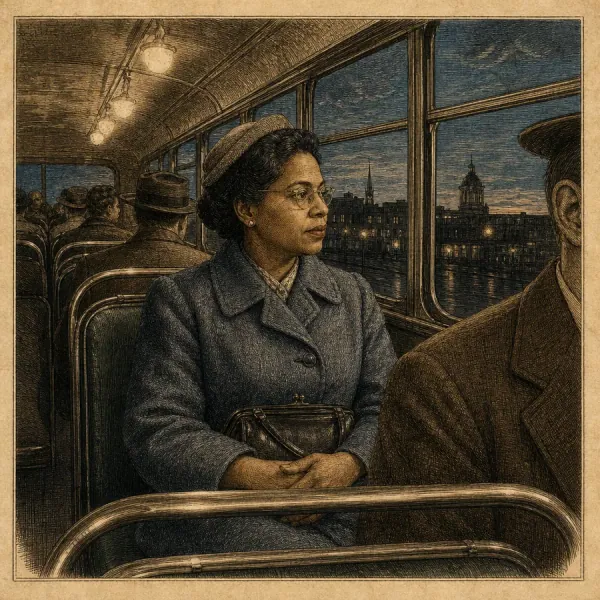
The essentials
On December 1, 1955, in Montgomery, Alabama, Rosa Parks refused to give up her seat to a white passenger and was arrested. Her act sparked a 381-day bus boycott that made Martin Luther King famous and shook segregation. But Rosa Parks was not a tired seamstress who came out of nowhere: you'll discover a seasoned activist, her childhood under Jim Crow laws, her fight before and after 1955, and why historians are now reassessing her role.
Key dates and facts
- 1901
- Segregation written into the Alabama Constitution
- 1913
- Born in Tuskegee
- 1928
- Her Montgomery school closes
- 1932
- Marries Raymond Parks
- 1943
- Secretary of the Montgomery NAACP
- 1945
- Registered to vote
- 1955
- Training at the Highlander Folk School
- Dec. 1, 1955
- Rosa Parks is arrested
- Dec. 5, 1955
- Trial and start of the boycott
- Nov. 13, 1956
- The Supreme Court affirms Browder v. Gayle
🌾 A childhood under Jim Crow
Rosa Louise McCauley was born on February 4, 1913, in Tuskegee, Alabama, in the American South. Her mother, Leona Edwards, was a teacher; her father, James McCauley, was a carpenter and stonemason. Her first and middle names combined those of her two grandmothers, Rose and Louisa. Her ancestry mixed African roots, a great-grandfather of Scottish and Irish descent and a great-grandmother who was partly Native American; her maternal grandfather, Sylvester Edwards, was the son of an enslaved woman and the son of a plantation owner.
🏡 In Pine Level, with her grandparents
As a baby, she first lived with her father's family in Abbeville. The house was too small, and her father, who moved from job to job, was often away, so her mother took her to Pine Level to live with her own family. Her mother taught during the week in a nearby village, and Rosa lived with her grandparents on their farm, where they grew fruit trees, pecans and walnuts and raised chickens and cows. At around six or seven, she began picking cotton on a neighboring plantation for 50 cents a day, the wage paid to Black children. Her mother taught her to sew: at 10 she finished her first quilt, and at 11 her first dress. Baptized at two in the African Methodist Episcopal Church, an independent Black church founded by free Black people in Philadelphia in the early 19th century, she remained a member all her life.
⛓️ The Jim Crow system
A body of laws and customs that enforced the separation of white and Black people in the American South, from the late 19th century to the 1960s. In Alabama, a constitutional convention formally wrote them into law in 1901. They governed nearly every part of life: banks, health care, churches, cemeteries and public transportation.
This segregation went hand in hand with racist violence. After World War I, the Ku Klux Klan, a white supremacist organization, stepped up its activities in Pine Level as in the rest of the country. Rosa Parks would remember often hearing, as a child, about Black people found dead in mysterious circumstances.
📚 Schools for Black children
She first attended a one-room school set up in a church, then, at around eleven or twelve, a vocational school for girls in Montgomery. After it closed in 1928, she went on to a public junior high school for Black students, then to a school attached to the Alabama State Teachers College for Negroes. She had to drop out to care for her grandmother and then her mother, who were ill, and afterward worked on the family farm and as a domestic worker in white households.
✊ An activist long before 1955
In 1931, at 18, Rosa McCauley met Raymond Parks, a 28-year-old man she would describe as the “first real activist” she had ever met; she admired his opposition to racial prejudice. They married on December 18, 1932, at Rosa's mother's house and settled in Montgomery. The couple immediately took up the defense of the Scottsboro Boys, nine young Black men falsely accused of raping two white women on a train and sentenced to death: they held fundraising meetings in their home. In 1933, encouraged by Raymond, Rosa earned her high school diploma, at a time when only 7% of Black Alabamians had one.
✈️ A window onto another world
She worked as a nurse's aide, then, from 1941, at Maxwell Air Force Base, where white and Black workers rode the same transportation. On the way home, though, she had to take segregated buses again. That contrast, she would say, opened her eyes.
📝 Secretary of the NAACP
In 1943, she joined the Montgomery chapter of the NAACP (National Association for the Advancement of Colored People), the leading organization defending the rights of African Americans, and became its secretary that December. She would later explain, wryly, that she accepted because she was the only woman there, they needed a secretary, and she was too timid to say no.
At the time, registering to vote was an obstacle course for Black people: a poll tax, literacy tests, intrusive questions, retaliation from employers. In 1940, fewer than 0.1% of Black residents of Montgomery were registered. Rosa Parks tried three times starting in 1943 and succeeded in 1945.
⚖️ Defending Black women
For the NAACP, she investigated racist and sexual violence. In 1944, she looked into the gang rape of Recy Taylor, a Black woman from Abbeville, by white men whom the courts refused to prosecute. With other activists, she launched a committee for “equal justice” that drew attention across the country; two grand juries nonetheless declined to indict the attackers. For historian Danielle McGuire, this campaign assembled, ten years earlier, the pieces that would make the Montgomery boycott a success.
🌳 Summer 1955 at Highlander
From 1954, Rosa Parks worked as a seamstress for Clifford and Virginia Durr, a white couple opposed to segregation, who helped her attend a training session in the summer of 1955 at the Highlander Folk School, a training center for activists in Tennessee. There she was mentored by the organizer Septima Clark. For the first time in her adult life, she lived somewhere white and Black people worked, cooked and lived together as equals, without racial hostility. In August 1955, back in Montgomery, she attended a meeting about the lynching of Emmett Till, whose murder that same August deeply shocked African Americans.
The rest of the course
This page publishes the first 2 parts. The full course has 8: here is what the next ones cover.
- 🚌 How bus segregation worked
The rules and customs of segregation on Montgomery's buses (reserved rows, the middle section, the drivers' power), Rosa Parks's first clash with driver James Blake in 1943, and the women arrested before her, including Claudette Colvin.
- 🪑 December 1, 1955
An account of the evening of December 1, 1955: Rosa Parks boards James Blake's bus, refuses to give up her seat to a white passenger, is arrested and then released on bail, and what she said about her act.
- 🚶 381 days of boycott
The Montgomery bus boycott (December 5, 1955 – December 20, 1956): the Women's Political Council's leaflets, Rosa Parks's trial, the founding of the Montgomery Improvement Association and the arrival of Martin Luther King, carpools, repression, and victory with the Browder v. Gayle ruling.
- 🏙️ Exile in Detroit and radical activism
Rosa Parks's hardships after the boycott (poverty, illness, threats), her move to Detroit in 1957, her work for Congressman John Conyers, her part in the March on Washington and Selma, and her support for Black Power in the 1960s and 1970s.
- 🌍 Against apartheid, to the very end
Rosa Parks's final decades: the fight against apartheid and support for Nelson Mandela, support for Jesse Jackson, the founding of her institute in 1987, her autobiography, the 1994 assault, major honors, then her death in 2005 and the tribute at the Capitol.
- 🗽 Memory and debate: the icon and the activist
The tributes paid to Rosa Parks in the United States and around the world (a statue at the Capitol, her bus on display in a museum, a Paris train station, schools), and historians' reassessment of her role: a lifelong radical activist, and the other forgotten women of the boycott.
Study “Rosa Parks” with flashcards and quizzes
In Oria, you read the full course, then practice on it: flashcards, multiple-choice quizzes, open questions or the Feynman method. Cards and questions then come back in your daily review, paced by spaced repetition.
Study this topic in OriaSources
These notes draw on the sources below. If a point seems doubtful, refer back to them.