History
Simone Veil: Biography and Study Notes
Auschwitz survivor, the minister behind the 1975 abortion law, first president of the elected European Parliament
Study this topic in OriaThe essentials
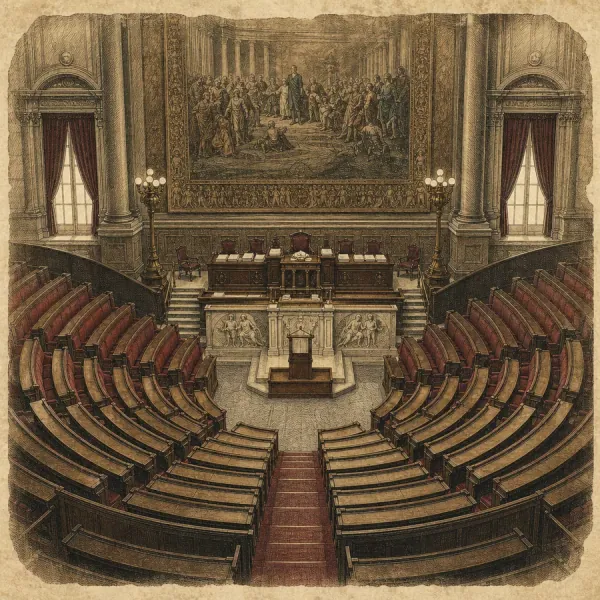
Born in Nice in 1927 into a secular Jewish family, Simone Jacob was deported to Auschwitz at 16 and lost part of her family there. Back in France, she became a magistrate, then Minister of Health: in 1974, before a parliament of almost all men, she defended the law that decriminalized abortion. You'll also follow her commitment to Europe, from the presidency of the Strasbourg Parliament in 1979 to her work on the memory of the Holocaust, up to her burial in the Panthéon in 2018.
Key dates and facts
- 1927
- Simone Jacob born in Nice
- 1937
- Enters the girls' lycée
- 1940
- France's defeat and the Vichy regime
- May 28, 1974
- Appointed Minister of Health
- Nov. 26, 1974
- Speech to the National Assembly
- Nov. 29, 1974
- Deputies vote 284 to 189
- Jan. 17, 1975
- The Veil Act becomes law
- 1976
- Anti-smoking law
- June 1979
- First European elections by universal suffrage
- July 17, 1979
- Elected President of the European Parliament
🌞 A childhood in Nice
Simone Jacob, who would become Simone Veil, was born on July 13, 1927 in Nice. She was the youngest of four children: before her came Madeleine, nicknamed Milou, in 1923, Denise in 1924 and Jean in 1925. The family had moved from Paris to the French Riviera in 1924, hoping to benefit from the region's many building projects.
🏛️ An architect father, a mother kept from studying
Her father, André Jacob, was an architect trained at the École des Beaux-Arts in Paris, winner of a second Grand Prix de Rome in 1919. His family came from Lorraine, from the village of Bionville-sur-Nied. In 1922, he had married Yvonne Steinmetz, a young woman who had just passed her baccalaureate and was about to study chemistry; he insisted that she give up her studies after the wedding.
✡️ Jewish and deeply secular
The Jacobs were a Jewish family, but non-observant and strongly attached to secularism. In her autobiography, Simone Veil explains that her father proudly claimed his belonging to the Jewish people, for cultural rather than religious reasons: in his eyes, the Jews were above all “the people of the Book,” the people of thought and writing.
🏕️ High school and the Girl Guides
With the economic crisis of 1929, the family had to leave its large apartment on avenue Georges-Clemenceau for a smaller home. In 1937, Simone started secondary school at the girls' lycée in Nice, today the lycée Albert-Calmette. With her whole family, she took part in the scouting movement of the Fédération française des éclaireuses, the French Girl Guides, which she considered a second family; she was given the totem name “Clever Hare.”
🕯️ Under the Occupation: hunted
In June 1940, France was defeated. Marshal Pétain signed the armistice on June 22 and set up the Vichy regime. Nice was at first in the unoccupied zone. André Jacob was crushed by the defeat, but he did not think French Jews had anything to fear.
📜 The Statute on Jews
He was wrong. As early as October 1940, the Vichy government adopted a first Statute on Jews, which barred them from many professions and forced them to register. André Jacob, who declared himself as the law required, lost the right to work as an architect. The family grew poorer; Yvonne spent her days looking for food for her family. Simone nevertheless kept going to school and to the Guides.
🇮🇹 The Italian respite
In November 1942, after the Allied landings in North Africa, Germany invaded the southern zone, but Nice and the region east of the Rhône were handed over to the Italian army. The Italians did not apply the Nazis' antisemitic measures. For ten months, the Jews of Nice enjoyed a relative respite.
🚨 The Gestapo arrives
Everything changed in September 1943. Italy signed an armistice with the Allies and its troops left the region, which the Germans occupied at once. The Gestapo, led in Nice by Alois Brunner, moved in, and arrests of Jews intensified. Warned by her father, Denise joined the Resistance near Lyon, in the Franc-Tireur movement. Simone, with false papers in the name of “Jacquier,” stopped going to school, worked at the municipal library and stayed with her literature teacher. The family scattered among friends, under false identities.
📝 A baccalaureate, then the arrest
At the end of March 1944, at 16, Simone took her baccalaureate exam anyway, under her real name. On March 30, as she was on her way to meet friends to celebrate the end of the exams, something her parents had forbidden, she was stopped in the middle of town by two Germans in plain clothes who spotted that her identity card was fake. She was taken to the Hotel Excelsior, where the Nazis gathered the Jews they arrested. The friend who was with her, to whom she had managed to slip an address, ran to warn her family, but he was followed: within hours, her mother, her sister Madeleine and her brother Jean were arrested in turn. Her father was arrested too.
The rest of the course
This page publishes the first 2 parts. The full course has 8: here is what the next ones cover.
- 🚆 Deportation
Convoy No. 71 from Drancy to Auschwitz-Birkenau in April 1944, the Bobrek camp, the evacuation of January 1945, Bergen-Belsen, her mother's death and liberation on April 15, 1945, as well as the fate of her father, her brother and Denise.
- 📖 Coming back, studying, becoming a magistrate
Her return to France in May 1945, studies in law and political science, marriage to Antoine Veil, the years in Germany, Madeleine's death, then her career as a magistrate until 1974.
- ⚖️ 1974: the abortion law
Appointed Minister of Health in 1974, Simone Veil defended before the National Assembly the law decriminalizing abortion: the background (the 343, Bobigny), the speech of November 26, 1974, the violent debates, the vote, what the law of January 17, 1975 said, and what came next.
- 🇪🇺 Minister, then President of the European Parliament
The Health Minister's other reforms (tobacco, hospitals, disability), then the European campaign of 1979, election as President of the European Parliament, and her years as an MEP until 1993.
- 🏛️ Minister of State, constitutional judge and guardian of memory
Return to government in 1993, the fight for gender parity, the Constitutional Council from 1998 to 2007, the presidency of the Foundation for the Memory of the Shoah, her autobiography A Life and election to the Académie française.
- 🕊️ Death, the Panthéon and her legacy
Her final years, Simone Veil's death on June 30, 2017, the national tribute at Les Invalides, her entry into the Panthéon with her husband on July 1, 2018, and her place in French memory today.
Study “Simone Veil” with flashcards and quizzes
In Oria, you read the full course, then practice on it: flashcards, multiple-choice quizzes, open questions or the Feynman method. Cards and questions then come back in your daily review, paced by spaced repetition.
Study this topic in OriaSources
These notes draw on the sources below. If a point seems doubtful, refer back to them.