Geography & countries
Spain: Summary and Study Notes
A plural kingdom between Europe, Africa and the Americas
Study this topic in OriaThe essentials
Spain occupies most of the Iberian Peninsula, with islands in the Atlantic and the Mediterranean and two cities in Africa. Roman, Visigothic and then Muslim, reunified by the Catholic Monarchs, it built the first global empire, before living through civil war, Franco's dictatorship and a democratic transition that became a model. You'll discover its geography, its history in brief, its languages and regions, its culture, its economy, its parliamentary monarchy, its place in the world and its challenges.
Key dates and facts
- c. 570 BC
- Greeks found Emporion
- 711
- Start of the Muslim conquest
- 1085
- Castile captures Toledo
- 1469
- Marriage of Isabella and Ferdinand
- 1492
- Fall of Granada, expulsion of the Jews, Columbus's voyage
- 1898
- Loss of Cuba and the Philippines
- 1931
- Proclamation of the Second Republic
- 1936
- Military coup and start of the civil war
- 1939
- Franco's victory
- 1975
- Death of Franco
☀️ A peninsula of plateaus, two archipelagos and two cities in Africa
Spain, officially the Kingdom of Spain, occupies most of the Iberian Peninsula, which it shares with Portugal, at the southwestern tip of Europe. At about 506,000 km², it is the largest country in Southern Europe and the second largest in the European Union after France. It also has two archipelagos, the Balearic Islands in the Mediterranean and the Canary Islands in the Atlantic, off the coast of the Sahara, and two autonomous cities on the African coast, Ceuta and Melilla, which makes it a transcontinental country.
🧭 Between two seas and two continents
To the north, the Pyrenees separate it from France and Andorra; to the west, the border with Portugal, 1,214 kilometers long, is the longest uninterrupted border in the European Union. To the south, the Strait of Gibraltar, only about fifteen kilometers wide, separates it from Morocco and Africa.
⛰️ A country of high plateaus
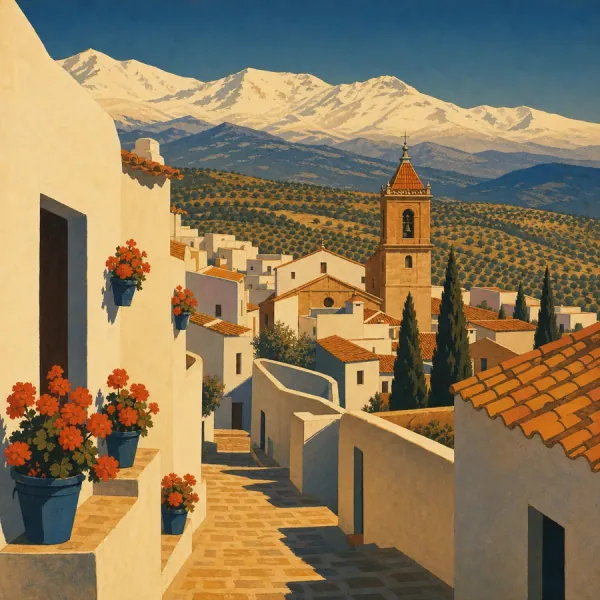
Contrary to the beach image many foreigners have of it, Spain is a very mountainous country. Its heart is the Meseta, a huge central plateau split in two by the Central System range, on which Madrid stands. It is ringed by mountain ranges: the Cantabrian Mountains, the Iberian System, the Sierra Morena and the Baetic ranges, where Mulhacén, in the Sierra Nevada, rises to 3,479 meters, the highest peak on the peninsula. The country's highest point, however, is in the Canary Islands: Teide, an active volcano on the island of Tenerife, about 3,715 meters high. The great rivers, the Tagus, the Ebro, the Douro, the Guadiana and the Guadalquivir, water plains that are often narrow, the largest being that of the Guadalquivir, in Andalusia.
🌵 From green Atlantic coasts to the Almería desert
Three main climate zones divide the country. A Mediterranean climate, with hot, dry summers, covers most of the territory, with cold winters in the interior of the Meseta. The southeast, around Murcia and Almería, is semi-arid, even desert-like. The north, from Galicia to the Basque Country, by contrast, has a mild, rainy oceanic climate, hence its nickname “Green Spain.” The Canary Islands enjoy almost tropical mildness all year round. Spain is one of the European countries hardest hit by climate change: heat waves and droughts are becoming more frequent and more severe.
🏙️ A thinly populated interior
With about 98 inhabitants per km², Spain is less densely populated than most Western European countries, and its population is very unevenly spread. Apart from the region of Madrid, the capital and largest city, in the center, high densities are concentrated on the coasts: Barcelona, Valencia, Seville, Málaga, Bilbao. Vast areas of the interior emptied out in the 20th century as people moved to the cities: according to the World Bank, about 80% of Spaniards live in urban areas (2025).
🕌 From Roman Hispania to Al-Andalus
Excavations at the Atapuerca site, near Burgos, show that the peninsula was inhabited by archaic humans about 1.3 million years ago. Neanderthals survived there until about 40,000 years before the present, among the last in Europe. In the Altamira cave, in Cantabria, Homo sapiens painted bison and other animals between about 35,600 and 13,500 BC (see the chapter “Lascaux Cave” for cave art).
⛵ Iberians, Celts, Phoenicians and Greeks
Before Rome, the peninsula was home to Iberians on the Mediterranean coast, Celts in the interior and the northwest, Lusitanians in the west and Tartessians in the southwest. Sailors from the eastern Mediterranean founded trading posts there: the Phoenicians established Gadir, today's Cádiz, considered one of the oldest cities in Western Europe, and the Greeks founded Emporion around 570 BC. Carthage, a city of Phoenician origin, then conquered much of the peninsula in the 3rd century BC.
🏛️ Six centuries of Roman Hispania
During the Second Punic War, from about 210 BC, Rome drove out the Carthaginians, then took nearly two centuries to conquer the whole peninsula, which it called Hispania, the origin of the name Spain. Deeply Romanized, Hispania exported gold, wool, olive oil and wine; it gave Rome the emperors Trajan, Hadrian and Theodosius and the philosopher Seneca. Most of the country's present-day languages, Christianity and the foundations of its law date from this period. After 409, Germanic peoples, the Suebi, Vandals and Alans, invaded the peninsula, which the Visigoths eventually united in a Christian kingdom centered on Toledo.
🌙 Al-Andalus, a center of civilization
From 711 to 718, Muslim armies from North Africa, serving the Umayyad Caliphate, crossed the Strait of Gibraltar and conquered almost the entire peninsula. Muslim Spain, called Al-Andalus, later became independent from the rest of the Islamic world. Around Córdoba, its capital, it formed one of the great intellectual and economic centers of the medieval world: Muslim, Jewish and Christian philosophers, physicians, poets and translators passed part of ancient learning on to Europe there. By the end of the 10th century, the majority of the population was probably Muslim. The chapter “The Islamic Golden Age” places this civilization in its wider context.
⚔️ The Reconquista
In the north, small Christian kingdoms, Asturias-León, Navarre, Aragon and Castile, held out and then slowly pushed the frontier south: this was the Reconquista, which lasted nearly eight centuries. In the 11th century, the Caliphate of Córdoba broke up into small rival kingdoms, the taifas; Castile's capture of Toledo in 1085 tipped the balance of power. Córdoba fell in 1236 and its Great Mosque was turned into a cathedral; Seville fell in 1248. In 1188, in León, an assembly bringing together bishops, nobles and elected representatives of the towns foreshadowed modern parliaments.
👑 1492, a turning point
The marriage of Isabella of Castile and Ferdinand of Aragon in 1469 united the two main Christian crowns: it is often seen as the birth of modern Spain, even though each kingdom kept its own laws. In 1492, the “Catholic Monarchs” took Granada, the last Muslim kingdom on the peninsula. That same year, they forced Jews to convert or leave: up to 200,000 of them were expelled. And also in 1492, Christopher Columbus, financed by Isabella, reached the Caribbean.
The rest of the course
This page publishes the first 2 parts. The full course has 9: here is what the next ones cover.
- 🌎 The first global empire and its decline
Spain from 1492 to 1898: the conquest of the Americas, the Habsburgs, the Golden Age, the expulsion of the Moriscos, decline, the Bourbons, the war against Napoleon, the loss of the colonies.
- 🕊️ Republic, civil war and Francoism
Spain from 1898 to 1975: social tensions and regional nationalisms, the Second Republic, the civil war, Franco's dictatorship, isolation and then the economic miracle.
- 🗣️ A plural society: languages, beliefs, immigration
Spanish society: population, birth rate and aging, immigration, Castilian and the co-official languages, religions, freedoms and schools.
- 💃 From the Golden Age to Gaudí: a far-reaching culture
Spanish culture: heritage, Islamic and modernista architecture, painting from Velázquez to Picasso, literature from Cervantes to Lorca, music and flamenco, cinema, food, festivals and sport.
- 🚄 An economy that caught up with Europe
The Spanish economy: global rank, recent growth, tourism, cars, renewable energy, large companies, high-speed rail, unemployment and inequality.
- 👑 A parliamentary monarchy and the State of Autonomies
The democratic transition and the Spanish political system: the 1978 Constitution, the king, the Cortes, the government, the autonomous communities, the Catalan question, recent politics and freedom indexes.
- 🌍 Between Europe, the Americas and the Maghreb: today's challenges
Spain in the world and its challenges: the European Union, NATO, Latin America, Gibraltar, Morocco, Ceuta and Melilla, Palestine, housing and tourism, climate, the 2025 blackout and demographics.
Study “Spain” with flashcards and quizzes
In Oria, you read the full course, then practice on it: flashcards, multiple-choice quizzes, open questions or the Feynman method. Cards and questions then come back in your daily review, paced by spaced repetition.
Study this topic in OriaSources
These notes draw on the sources below. If a point seems doubtful, refer back to them.