Geography & countries
Ethiopia: Summary and Study Notes
The ancient highland empire that became a demographic giant
Study this topic in OriaThe essentials
Ethiopia is a landlocked country of high plateaus in the Horn of Africa, home to more than 130 million people and over 80 ethnic groups. A cradle of humankind and one of the oldest Christian states, it resisted European colonization and today hosts the headquarters of the African Union. You'll discover its geography, its history from Lucy to the recent wars, its peoples and culture, a fast-growing economy in one of the world's poorest countries, its ethnic federalism, its place in the region and its challenges.
Key dates and facts
- c. 3.2 million years ago
- Lucy lives in today's Afar region
- c. 980 BC
- Kingdom of D'mt
- c. 330
- King Ezana converts to Christianity
- 1270
- Start of the Solomonic dynasty
- 1636
- Gondar becomes the capital
- 1896
- Victory over Italy at Adwa
- 1930
- Coronation of Haile Selassie
- 1936 – 1941
- Italian occupation
- 1963
- Founding of the OAU in Addis Ababa
- 1974
- Fall of the empire
⛰️ A water tower on the roof of Africa
Ethiopia, officially the Federal Democratic Republic of Ethiopia, lies in the Horn of Africa, on the eastern side of the continent. It is bordered by Eritrea to the north, Djibouti and Somalia to the east, Kenya to the south, and South Sudan and Sudan to the west. Covering about 1.1 million km², it is a large country, but it has had no access to the sea since Eritrea's independence in 1993: it is the most populous landlocked country in the world. Its capital, Addis Ababa, is its largest city.
🏔️ Highlands split by the Rift
Most of the country is made up of the Ethiopian Highlands, the largest continuous mountain area in Africa, cut by deep canyons. The Great Rift Valley runs through them from southwest to northeast: here the African and Somali plates are slowly pulling apart, which explains the still-active volcanoes, such as Erta Ale, and the hot springs. The contrasts are extreme: the summit of Ras Dashen, in the Simien Mountains, rises to 4,550 m, while the Danakil Depression, in the Afar region, drops to about 120 m below sea level. Dallol, in this depression, holds the record for the highest average annual temperature of any inhabited place on Earth, about 34°C. The country also has the largest cave in Africa, Sof Omar.
🌦️ Eternal spring at altitude
Although it is close to the equator, most of the country has a temperate climate thanks to its altitude. Most of the major cities, such as Gondar, Aksum and Addis Ababa, sit between 2,000 and 2,500 m. In the capital, at about 2,400 m, the average temperature is 16°C all year round; the seasons are defined by rain: a dry season from October to February, the short rains from March to May, and the long rains from June to September. The lowlands of the east and southeast, by contrast, are hot and arid. The country is highly exposed to climate change, which is shifting rainfall patterns and making droughts more frequent.
💧 The water tower of East Africa
Fourteen major rivers flow down from the highlands, and Ethiopia has the largest water reserves in Africa. Lake Tana, in the north, is the source of the Blue Nile, called the Abay in Ethiopia. Through the Blue Nile, the Sobat and the Atbara, the country supplies about 80% of the Nile's water, which makes it a central player in the tensions over the river.
🐒 Unique and threatened wildlife
The isolation of the mountains has favored species found nowhere else: the gelada, a monkey of the high grasslands, the walia ibex and the Ethiopian wolf. More than 850 bird species have been recorded there. Ethiopia is also one of the great centers of origin of cultivated plants, such as coffee, teff and enset, a false banana. But forest, which covered about 35% of the land in the early 20th century, now covers only about 12%, because of firewood collection, farming and overgrazing.
🦴 From the cradle of humankind to the Christian kingdoms
Ethiopia is one of the most important places for understanding human origins, and one of the oldest states in the world.
🦴 Lucy and the first Homo sapiens
In 1974, in the Awash Valley (Afar region), a team led by Donald Johanson discovered Lucy, known as Dinkinesh in Ethiopia: a skeleton of Australopithecus afarensis about 3.2 million years old, one of the most complete ever found. Older still, Ardipithecus ramidus (“Ardi”) dates back 4.2 million years. In the Omo Valley, in the south, researchers unearthed some of the oldest known remains of Homo sapiens, dated to about 200,000 years ago.
👑 D'mt and Aksum
Around 980 BC, the kingdom of D'mt extended over present-day Eritrea and northern Ethiopia. In the 1st century AD, the kingdom of Aksum emerged in today's Tigray region. A great trading power between India and the Roman Empire, it exported ivory, gold and emeralds; in the 3rd century, the Persian prophet Mani counted it among the four great powers of the world, alongside Rome, Persia and China. Its kings erected immense monolithic stelae. Around 330, King Ezana converted to Christianity under the influence of Frumentius, a Christian from Tyre: Ethiopia became one of the very first Christian states, the second after Armenia. In 615, the ruler of Aksum took in Muslims persecuted in Mecca during the first Hijra, so Islam was present in the region very early on.
⛪ Lalibela and the Solomonic dynasty
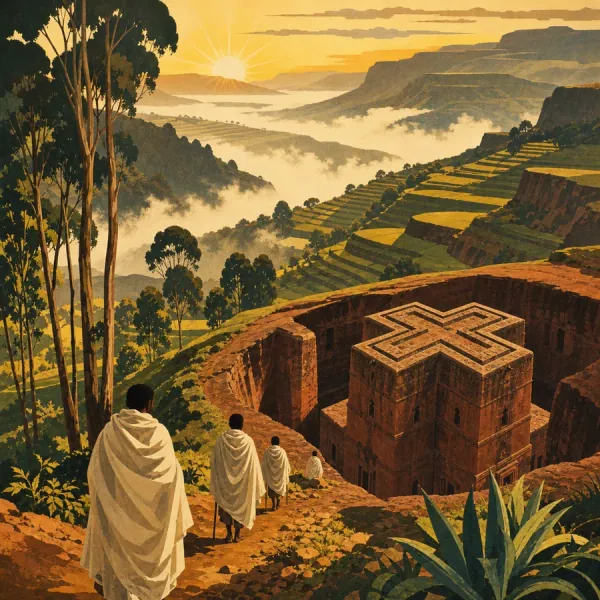
After Aksum declined, around the 10th century, the Zagwe dynasty dominated the north-central highlands. It is credited with the churches of Lalibela, carved from single blocks of rock and conceived as a “new Jerusalem”; they have been a UNESCO World Heritage Site since 1978. In 1270, Yekuno Amlak overthrew the Zagwe and founded the Solomonic dynasty, which claimed descent from King Solomon and the Queen of Sheba through their legendary son Menelik I. The empire expanded at the expense of neighboring Muslim sultanates, then was nearly conquered in a long war against the Adal Sultanate, which ended only in 1543 with the victory of Wayna Daga. In the 16th century, Oromo migrations reshaped the country's human map.
🏰 Gondar and the “Era of the Princes”
Under the influence of Jesuit missionaries, Emperor Susenyos made Catholicism the state religion in 1622, which sparked revolts. Emperor Fasilides restored the Orthodox Church and in 1636 moved the capital to Gondar, where he built the fortress of Fasil Ghebbi. From 1769 to 1855, during the Zemene Mesafint (“Era of the Princes”), the emperors were mere figureheads, and real power lay with the regional lords.
The rest of the course
This page publishes the first 2 parts. The full course has 9: here is what the next ones cover.
- 🛡️ Adwa, the Italian occupation and Haile Selassie
Ethiopia from 1855 to 1974: reunification under Tewodros II, the expansion of Menelik II, the victory over Italy at Adwa, the reign of Haile Selassie, the Italian occupation, liberation and the fall of the empire.
- ⚔️ From the Derg to the wars of the 21st century
Ethiopia since 1974: the Derg's Marxist dictatorship, the Red Terror and famine, the EPRDF regime, Eritrea's independence, the rise of Abiy Ahmed, the Tigray War and recent conflicts up to 2026.
- 🗣️ More than 80 peoples, one singular culture
Ethiopia's population and culture: population growth, peoples, languages and the Ge'ez script, religions, the calendar, festivals, food, the coffee ceremony, music and distance running.
- ☕ Coffee, dams and planes: rapid growth
Ethiopia's economy: very fast growth but high poverty, agriculture and coffee, light industry, Ethiopian Airlines, hydropower and the Grand Renaissance Dam, the reform of the birr and the IMF program.
- 🏛️ Ethnic federalism under strain
Ethiopia's political system: the 1995 Constitution, federalism based on peoples, Parliament, Prime Minister Abiy Ahmed and the Prosperity Party, the 2021 and 2026 elections, and what freedom indexes say.
- 🌍 Addis Ababa, Africa's diplomatic capital
Ethiopia in the world: headquarters of the African Union, BRICS, relations with China and the United States, the quest for access to the sea, and relations with Eritrea, Somalia, Kenya, Egypt and Sudan.
- ⏳ The challenges: peace, bread and jobs
Ethiopia's major challenges today: conflict and displacement, hunger and droughts, climate change and deforestation, population growth, youth employment, electricity and the cost of living.
Study “Ethiopia” with flashcards and quizzes
In Oria, you read the full course, then practice on it: flashcards, multiple-choice quizzes, open questions or the Feynman method. Cards and questions then come back in your daily review, paced by spaced repetition.
Study this topic in OriaSources
These notes draw on the sources below. If a point seems doubtful, refer back to them.