Planet & nature
The Arctic and Its Sea Ice: Summary and Study Notes
A frozen sea, age-old peoples, the polar bear, and a region melting faster than the rest of the world
Study this topic in OriaThe essentials
The Arctic is not a continent but an ocean surrounded by land, covered by sea ice that forms and breaks up with the seasons. You'll discover how sea ice forms, how the polar bear and other animals depend on it, and how the Inuit, the Sámi and the other peoples of the Far North built their cultures, then lived through colonization and assimilation. Next you'll measure the melt with NSIDC data, before exploring the new shipping routes and the geopolitics of a region contested by the countries that border it.
Key dates and facts
- 1979
- Continuous satellite record begins
- 2007
- Minimum drops by more than a million km²
- 2012
- Record minimum: 3.39 million km²
- 2025
- Lowest winter maximum: 14.33 million km²
🧭 Where does the Arctic begin?
The word Arctic comes from the Greek arktos, “bear,” a reference to the constellations of the Great Bear and the Little Bear, which shine near the celestial North Pole. Antarctica, in the south, is literally “the opposite of the Arctic.” But where Antarctica is an ice-covered continent surrounded by ocean, the Arctic is exactly the reverse: an ocean surrounded by land.
📏 Three ways to draw the boundary
- The Arctic Circle, at about 66° 34' north latitude: beyond it, the sun does not set on at least one summer day (the midnight sun) and does not rise on at least one winter day (the polar night).
- The 10 °C isotherm, a definition favored by ecologists: the region where the average temperature of the warmest month, July, stays below 10 °C (50 °F).
- The tree line, which roughly follows this isotherm: to the north of it, no trees grow. This is where the tundra begins, a carpet of dwarf shrubs, grasses, mosses and lichens lying on permafrost, ground that is permanently frozen.
Eight countries have land in the Arctic: Canada, the United States (with Alaska), the Kingdom of Denmark (with Greenland), Iceland, Norway, Sweden, Finland and Russia. About four million people live on Arctic lands.
🌊 The smallest of the oceans
At the center lies the Arctic Ocean, the smallest, shallowest and coldest of the five oceans, covering about 14 million km² (5.4 million square miles). It connects to the Pacific through the narrow Bering Strait and to the Atlantic notably through the Fram Strait, between Greenland and Svalbard. An underwater mountain range, the Lomonosov Ridge, splits it into two deep basins about 4,000 meters deep. Fed by abundant fresh water from rivers, it is on average the least salty of the oceans.
❄️ An extreme climate
The Arctic climate combines very cold winters with cool summers. Average winter temperatures can drop to −40 °C, and the record low is close to −68 °C. Precipitation is low, often less than 50 cm (20 inches) a year, mostly as snow, which the wind often whips up so much that it seems to be falling continuously. On the coasts, the ocean moderates the climate; inland, it is colder and drier.
🧊 Sea ice, a sea that freezes
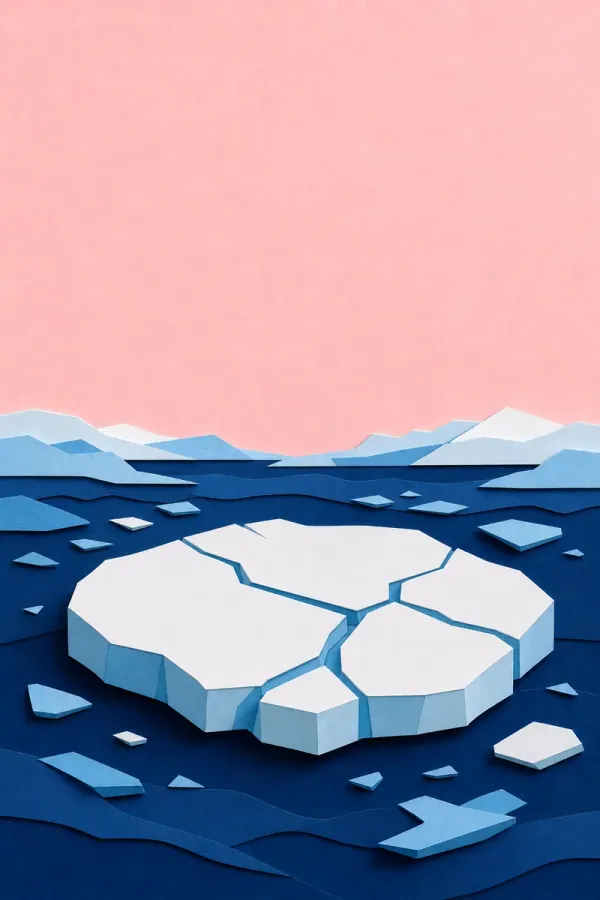
Sea ice is the ice that forms on the surface of the sea when the water freezes. It should not be confused with icebergs, chunks of freshwater glaciers that have fallen into the sea, or with the Greenland ice sheet, a huge glacier sitting on solid ground.
🔬 From ice “soup” to slab
Salty seawater doesn't freeze at 0 °C but at around −1.8 °C (29 °F). The first crystals, like tiny flakes, form a kind of soup called frazil. If the sea is calm, it thickens into a flexible crust, nilas. If it is rough, the crystals clump into rounded plates with raised edges, pancake ice. Once the surface is frozen, the ice insulates the ocean from the cold air and slowly thickens from below. As seawater freezes, it expels most of its salt: the remaining water, saltier and denser, sinks into the depths, which drives the great ocean circulation.
First-year ice forms during the winter and generally reaches 1.5 to 2 meters. Ice that survives one or more summers becomes multiyear ice: thicker, 3 to 4 meters, with pressure ridges up to 20 meters thick. Pushed by winds and currents, it drifts across the ocean for years.
🔄 An annual heartbeat
Arctic sea ice breathes with the seasons. It reaches its maximum in March, at the end of winter, then melts through spring and summer down to its minimum, around mid-September. In summer, its area is only about half its winter area.
🪞 The planet's mirror
Sea ice plays a major role in the climate. Its bright surface reflects about 60% of sunlight back into space, and up to 80% when it is covered with snow, compared with about 10% for the dark ocean. This is the albedo effect. When the ice melts, open water absorbs more heat, which melts even more ice: a loop that amplifies warming. Sea ice also insulates the relatively warm ocean from the frigid air.
One common misconception needs correcting: melting sea ice barely raises sea level at all. Like an ice cube in a glass, floating ice already takes up the space of the water it will become. It is glaciers and ice sheets sitting on land, like Greenland's, that raise the oceans when they melt.
🧭 Exploring the pole on the ice
The Norwegian Fridtjof Nansen was the first to cross the Arctic Ocean by ship, letting his vessel, the Fram, drift locked in the ice from 1893 to 1896. The American submarine Nautilus passed under the North Pole in 1958, and the Soviet nuclear icebreaker Arktika was the first ship to reach it on the surface, in 1977. Between 1937 and 1991, 88 Soviet and international crews lived on stations set up on drifting ice, carried thousands of kilometers.
The rest of the course
This page publishes the first 2 parts. The full course has 8: here is what the next ones cover.
- 🐻❄️ The polar bear and life on the ice
The polar bear (anatomy, seal hunting, swimming, numbers, IUCN status, the 1973 agreement, threats from the melt) and the Arctic's other animals, on land and at sea.
- 🛶 The Inuit, people of the ice
The Inuit: Thule origins, techniques adapted to the cold (kayak, igloo, sleds, inuksuk), colonization and forced settlement in the 20th century, then a political revival leading to the creation of Nunavut in 1999 and self-rule in Greenland.
- 🦌 The Sámi and the other peoples of the Far North
The Sámi of Lapland (Sápmi): a homeland spanning four countries, reindeer herding, assimilation policies, the fight for their rights and Sámi parliaments; then the Arctic's other Indigenous peoples and their place on the Arctic Council.
- 📉 The melt, by the NSIDC numbers
Satellite measurement of sea ice since 1979 and what the NSIDC says about it: the 2012 and 2025 records, the September trend, younger and thinner ice, Arctic amplification, and projections of an ice-free Arctic summer.
- 🚢 The shipping routes of the Far North
The two Arctic routes between the Atlantic and the Pacific: the Northwest Passage (Franklin, Amundsen, the Manhattan) and the Northern Sea Route along Russia (Nordenskiöld, nuclear icebreakers), their advantages, their limits and their risks.
- 🌐 Who owns the Arctic?
The rules of the law of the sea in the Arctic, the claims to the seabed around the North Pole (Russia, Denmark, Canada, Norway), disputes over shipping passages, the Svalbard Treaty, the Arctic Council and strategic competition.
Study “The Arctic and Its Sea Ice” with flashcards and quizzes
In Oria, you read the full course, then practice on it: flashcards, multiple-choice quizzes, open questions or the Feynman method. Cards and questions then come back in your daily review, paced by spaced repetition.
Study this topic in OriaSources
These notes draw on the sources below. If a point seems doubtful, refer back to them.