Arts
The Beatles: Summary and Study Notes
Four lads from Liverpool who changed popular music
Study this topic in OriaThe essentials
John Lennon, Paul McCartney, George Harrison and Ringo Starr started out in the clubs of Liverpool and Hamburg before setting off a worldwide frenzy, Beatlemania. You'll follow their rise, from The Ed Sullivan Show to the Paris Olympia, then their transformation into studio artists with Revolver and Sgt. Pepper. You'll understand how they recorded, why they stopped touring, how the band tore itself apart, and what the world still owes them today.
Key dates and facts
- 1957
- Lennon meets McCartney
- 1958
- Harrison joins the group
- 1960
- The Beatles name and Hamburg
- 1962
- Ringo Starr on drums
- Feb. 11, 1963
- Please Please Me recorded in a day
- Oct. 13, 1963
- The word Beatlemania is born
- Jan. 16, 1964
- Olympia concerts begin
- Feb. 9, 1964
- The Ed Sullivan Show, 73 million viewers
- Apr. 4, 1964
- The top five places in the U.S. chart
- Jan. 30, 1969
- The rooftop concert
🎸 From Liverpool to Hamburg
The Beatles were a British rock band formed in Liverpool, a major port in northwest England. Their classic lineup brought together John Lennon, Paul McCartney, George Harrison and Ringo Starr. They are regarded as the most influential band in the history of popular music. It all began with teenagers learning songs by ear.
🏠 Four Liverpool childhoods
John Lennon was raised by his Aunt Mimi; his mother Julia, who taught him the banjo, was killed by a car on July 15, 1958. Paul McCartney had lost his mother, Mary, to cancer on October 31, 1956; his father, a cotton salesman, had led an amateur jazz band. George Harrison was the youngest of a bus driver's four children. The future Ringo Starr, Richard Starkey, an only child who was often ill, left school at fifteen with a passion for drumming.
🎶 The Quarrymen
A popular style of music in 1950s Britain, played on simple, sometimes homemade instruments, mixing folk, blues and jazz.
Toward the end of 1956 or in early 1957, depending on the source, sixteen-year-old Lennon formed a skiffle group with classmates from his school, Quarry Bank High School: the Quarrymen. On July 6, 1957, at the garden fête of St Peter's Church in Woolton, a mutual friend introduced him to fifteen-year-old Paul McCartney, who played Eddie Cochran's Twenty Flight Rock for him. Paul joined the group. In early 1958, McCartney brought in his friend George Harrison, whom Lennon at first thought too young; Harrison finally won him over by playing the instrumental Raunchy on the top deck of a Liverpool bus.
In January 1960, Stuart Sutcliffe, Lennon's friend from Liverpool art college, bought a bass guitar with the money from a painting he had sold and joined the band. He suggested “Beatals,” as a tribute to Buddy Holly's Crickets. After “Silver Beetles” and then “Silver Beatles,” the name was settled in mid-August 1960: The Beatles, a blend of beat (the rhythm) and beetle (the insect).
🌃 The Hamburg nights
Their unofficial agent, Allan Williams, got them a booking in Hamburg, West Germany. The drummer Pete Best was hastily recruited in mid-August 1960, and the band arrived a few days later in the red-light district of the Reeperbahn, in St. Pauli. The Beatles made five stays there between 1960 and 1962, in clubs such as the Indra, the Kaiserkeller, the Top Ten Club and the Star-Club. They played for hours every night, broadened their repertoire and learned how to hold a room. The first stay ended badly: Harrison, underage, was deported, then McCartney and Best, accused of trying to set fire to their lodgings.
“I might have been born in Liverpool, but I grew up in Hamburg.”
John Lennon
In Hamburg, they befriended the photographer Astrid Kirchherr, who took the first photos of the band and became Sutcliffe's girlfriend. It was under her influence and that of her student friends that their famous haircut was born, with bangs combed forward, far from the greased-back quiffs of the rockers. In June 1961, they backed the singer Tony Sheridan on the single My Bonnie. Sutcliffe left the band in 1961 to return to painting in Germany, and McCartney switched to bass. Sutcliffe died of a brain hemorrhage on April 10, 1962, at twenty-one.
🎙️ Epstein, Martin and Ringo: a professional band
Back from Hamburg, the Beatles had become real stage animals. On December 27, 1960, at Litherland Town Hall, near Liverpool, the dance floor emptied as soon as they started playing: the crowd surged toward the stage to watch them. But they remained unknown outside their home region, Merseyside.
🕳️ The Cavern Club and Brian Epstein
The Cavern Club was a basement club in Liverpool where the band played nearly 300 times until August 1963. On November 9, 1961, Brian Epstein, who ran the record department of his family's NEMS store, came to hear them after customers had asked him for My Bonnie. He later recalled: “I immediately liked what I heard. They were fresh, and they were honest, and they had what I thought was a sort of presence.” With no experience as a manager, he signed them on January 24, 1962.
Epstein changed their image. No more leather: he had them wear suits and bow to the audience at the end of shows, and banned eating, smoking and swearing on stage. He canvassed the London record companies. On January 1, 1962, the very nervous band recorded fifteen songs at an audition for Decca. The answer was no; according to Epstein's account, he was told that “guitar groups are on the way out.” Dick Rowe, who preferred to sign another group, went down in history as “the man who turned down the Beatles.”
🎚️ George Martin and EMI
Thanks to the audition tapes, Epstein got a meeting with George Martin, head of A&R at the Parlophone label, a subsidiary of EMI. On May 9, 1962, he cabled the band, then in Hamburg, that a deal had been struck. On June 6, 1962, the Beatles entered the EMI studios at 3 Abbey Road, London, for the first time. When Martin asked them whether there was anything they didn't like, Harrison replied that he didn't like his tie: the joke broke the ice.
🥁 Pete Best replaced by Ringo Starr
Martin felt that the drummer Pete Best didn't keep time well enough and wanted a session musician for the recordings. The other three, who had already been thinking about it, replaced him in mid-August 1962 with Ringo Starr, drummer of another Liverpool band, Rory Storm and the Hurricanes, whom they had known in Hamburg. The abrupt sacking of Best, very popular with some of the fans, caused an uproar.
💿 Love Me Do
The first single, Love Me Do, came out on October 5, 1962, and reached No. 17 on the British chart. At one session, Martin used a session drummer, Andy White, and Ringo had to make do with the tambourine. Martin then advised speeding up Please Please Me, until then played slowly. At the end of November, after recording the new version, he reportedly told them they had just made their first number one. He was right: the song topped nearly every British chart in early 1963.
The rest of the course
This page publishes the first 2 parts. The full course has 9: here is what the next ones cover.
- 📣 Beatlemania
The explosion of 1963–1964: the first album recorded in a day, the birth of the word Beatlemania, the stint at the Paris Olympia, The Ed Sullivan Show, the British Invasion, and the refusal to play segregated concerts.
- 🏟️ Global fame and the end of touring
The years of world tours from 1964 to 1966: meeting Bob Dylan, the MBE, Yesterday, the Shea Stadium concert, the crises of 1966 (Japan, the Philippines, “more popular than Jesus”), and the last concert in San Francisco.
- 🎛️ The studio as an instrument
How the Beatles wrote and recorded: the Lennon–McCartney partnership, their influences, the role of George Martin and the engineers, and the studio techniques they invented or popularized (loops, reversed tapes, new instruments).
- 🌈 Sgt. Pepper and the summer of 1967
The year 1967: Strawberry Fields Forever and Penny Lane, the album Sgt. Pepper's Lonely Hearts Club Band and its cover, the dawn of the album era, All You Need Is Love broadcast worldwide, then Brian Epstein's death and the failure of Magical Mystery Tour.
- 💔 From India to the breakup
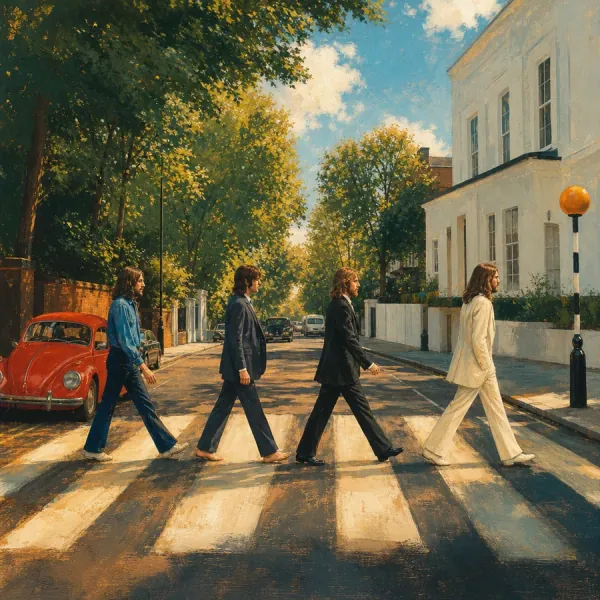
The band's final years: the stay in Rishikesh, the founding of Apple Corps, the “White Album,” the Get Back project and the rooftop concert, Abbey Road and its cover, then the 1970 breakup and its long legal process.
- 🕊️ After the Beatles
The solo careers, John Lennon's murder in 1980, George Harrison's death in 2001, the Anthology project, the compilation 1, remastering and streaming, then Get Back and the “last song,” Now and Then, in 2023.
- 🌍 A global legacy
What the Beatles changed: sales records, the model of the band that writes its own songs, the album and music-video era, fashion and youth culture, and memorial sites from Liverpool to Mazatlán.
Study “The Beatles” with flashcards and quizzes
In Oria, you read the full course, then practice on it: flashcards, multiple-choice quizzes, open questions or the Feynman method. Cards and questions then come back in your daily review, paced by spaced repetition.
Study this topic in OriaSources
These notes draw on the sources below. If a point seems doubtful, refer back to them.