History
The building of Europe: Summary and Study Notes
From the ECSC to a Union of 27: seventy years to unite a continent
Study this topic in OriaThe essentials
After two world wars, six countries decided in 1950 to pool their coal and steel production to make war “materially impossible.” From that grew the Common Market, then the European Union, the euro, and a Europe of 27. You'll discover the major milestones (Schuman, Rome, the Single European Act, Maastricht), the enlargements, the role of each institution, the crises from 2005 to 2020, and the debates that still divide Europeans today.
Key dates and facts
- 9 May 1950
- Schuman Declaration
- 18 April 1951
- Treaty of Paris, birth of the ECSC
- 30 August 1954
- France rejects the EDC
- 7 June 1979
- First direct election of the European Parliament
- 14 June 1985
- Schengen Agreement
- 1 July 1987
- Single European Act enters into force
- 7 February 1992
- Signing of the Maastricht Treaty
- 20 September 1992
- French referendum: yes at 51.05%
- 1 January 1999
- Birth of the euro
- 1 January 2002
- Euro coins and banknotes
💡 The idea of Europe, from the Enlightenment to the postwar years
The building of Europe refers to the process by which European states chose, starting in 1950, to pool part of their powers. But the idea of uniting the continent is far older.
📜 An old dream of peace
In 1713, in the aftermath of a long European war, the abbé de Saint-Pierre imagined a union of European states to do away with war. In 1795, in his Perpetual Peace, the philosopher Immanuel Kant proposed a “federation of free states.” In the 19th century, Victor Hugo repeatedly called for the creation of the “United States of Europe,” which he saw as the only real guarantee of peace on the continent.
After the First World War, the French minister Aristide Briand presented a plan for a “European federal union” before the League of Nations in September 1929. During the Second World War, resistance fighters took up the idea again: the Italian Altiero Spinelli founded the European Federalist Movement in Milan in 1943.
🕊️ After 1945: “Let Europe arise!”
In 1945, Europe lay in ruins. The human and material toll of two world wars had convinced many leaders that countries had to be bound together to make another conflict impossible. The early Cold War also played a part: facing the Soviet bloc, the United States backed the economic unification of Western Europe and guaranteed its defense.
In September 1946, at the University of Zurich, former British Prime Minister Winston Churchill issued a resounding appeal.
“We must build a kind of United States of Europe. […] The first practical step is to form a Council of Europe. And in all this urgent work, France and Germany must take the lead together.”
Winston Churchill, Zurich speech (September 1946)
From 7 to 10 May 1948, the Hague Congress brought together 800 delegates from eighteen countries who favored European unity. It led to the creation, on 5 May 1949, of the Council of Europe, an organization devoted to human rights and democracy. But this was only cooperation between governments: the most committed Europeans wanted to go further.
🔥 The Schuman Declaration and the ECSC
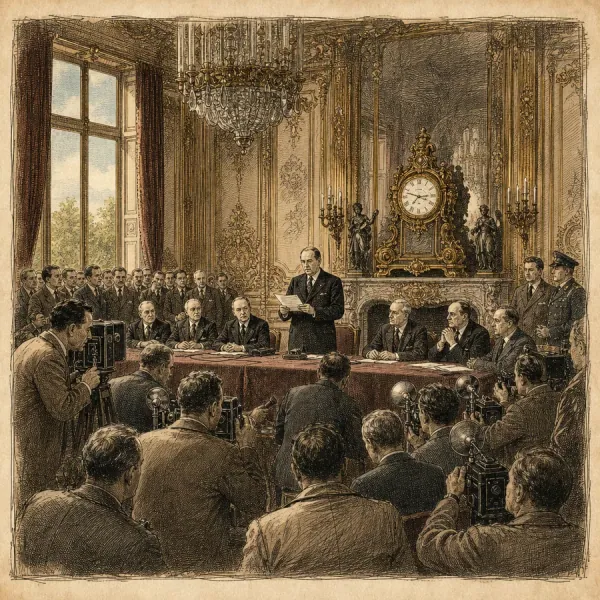
The building of Europe truly begins on 9 May 1950. That day, in the Clock Room of the French Foreign Ministry in Paris, French minister Robert Schuman read out a declaration now seen as the founding text of the European Union.
⚙️ Coal and steel, so war becomes unthinkable
The context was tense: West Germany, which had just adopted a constitution in 1949, was rebuilding fast, and France feared the return of a rival. The text had been drafted by Jean Monnet, commissioner-general for economic planning. It proposed placing all Franco-German production of coal and steel — the basic materials of industry and weapons — under a common authority, open to other European countries.
“Europe will not be made all at once, or according to a single plan. It will be built through concrete achievements which first create a de facto solidarity.”
Robert Schuman, declaration of 9 May 1950 (translated)
The goal was to make any war between France and Germany “not merely unthinkable, but materially impossible.” The economy became a tool in service of a political cause: laying the first concrete foundations of a European federation and a lasting peace. In 1985, 9 May became Europe Day.
🏭 The ECSC, the first European community
Six countries answered the call: France, West Germany, Italy, Belgium, the Netherlands, and Luxembourg, from then on known as “the Six.” The Treaty of Paris, signed on 18 April 1951, created the European Coal and Steel Community (ECSC). It entered into force on 23 July 1952 for fifty years, and abolished customs duties on these goods between the Six. Production was placed under a High Authority independent of national governments, first chaired by Jean Monnet.
Sitting above the level of individual states: a supranational institution makes decisions that are binding on member countries, even those that disagreed. This is the opposite of simple cooperation between governments.
🪖 The failure of a European army
In June 1950, the Korean War broke out, and the United States pushed for the rearmament of West Germany. To keep it under control, France proposed a European army in October 1950: the European Defence Community (EDC), whose treaty was signed in May 1952. But in France, the debate turned bitter. On 30 August 1954, the National Assembly rejected the treaty by 319 votes to 264. Political and military Europe was shelved for a long time; European integration would move forward through economics instead.
The rest of the course
This page publishes the first 2 parts. The full course has 9: here is what the next ones cover.
- 🖋️ The Treaty of Rome and the Common Market
The Messina relaunch (1955), the Treaties of Rome of 25 March 1957 creating the EEC and Euratom, the customs union, the CAP, and the de Gaulle years: a Europe of nations, British vetoes, and the empty-chair crisis.
- 🗺️ From six to twenty-eight: the enlargements
The waves of accession from 1973 to 2013: the United Kingdom, Ireland, and Denmark, enlargement to the south, the neutral countries in 1995, the great eastward enlargement of 2004–2007, and Croatia.
- 🔓 The Single European Act and the single market
The 1979–1992 relaunch: the European Monetary System, the first direct election of the European Parliament, the Schengen agreements, Jacques Delors, and the 1986 Single European Act that paved the way for the single market.
- 💶 Maastricht and the birth of the euro
The Maastricht Treaty (1992), which created the European Union, European citizenship, and economic and monetary union, the French referendum, the convergence criteria, and the arrival of the euro (1999–2002).
- 🏛️ Who decides? The institutions explained simply
The role of the Commission, the European Parliament, the Council of the European Union, the European Council, and the Court of Justice, and how a European law gets adopted.
- ⚡ A time of crises
The Union's crises from 2005 to 2020: the rejection of the European Constitution in France and the Netherlands, the Treaty of Lisbon, the eurozone debt crisis, and Brexit.
- 🧭 Europe today: challenges and debates
The Union's challenges since 2020 (the pandemic and shared debt, the war in Ukraine, defense, competitiveness, new candidate countries) and the big debates: federalism versus a Europe of nations, the democratic deficit, unanimity.
Study “The building of Europe” with flashcards and quizzes
In Oria, you read the full course, then practice on it: flashcards, multiple-choice quizzes, open questions or the Feynman method. Cards and questions then come back in your daily review, paced by spaced repetition.
Study this topic in OriaSources
These notes draw on the sources below. If a point seems doubtful, refer back to them.