History
Elizabeth II: Biography and Study Notes
Seventy years on the throne, from Empire to Commonwealth
Study this topic in OriaThe essentials
Nothing destined little Lilibet for the throne until her uncle abdicated in 1936. Queen from 1952, Elizabeth II reigned for more than seventy years, from the early days of television to the age of social media, while the British Empire turned into the Commonwealth. You'll discover her life, the real role of a constitutional monarch, her great journeys, her crises, from the annus horribilis to the death of Diana, and the debates her legacy stirs in the United Kingdom and in the former colonies.
Key dates and facts
- 1926
- Born in London
- 1930
- Birth of her sister Margaret
- 1936
- Abdication of Edward VIII
- 1939
- A decisive meeting with Philip
- 1940
- First radio broadcast
- 1945
- Joins the ATS
- 1947
- 21st-birthday vow and wedding
- 1948
- Birth of Prince Charles
- 1966
- Aberfan disaster
- 1992
- Annus horribilis and the Windsor fire
👑 Lilibet, a princess who was not meant to reign
Elizabeth Alexandra Mary was born on April 21, 1926, at 2:40 a.m., by Caesarean section, at her maternal grandfather's London home, 17 Bruton Street, in Mayfair. She was the first child of Prince Albert, Duke of York, the second son of King George V, and his wife Elizabeth, the daughter of a Scottish aristocrat. She was named after her mother, her great-grandmother Alexandra, who had died five months earlier, and her grandmother Mary. Her family called her “Lilibet,” after the way she pronounced her own name.
🧸 A sheltered childhood
Her only sister, Margaret, was born in 1930. The two girls were educated at home by their governess, Marion Crawford, who taught them history, languages, literature and music. Crawford described an orderly, very responsible child who loved horses and dogs. Winston Churchill described her at two as “a character. She has an air of authority and reflectiveness astonishing in an infant.” But no one then imagined she would reign: she was only third in line to the throne, behind her uncle Edward, Prince of Wales, and her father. Edward was young, and it was expected that he would have children who would come before her.
💔 1936, the year of three kings
In 1936, George V died and his eldest son became king as Edward VIII. But his plan to marry Wallis Simpson, a divorced American, triggered a constitutional crisis, resolved at the end of the year by Edward's abdication. Elizabeth's father became king as George VI, and the ten-year-old girl became heir presumptive to the throne.
A person in line to inherit the throne whose place can still be lost to a better-placed heir. At the time, boys came before girls: had George VI had a son, the boy would have become heir in Elizabeth's place.
Her education then changed in nature. The Vice-Provost of Eton College, Henry Marten, gave her private lessons in constitutional history, and native-speaking governesses taught her French. So that she could mix with girls her own age, a Girl Guides company was even created especially at Buckingham Palace.
🎖️ The war, the vow and the wedding
When Britain went to war against Nazi Germany in September 1939, it was suggested that thirteen-year-old Princess Elizabeth and her sister be sent to Canada, safe from the bombing. Their mother refused: the children would not leave without her, she would not leave without the King, and the King would never leave. The princesses spent most of the war at Windsor Castle, near London.
📻 First steps in public
In 1940, at fourteen, Elizabeth made her first radio broadcast, on a BBC program for children evacuated from the cities. In February 1945 she joined the Auxiliary Territorial Service (ATS), the women's branch of the British Army, where she learned to drive and repair vehicles. On May 8, 1945, VE Day, the two princesses mingled incognito with the jubilant crowds in the streets of London; she would recall in 1985 that they were “terrified of being recognised.”
🤝 The vow of 1947
In 1947 she accompanied her parents on their first major tour of southern Africa. On her 21st birthday, in a radio address to the whole Commonwealth, she made a commitment she would recall for the rest of her life.
“I declare before you all that my whole life, whether it be long or short, shall be devoted to your service and the service of our great imperial family to which we all belong.”
Princess Elizabeth, 21st-birthday broadcast (April 21, 1947)
💍 Philip
Elizabeth had met her distant cousin, Prince Philip of Greece and Denmark, in 1934 and again in 1937. In July 1939, during a visit to the Royal Naval College at Dartmouth, the thirteen-year-old fell in love with the eighteen-year-old; they then wrote to each other regularly. Their engagement, announced on July 9, 1947, was not universally welcomed: Philip had no fortune, he was foreign-born, and his sisters had married German aristocrats with Nazi ties. Before the wedding, he renounced his Greek and Danish titles and took his mother's British surname, Mountbatten; he was made Duke of Edinburgh.
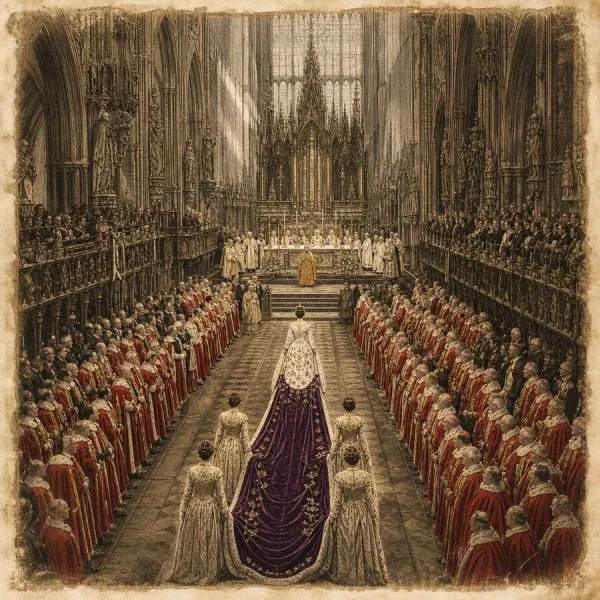
The wedding was held on November 20, 1947, at Westminster Abbey. The country, still scarred by the war, was living under rationing: the princess had to use ration coupons to buy the material for her gown. Their first child, Charles, was born in November 1948, followed by Anne in August 1950. Between 1949 and 1951, the couple lived on and off in Malta, where Philip was serving as a Royal Navy officer.
The rest of the course
This page publishes the first 2 parts. The full course has 9: here is what the next ones cover.
- 📺 1952 – 1953: a 25-year-old queen and a televised coronation
News of George VI's death reaching her in Kenya on February 6, 1952, the choice of her regnal name and of the House of Windsor, and the coronation of June 2, 1953, the first to be televised.
- ⚖️ Reigning without ruling: the job of a constitutional monarch
What a constitutional monarch like Elizabeth II actually does: political neutrality, appointing prime ministers, audiences, royal assent, and the rare moments when her role was debated (1957, 1963, 1974, Australia 1975, Scotland 2014).
- 🌍 From Empire to Commonwealth
The transformation of the British Empire into the Commonwealth during her reign: the great tour of 1953–1954, the decolonization of Africa and the Caribbean, Rhodesia, colonial memory, and countries that became republics, such as Mauritius and Barbados.
- 🔥 The stormy years: from the annus horribilis to the death of Diana
The criticism and ordeals of the reign: Aberfan (1966), blank shots (1981), an intruder in the palace (1982), the tabloids, the annus horribilis of 1992, income tax, then the crisis of confidence after Diana's death in 1997.
- 🤝 A diplomat of reconciliation
Elizabeth II's historic state visits: Germany (1965), Yugoslavia (1972), China (1986), the U.S. Congress (1991), Russia (1994), India and Amritsar (1997), Ireland (2011), and the 2012 Olympic Games.
- 🕰️ The final years and death at Balmoral
The jubilees, the longevity records, the pandemic address of 2020, Philip's death in 2021, the Platinum Jubilee, then the Queen's death at Balmoral on September 8, 2022, and her state funeral.
- 🌐 A global icon and a debated legacy
Elizabeth II's public image and how it evolved, her popularity, her passions (horses, corgis), her portrayals on screen, and the debates over her legacy: the monarchy, the Empire and the future of the Commonwealth.
Study “Elizabeth II” with flashcards and quizzes
In Oria, you read the full course, then practice on it: flashcards, multiple-choice quizzes, open questions or the Feynman method. Cards and questions then come back in your daily review, paced by spaced repetition.
Study this topic in OriaSources
These notes draw on the sources below. If a point seems doubtful, refer back to them.