Law & society
The Nuremberg Trials: Summary and Study Notes
When the Nazi leaders had to answer for their crimes before a court
Study this topic in OriaThe essentials
In the fall of 1945, in a German city in ruins, the United States, the United Kingdom, the Soviet Union and France put on trial the leading surviving figures of the Third Reich. For the first time, heads of state and government had to answer personally for crimes against peace, war crimes and crimes against humanity. You will discover why the Allies chose a trial rather than summary executions, who the defendants were, how ten months of hearings unfolded, what verdicts were handed down, and why this trial, criticized as “victors' justice,” nonetheless laid the foundations of international criminal law.
Key dates and facts
- January 1942
- St James's Declaration
- Nov. 1, 1943
- Moscow Declaration
- May 2, 1945
- Truman announces an international tribunal
- May 8, 1945
- Germany surrenders
- Nov. 20, 1945
- The trial opens
- Nov. 29, 1945
- The camp film is screened
- Jan. 17, 1946
- The French prosecution begins
- Feb. 8, 1946
- The Soviet prosecution begins
- Sept. 30, 1946
- Reading of the judgment begins
- Oct. 1, 1946
- Sentences announced
⚖️ Trial rather than firing squad: the Allies' decision
The Nuremberg trial was the first major international trial of leaders accused of mass crimes. It took place from November 1945 to October 1946 in a defeated Germany. Before getting there, the Allies hesitated for a long time over how to punish those responsible for Nazi crimes.
🌍 The scale of the crimes
Between 1939 and 1945, Nazi Germany invaded Poland, Denmark, Norway, the Netherlands, Belgium, Luxembourg, France, Yugoslavia, Greece and the Soviet Union. The occupations came with extreme brutality: the Soviet Union alone counted about 27 million dead, most of them civilians. Above all, the regime organized the systematic extermination of millions of Jews, known today as the Holocaust (the “Holocaust” chapter is devoted to it). According to the legal historian Kirsten Sellars, the extermination camps would form the moral heart of the prosecution's case.
📣 The first warnings
In January 1942, nine governments in exile in London, together with the British government, announced in the St James's Declaration that they would bring the leaders of the Reich to justice. On November 1, 1943, the Soviet Union, the United Kingdom and the United States signed the Moscow Declaration: the major Nazi criminals would be tried jointly by the Allies, the others in the countries where they had committed their crimes. The signatories promised to pursue them “to the uttermost ends of the earth” so that justice would be done.
🤔 Trial or executions?
The Allies were divided, though. The British government preferred the summary execution of the top leaders: it remembered the failure of the trials after World War I and doubted that people could be punished for acts that were not crimes when they were committed. The Soviet Union wanted a trial with a verdict decided in advance, on the model of the Moscow show trials of the 1930s; its jurist Aron Trainin coined the notion of “crimes against peace,” meaning the waging of a war of aggression. The United States, for its part, wanted a trial that would look legitimate in the eyes of the world, to demonstrate the superiority of the rule of law and help transform Germany.
The Yalta Conference, in February 1945, did not settle the matter. On May 2, 1945, US President Harry Truman announced the creation of an international military tribunal. Six days later, on May 8, Germany surrendered unconditionally. Adolf Hitler, Heinrich Himmler and Joseph Goebbels had killed themselves: they would never stand trial.
📜 The London Agreement: inventing a court
From June 26 to August 2, 1945, American, British, Soviet and French jurists met in London to invent a court that had never existed. Until the end of the negotiations, it was not even certain that a trial would take place. On August 8, 1945, the four powers signed the London Agreement, with the Charter of the International Military Tribunal annexed to it.
🧾 Four counts
- Conspiracy: taking part in a common plan to commit the other crimes. This notion, drawn from Anglo-American law, made it possible to prosecute leaders who had never killed anyone themselves.
- Crimes against peace: planning, starting or waging a war of aggression. This was a major innovation: war, until then considered a prerogative of sovereign states, became a crime.
- War crimes: violations of the laws and customs of war, such as the murder of prisoners or civilians, the execution of hostages or looting. This notion already existed.
- Crimes against humanity: a partly new notion, which made it possible to try crimes committed by a state against its own citizens, such as German Jews.
The Charter defines them as “murder, extermination, enslavement, deportation, and other inhumane acts committed against any civilian population, before or during the war; or persecutions on political, racial or religious grounds.” An important restriction was added: these crimes had to be connected to the war of aggression or to the other crimes being tried. According to historians, neither the Americans nor the Soviets wanted an international court to be able to judge how a state treats its citizens in peacetime, for fear that the precedent might be turned against racial segregation in the United States or against Soviet purges and deportations.
🚫 No immunity, no “following orders”
The Charter overturned the tradition of international law, which recognized only states: from now on, individuals were responsible. Its Article 7 stated that a defendant's official position, even as head of state, did not free him from responsibility. Article 8 specified that having obeyed a superior's orders did not erase responsibility, although it could justify a lighter sentence. Article 16 guaranteed the defendants a fair trial and free choice of counsel.
🏛️ Why Nuremberg?
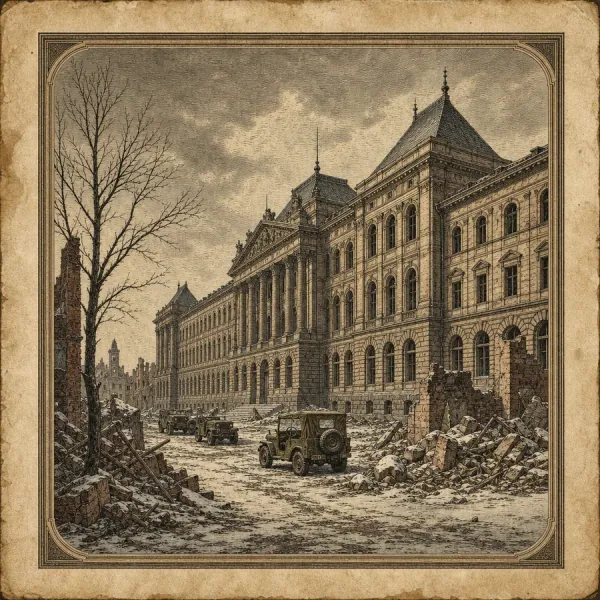
The tribunal's official seat was set in Berlin, where it held its opening session on October 18, 1945, to receive the indictment. But the trial itself would take place in Nuremberg, in the American occupation zone. The city had been largely destroyed by bombing, but its Palace of Justice had held up relatively well, and it was connected by a tunnel to a large prison. The place also carried strong symbolic weight: Nuremberg was where the Nazi Party held its great rallies and where the antisemitic laws of 1935 had been proclaimed.
The rest of the course
This page publishes the first 2 parts. The full course has 8: here is what the next ones cover.
- 👥 The judges, the prosecutors and the defendants
Who judged, who prosecuted and who sat in the dock: the four Allied delegations, the twenty-four men indicted and the six organizations.
- 🎧 Ten months of hearings
How the trial unfolded from November 1945 to August 1946: the opening, simultaneous interpretation, the evidence and the cases of the four delegations.
- 🛡️ The defense: Göring, Hess, Speer and “tu quoque”
The strategies of the defendants and their lawyers, from March to August 1946: blaming Hitler, the “you did it too” argument and the revelation of the Nazi-Soviet Pact.
- 🔨 The verdict of September 30 and October 1, 1946
The judgment: the war of aggression branded the supreme international crime, twelve death sentences, seven prison terms, three acquittals and four organizations declared criminal.
- 🏛️ After the main trial: twelve more trials
The twelve American Nuremberg trials (doctors, judges, industrialists, Einsatzgruppen), the Nuremberg Code, the German reaction and the early releases.
- 🧭 A contested but foundational legacy
The criticisms leveled at the trial (victors' justice, retroactivity, Allied crimes ignored) and its legacy: the Nuremberg principles, the Genocide Convention, international tribunals and the ICC.
Study “The Nuremberg Trials” with flashcards and quizzes
In Oria, you read the full course, then practice on it: flashcards, multiple-choice quizzes, open questions or the Feynman method. Cards and questions then come back in your daily review, paced by spaced repetition.
Study this topic in OriaSources
These notes draw on the sources below. If a point seems doubtful, refer back to them.