Great discoveries & mysteries
The Pyramids of Giza: Summary and Study Notes
How were the stone giants built?
Study this topic in OriaThe essentials
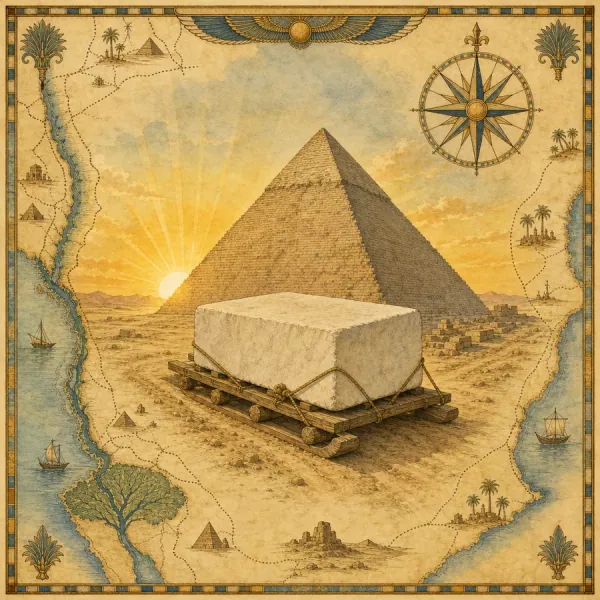
The three pyramids of Giza, raised about 4,500 years ago for the pharaohs Khufu, Khafre and Menkaure, are the only one of the Seven Wonders of the Ancient World still standing. You will discover why they were built, how the stones were quarried and transported, what the logbook of the inspector Merer, the oldest known inscribed papyrus, reveals, and who their builders really were. You will also see what we still don't know, from the ramps to hidden cavities, and why the theories of aliens or Atlantis don't stand up to the evidence.
Key dates and facts
- c. 2600 BC
- Construction of Khufu's Great Pyramid
- c. 2520 – 2494 BC
- Reign of Khafre, builder of the second pyramid and probably of the Sphinx
- c. 2490 – 2472 BC
- Reign of Menkaure, builder of the third pyramid
- 1979
- Inscribed on the UNESCO World Heritage List
- c. 2560 BC
- Merer keeps his diary, at the end of Khufu's reign
- 2011
- French excavations begin at Wadi al-Jarf
- 2013
- The papyri are discovered
- 1837
- The relieving chambers and graffiti naming Khufu are opened
- 2015
- Launch of the ScanPyramids project
- 2017
- Announcement of the large cavity above the Grand Gallery
🔺 Three pyramids, a sphinx and a plateau
The pyramids of Giza stand on a limestone plateau at the edge of the Western Desert, on the west bank of the Nile, about 13 kilometers (8 miles) southwest of central Cairo, Egypt's capital. They were built under the 4th Dynasty of Egypt's Old Kingdom, between about 2600 and 2500 BC, for three kings of the same family: Khufu (known to the Greeks as Cheops), his son Khafre (Chephren) and his grandson Menkaure (Mycerinus). For the broader picture of this civilization, its gods and its pharaohs, see the “Egypt of the Pharaohs” chapter.
📏 Extraordinary dimensions
The Great Pyramid, Khufu's, was built around 2600 BC in about twenty years (between 20 and 27 years, depending on the estimate). It originally stood 146.6 meters (481 feet) tall, or 280 Egyptian royal cubits, on a square base about 230 meters (755 feet) on each side. Today it stands only 138.5 meters (454 feet) tall, because its casing of polished white limestone has almost entirely disappeared. It remained the tallest human-made structure in the world for more than 3,700 years. Its volume is about 2.6 million cubic meters.
- The Pyramid of Khafre, slightly smaller (143.5 meters originally, 136.4 today), nonetheless looks taller, because it stands on higher ground and has a steeper slope. It still has part of its casing at the top.
- The Pyramid of Menkaure, much more modest (about 65 meters originally, 61 today), had its sixteen lowest courses clad in red granite from Aswan.
🦁 Much more than three pyramids
Each pyramid was the heart of a funerary complex: a valley temple at the water's edge, linked by a long causeway to a mortuary temple set against the pyramid. Around them are small so-called “queens'” pyramids, cemeteries of rectangular tombs (mastabas) for the royal family and senior officials, and pits cut into the rock for boats. One of them, found intact at the foot of the Great Pyramid, the Khufu ship, was restored and moved to the Grand Egyptian Museum. To the east lies the Great Sphinx, a reclining lion with a human head carved out of the bedrock; most Egyptologists believe its face is Khafre's.
🌍 The last of the Seven Wonders
In the Hellenistic era, the Greek writer Antipater of Sidon included the Great Pyramid in his list of the Seven Wonders of the World. It is by far the oldest of these wonders, and the only one that still exists. Since 1979 the site has been part of UNESCO World Heritage, along with the other pyramid fields of the region of Memphis, the ancient capital, such as Saqqara and Dahshur.
🌅 Why pyramids? Tombs for eternity
The pyramids are royal tombs. The Great Pyramid still contains Khufu's granite sarcophagus, in the so-called “King's Chamber.” For the Egyptians, death on earth was the start of a journey to the other world. Part of the king's soul, the ka, remained tied to his body: so it had to be protected and nourished with offerings, and the dead king had to be able to join the gods. The pyramid's shape is often linked to the rays of the sun and to the god Ra, whom the pharaoh was to join on his journey across the sky.
“Make your tomb well furnished and prepare your place in the West. […] The house of the dead is made for life.”
Instruction of Hordjedef, son of Khufu (translated)
🪜 From a pile of bricks to the perfect pyramid
The pyramids of Giza did not appear all at once: they were the culmination of more than a century of experiments. Egypt's first kings were buried under mastabas, rectangular flat-roofed structures of mud brick. Under the reign of Djoser (c. 2687 – 2667 BC), the architect Imhotep stacked several ever-smaller stone mastabas for his king at Saqqara: this was the first pyramid, a step pyramid. Under Sneferu, Khufu's father, the builders felt their way forward: at Dahshur, the “Bent” Pyramid changes angle halfway up, as if a slope that was too steep had been corrected, before the “Red” Pyramid finally achieved the perfect smooth shape. Khufu inherited this know-how.
🔎 How do we know it is Khufu's tomb?
Greek writers such as Herodotus already attributed the Great Pyramid to Khufu, but other builders were proposed for a long time. Decisive evidence appeared in 1837: when four small relieving chambers above the King's Chamber, inaccessible until then, were opened, they turned out to contain red-paint inscriptions left by the workers. Construction gangs marked blocks with their names, and these names contained the king's, for example “the gang: the White Crown of Khnum-Khufu is powerful.” Khufu's name appears more than a dozen times. Similar inscriptions exist in the quarries and ports worked during his reign. The nearby cemeteries hold his mother, his wives, his children and his senior officials.
🕳️ Tombs emptied very early
The Great Pyramid's inner chambers bear no decoration or religious text: at that time, texts were not yet inscribed in pyramids, a practice that appeared more than two centuries later. The pyramid was probably looted as early as the First Intermediate Period, a few centuries after it was built. Unlike Tutankhamun's tomb, found almost intact in the Valley of the Kings (see the “Tutankhamun” chapter), no treasure was discovered there by modern archaeologists.
The rest of the course
This page publishes the first 2 parts. The full course has 8: here is what the next ones cover.
- ⛏️ From quarry to building site: stones, tools and boats
The materials of the Great Pyramid (2.3 million blocks, local limestone, Tura limestone, Aswan granite), arsenical copper tools, transport on sledges and the ancient branch of the Nile that let stones be brought in by boat.
- 📜 The Diary of Merer, an eyewitness
The 2013 discovery, at the ancient port of Wadi al-Jarf on the Red Sea, of the papyri of the inspector Merer, the oldest known inscribed papyrus, which tells of transporting limestone blocks from Tura to the Great Pyramid under Khufu.
- 👷 Who built the pyramids? Workers, not slaves
The myth of slaves inherited from Greek writers, the 1990 discovery of the workers' tombs, the builders' village excavated by Mark Lehner, workforce estimates and the organization into gangs, phyles and divisions.
- 🛤️ The great debate: how were the blocks raised?
The hypotheses for hoisting blocks to the top: a straight ramp, zigzag or spiral ramps, Jean-Pierre Houdin's internal ramp, the levers described by Herodotus, the staircase ramp found at Hatnub in 2018, and the monument's remarkable precision.
- 🕳️ What we still don't know
The questions still open: the large cavity found in 2017 using muons by the ScanPyramids project, the hidden corridor explored in 2023, the shafts of the Queen's Chamber, the gaps in radiocarbon dating and the fate of the casing.
- 👽 Aliens, Atlantis, Orion: the rejected theories
Alternative explanations of the pyramids, from Joseph's granaries to 19th-century “pyramidology,” from Erich von Däniken's aliens to the Orion correlation and the “rain-eroded” Sphinx, and the precise reasons scientists reject them.
Study “The Pyramids of Giza” with flashcards and quizzes
In Oria, you read the full course, then practice on it: flashcards, multiple-choice quizzes, open questions or the Feynman method. Cards and questions then come back in your daily review, paced by spaced repetition.
Study this topic in OriaSources
These notes draw on the sources below. If a point seems doubtful, refer back to them.