Great discoveries & mysteries
Atlantis: Summary and Study Notes
The sunken island invented by Plato, which the world has been searching for for two thousand years
Study this topic in OriaThe essentials
Atlantis appears only in two of Plato's dialogues, the Timaeus and the Critias, written around 360 BC. You'll discover exactly what the philosopher tells us, why the vast majority of specialists see it as a political fable, and which real disasters, like the eruption of Santorini, may have inspired it. You'll also see why people keep searching for it, from the Atlantic to the Sahara, and why geology and archaeology reject the theories of a lost continent.
Key dates and facts
- 6th century BC
- Solon's trip to Egypt, according to Plato
- c. 360 BC
- The Timaeus and Critias are written
- 348 BC
- Death of Plato
- c. 1600 BC
- Eruption of Thera (Santorini)
- 415 – 413 BC
- Disaster of the Athenian expedition to Sicily
- 373 BC
- Helike swallowed up by an earthquake and a tsunami
- 1967
- Marinatos begins excavating Akrotiri
- 1627
- Francis Bacon's New Atlantis
- 1679
- Olof Rudbeck places Atlantis in Sweden
- 1882
- Ignatius Donnelly publishes Atlantis: The Antediluvian World
🌊 Plato's story in the Timaeus
Everything begins, and almost everything ends, with a single author. The only sources on Atlantis are two dialogues by the Athenian philosopher Plato (c. 428 – 348 BC), the Timaeus and the Critias, written around 360 BC. All other ancient mentions depend on them. That is the first fact to keep in mind in this investigation. Explorer's “Plato” title presents the philosopher's life and thought.
🗣️ A story passed on by word of mouth
The Timaeus takes the form of a conversation between Socrates and three guests: the philosopher Timaeus of Locri, the statesman Hermocrates, and Critias, an Athenian related to Plato. Only Critias talks about Atlantis. The day before, Socrates described an ideal city, the one in the Republic, and wonders whether it could be seen in action. Critias then offers a “true” story.
He supposedly got it from his grandfather, to whom Dropides, his great-grandfather, had passed it on after receiving it from the wise lawgiver Solon. During a trip to Egypt in the 6th century BC, Solon is said to have heard the story from a priest of the temple at Sais. The Egyptians, the priest explains, preserve in writing the memory of great deeds of ancient Athens.
🏝️ An island beyond the Pillars of Heracles
According to this story, 9,000 years before Solon's time, a power from the Atlantic Ocean threatened the whole Mediterranean. Its seat was an island lying in front of the strait the Greeks called the Pillars of Heracles, which for Greeks of Plato's time meant today's Strait of Gibraltar. This island was “larger than Libya and Asia put together”; Libya then meant North Africa, and Asia meant present-day Asia Minor and the Near East. Its kings ruled the island, other islands and part of a continent beyond, and, within the Mediterranean, Libya as far as Egypt and Europe as far as Italy.
When this power tries to enslave the peoples of the Mediterranean, Athens takes the lead of the Greeks. Abandoned by its allies, it fights alone, wins and frees the subjugated peoples. Then comes the catastrophe.
“But afterwards there occurred violent earthquakes and floods; and in a single day and night of misfortune all your warlike men in a body sank into the earth, and the island of Atlantis in like manner disappeared in the depths of the sea.”
Plato, Timaeus (c. 360 BC, translated by Benjamin Jowett)
The priest adds that the sea in that place has remained impassable, because of the muddy shoals the island left behind as it sank. The island's very name, Atlantis in Greek, means “the island of Atlas.”
One detail of the text has struck specialists: Critias says he noticed with astonishment how, “by some mysterious coincidence,” Solon's story matched on almost every point the ideal city Socrates had described the day before. For many of them, this wink gives away the invention.
🏛️ Poseidon's city as described in the Critias
The Critias, the sequel to the Timaeus, goes into detail. When the gods divide up the Earth, the island falls to Poseidon, god of the sea. He takes as his partner a mortal woman of the island, Cleito, who bears him five pairs of twins. The eldest, Atlas, becomes king of the whole island and gives his name to the island and to the ocean around it, the Atlantic. His twin receives the tip of the island facing the Pillars of Heracles, the land of Gadeira, the region of present-day Cádiz. The ten brothers and their descendants each rule a kingdom.
⭕ A capital of rings
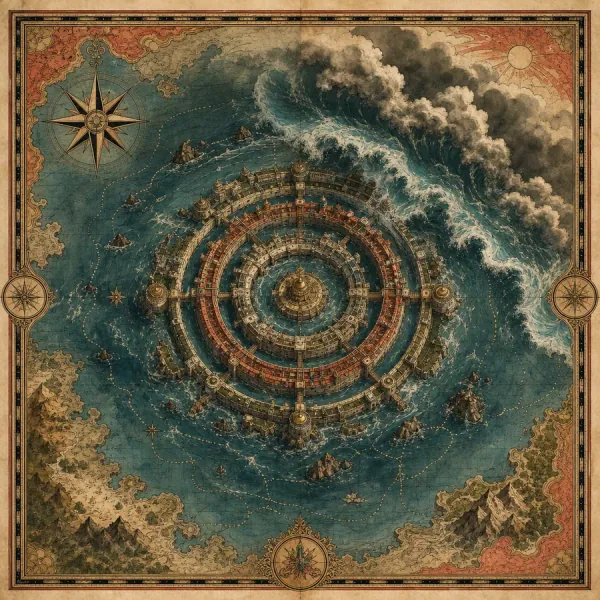
Around the hill where Cleito lives, Poseidon digs three rings of water separated by two rings of land, perfectly circular. The Atlanteans add bridges, a great canal to the sea and tunnels allowing ships to reach the center. The walls, made of red, white and black stone quarried on the spot, are coated with bronze, tin and a mysterious metal, orichalcum. At the center stand the palace and the temple of Poseidon.
“… that which is now only a name and was then something more than a name, orichalcum, was dug out of the earth in many parts of the island, being more precious in those days than anything except gold.”
Plato, Critias (c. 360 BC, translated by Benjamin Jowett)
🌾 An island too good to be true
The island overflows with everything: forests, metals, domestic and wild animals, even elephants. To the south, an immense rectangular plain, 3,000 stades by 2,000 (about 555 km by 370), is crisscrossed by irrigation canals that allow two harvests a year. Plato specifies the military organization and the number of chariots and ships each district must provide. The ten kings meet regularly, and their religion, centered on Poseidon, involves the sacrifice of a bull, captured and then slaughtered on a pillar-shaped altar.
A unit of length in ancient Greece, about 185 meters. The dimensions Plato gives make the plain of Atlantis a region the size of a large country.
⚡ Decline and the wrath of Zeus
As long as the divine part inherited from Poseidon prevails in them, the Atlanteans remain wise and virtuous. But as they mix with mortals, this part weakens. They become greedy for wealth and power. It is then that “Zeus, the god of gods, who rules according to law,” decides to punish them to make them wiser, and gathers all the gods in his dwelling.
And the text stops there, in the middle of a sentence. The end of the Critias has not come down to us. To understand this story, you need to keep three things in mind: it is extremely precise about measurements and institutions, it is set in an unverifiable past 9,000 years earlier, and it is centered on a moral lesson, the fall of a people corrupted by excess.
The rest of the course
This page publishes the first 2 parts. The full course has 8: here is what the next ones cover.
- 📚 A philosophical fable: the specialists' consensus
Why philologists and historians of antiquity consider Atlantis a fiction by Plato: the role of the story in the Timaeus, the contrast between Athens and a maritime empire, the clues left in the text, and the analyses of Vidal-Naquet, Brisson and Julia Annas.
- 📜 What the ancients thought
Ancient reactions to Plato's story: a skeptical Aristotle, Crantor and the disputed testimony of Proclus, a cautious Strabo and Posidonius, Theopompus's parody, then the Christian authors and the relative neglect of the Middle Ages.
- 🌋 Real disasters behind the myth?
The serious hypotheses about what may have inspired Plato: the eruption of Santorini around 1600 BC and the Minoan hypothesis with its objections, the city of Helike swallowed up in 373 BC, Syracuse, the Sicilian Expedition and a submerged island near Gibraltar.
- 🗺️ Why people are still looking for it
How, from the Renaissance to the 20th century, Atlantis became an obsession: America, Rudbeck's Sweden, Ignatius Donnelly, the esotericists Blavatsky and Cayce, and ideological hijackings, up to Nazism.
- ❌ The theories science rejects, and why
The main locations proposed for Atlantis (an Atlantic continent, the Azores, Bimini, the Richat Structure, Doñana, Google Earth images) and the geological and archaeological reasons they are ruled out.
- 🎭 A myth that never dies
The legacy of Atlantis in literature, music and popular culture around the world, the other sunken lands of myth, the conferences that keep searching for it, and the lesson of the investigation.
Study “Atlantis” with flashcards and quizzes
In Oria, you read the full course, then practice on it: flashcards, multiple-choice quizzes, open questions or the Feynman method. Cards and questions then come back in your daily review, paced by spaced repetition.
Study this topic in OriaSources
These notes draw on the sources below. If a point seems doubtful, refer back to them.