Great discoveries & mysteries
The Rosetta Stone: Summary and Study Notes
The investigation that gave hieroglyphs back their voice
Study this topic in OriaThe essentials
In July 1799, French soldiers in a fort in the Nile Delta uncovered a stone slab covered in three scripts: hieroglyphs, Demotic and Greek. You will follow the investigation that led from this stone to the decipherment announced by Jean-François Champollion in 1822, with its false leads, its rivalries between English and French scholars, and what is still debated today. You will also see why the stone is in London and why Egyptian voices are calling for its return.
Key dates and facts
- 1798
- The French army lands in Egypt
- July 1799
- The stone is discovered at Fort Julien
- July 19, 1799
- Report read at the Institut d'Égypte
- 1800
- First copies printed from the stone
- August 30, 1801
- French surrender at Alexandria
- February 1802
- The stone arrives in Portsmouth
- March 11, 1802
- Presented to the Society of Antiquaries of London
- June 1802
- Put on display at the British Museum
- September 14, 1822
- He reads the names of Ramesses and Thutmose
- September 27, 1822
- The Letter to M. Dacier is read at the Académie
🪨 A stone slab in the walls of a fort
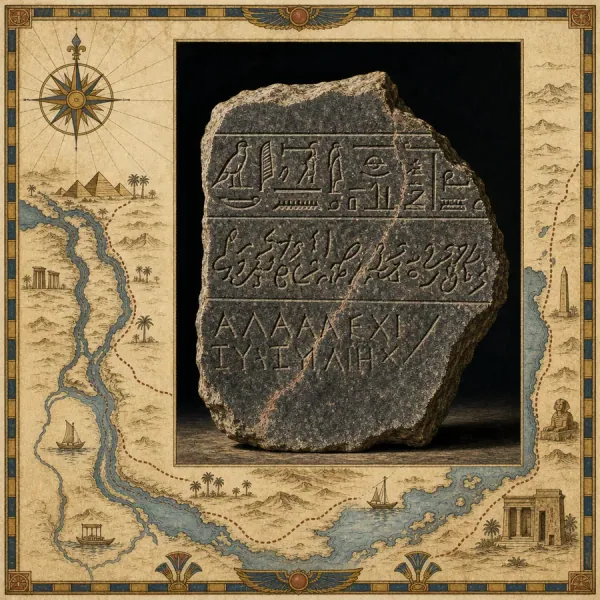
In 1798, the French army led by Napoleon Bonaparte invaded Egypt, then a province of the Ottoman Empire. It came with a corps of 151 scholars, engineers and artists, the Commission of Sciences and Arts, tasked with studying the country. In mid-July 1799, soldiers were strengthening the defenses of Fort Julien, a few miles northeast of the port of Rosetta, today Rashid, in the Nile Delta. While knocking down an old wall, they uncovered a dark slab covered in inscriptions.
🔎 Lieutenant Bouchard understands at once
The officer Pierre-François Bouchard and his colonel, d'Hautpoul, sensed that it was an important object and alerted General Menou, who was in Rosetta. A report by the scholar Michel Ange Lancret was read at the Institut d'Égypte, the learned society Bonaparte had founded in Cairo, on July 19, 1799. It noted three inscriptions, the first in hieroglyphs, the last in Greek, and rightly suggested that they were three versions of the same text. This was the starting hypothesis of the whole investigation.
The stone is a fragment of a stele made of granodiorite, a rock similar to granite, from a quarry in the Aswan region. It is about 112 cm (44 in) tall, 76 cm (30 in) wide and 28 cm (11 in) thick, and weighs about 760 kg (1,680 lb). Its front is polished, its back only roughly worked: it was made to be seen from one side. For a long time it was thought to be black basalt, because in London it had been coated with carnauba wax and white chalk had been rubbed into the signs to make them legible. The 1999 cleaning revealed its true color, a sparkling dark gray crossed by a pink vein.
“This piece is of great interest for the study of hieroglyphic characters; perhaps it will even provide the key to them at last.”
Anonymous journalist, Courrier de l'Égypte (September 1799) (translated)
🖨️ The stone becomes a printing plate
Taken to Cairo, the stone was studied by the scholars. In 1800, three of them devised ways of copying it. The printer and linguist Jean-Joseph Marcel recognized that the middle script, first taken for Syriac, was cursive Egyptian, what would come to be called Demotic. The artist and inventor Nicolas-Jacques Conté had the idea of inking the stone itself and using it as a printing plate. The prints were sent to Paris: for the first time, Europe's scholars could study the text without seeing the original.
One detail sums up the object's story: the stone was not in its original place. It had been reused as building material in a fort put up in the 15th century by the Mamluk sultan Qaitbay. Before becoming a modern puzzle, it had already lived several lives.
📜 What the stone says: a decree from 196 BC
The text carved on the Rosetta Stone is no esoteric secret. It is an administrative and religious decree, adopted by an assembly of priests gathered at Memphis, the ancient capital of Egypt. It is dated March 27, 196 BC, the ninth year of the reign of Ptolemy V Epiphanes.
👑 A teenage king in a troubled kingdom
Since Alexander the Great's conquest, Egypt had been ruled by a dynasty of Greek origin, the Ptolemies, based in Alexandria. Ptolemy V became king at five, after the sudden death of his parents. His reign began in turmoil: rival regents, territory lost to the Seleucids in Syria, and a major revolt in southern Egypt, around Thebes. He was only crowned at Memphis at twelve. A little over a year later, the priests adopted the decree.
The text lists the king's good deeds: gifts of money and grain to the temples, works to hold back an especially high Nile flood. In return, the priests pledged to celebrate his birthday and coronation day every year, and to worship him in every temple. This kind of stele, in which the temples honor the king rather than the other way around, is unique to Ptolemaic Egypt: it was a practice borrowed from Greek cities. For a Greek-speaking regime, securing the support of the powerful priests of Memphis was essential.
The decree orders a copy to be set up in every temple, written in the “language of the gods” (hieroglyphs), the “language of documents” (Demotic, the cursive script of everyday Egyptian) and the “language of the Greeks,” that of the administration. So there are two languages, Egyptian and Greek, and three scripts.
🧩 A fragment of a larger stele
None of the three texts is complete. Only the last 14 lines of the hieroglyphs survive, all damaged; the Demotic has 32 lines and is the best preserved; the Greek has 54, with the end broken off. By comparing it with other decrees of the same kind, such as the Canopus decree (238 BC), specialists estimate that 14 or 15 lines of hieroglyphs are missing and that the complete stele, with a rounded top, stood about 1.49 m (4 ft 11 in) tall. It was probably topped by a scene showing the king before the gods.
The stele probably did not come from Rosetta but from a temple farther inland in the Delta, perhaps at Sais. The temple was probably closed around 392, when the Roman emperor Theodosius I ordered non-Christian sanctuaries shut; its stones were later used as a quarry. Other fragmentary copies of the same decree are known today, found after 1799, which shows that the order to spread it was indeed carried out.
One point is still debated: which of the three versions is the original? The philologist Letronne thought in 1841 that it was the Greek; other researchers believe all three were drafted together. Above all, the three texts do not match word for word. That is one of the reasons the decipherment took much longer than expected.
The rest of the course
This page publishes the first 2 parts. The full course has 8: here is what the next ones cover.
- ⚓ From the French army to the British Museum
How the stone passed into British hands through the Capitulation of Alexandria in 1801, its arrival in London in 1802 and its life at the British Museum.
- 🔒 Why no one could read hieroglyphs anymore
How knowledge of the Egyptian scripts was lost after the 4th century, the false leads that misled scholars for centuries and the role of Coptic.
- 🔍 The first investigators: Sacy, Åkerblad and Young
The first breakthroughs from 1802 to 1819: translations of the Greek, proper names spotted in the Demotic by Silvestre de Sacy and Åkerblad, then Thomas Young's discoveries about the name of Ptolemy.
- 💡 Champollion: “I've got it!”
The life of Jean-François Champollion, his 1822 discoveries (the cartouches of Cleopatra, Ramesses and Thutmose), the Letter to M. Dacier and the 1824 Précis that revealed how hieroglyphs really work.
- ⚖️ Young or Champollion? What is established, what is still debated
The dispute over credit between Thomas Young and Champollion, what historians accept as settled, and how Lepsius and the Canopus decree confirmed the decipherment.
- 🌍 Who owns the Rosetta Stone?
Calls since 2003 for the stone to be returned to Egypt, the British Museum's arguments, and the legacy of the phrase “Rosetta Stone.”
Study “The Rosetta Stone” with flashcards and quizzes
In Oria, you read the full course, then practice on it: flashcards, multiple-choice quizzes, open questions or the Feynman method. Cards and questions then come back in your daily review, paced by spaced repetition.
Study this topic in OriaSources
These notes draw on the sources below. If a point seems doubtful, refer back to them.