Psychology & decisions
Thinking, Fast and Slow by Daniel Kahneman: Summary and Study Notes
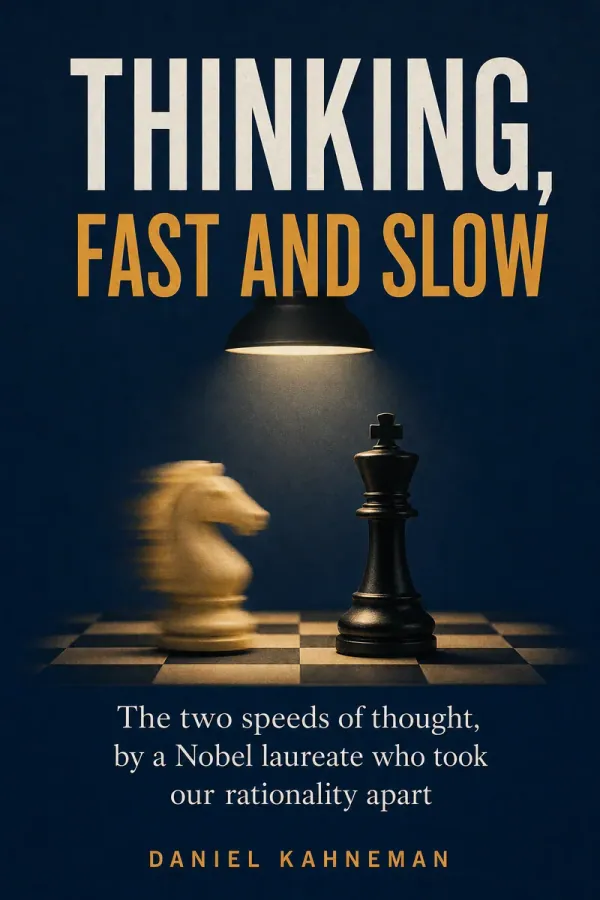
The two speeds of thought, by a Nobel laureate who took our rationality apart
Study this topic in OriaThe essentials
In Thinking, Fast and Slow (2011), psychologist Daniel Kahneman sums up decades of research into our errors of judgment. He contrasts a fast, intuitive mind with a slow, deliberate one, then walks through biases, overconfidence, loss aversion, and the traps of memory. You will also meet the man behind the book, its huge success, and the replication crisis that later shook some of its chapters.
Key dates and facts
- 1934
- Born in Tel Aviv, raised in Paris
- 1969
- Begins his collaboration with Amos Tversky
- 1979
- Publishes the prospect theory paper
- 2002
- Nobel Prize in economics
- 2011
- Thinking, Fast and Slow is published
- 2011
- Published and enters the New York Times bestseller list
- 2011
- Los Angeles Times Book Prize
- 2012
- Over one million copies sold
- 2012
- National Academies Communication Award
🧠 Daniel Kahneman, the Nobel laureate in economics who was a psychologist
The author of Thinking, Fast and Slow, Daniel Kahneman, is one of the most influential psychologists of his time. In an irony of his career, this researcher who said he had never taken a single economics course went on to receive the Nobel Prize in economics.
🇫🇷 A childhood under the Occupation
Kahneman was born on March 5, 1934, in Tel Aviv, then under British mandate, during a visit his mother was making to her family. His parents, Jews originally from Lithuania, lived in France, and he grew up in Paris. During the Occupation, his family had to hide; his father died in 1944. Kahneman tells one striking memory: one evening, wearing the yellow star hidden under a sweater turned inside out, he ran into an SS soldier who, instead of arresting him, hugged him with visible emotion and gave him money. He took from it the lesson that people are endlessly complicated and interesting, a curiosity that would draw him toward psychology. In 1948, the family moved to Palestine, just before Israel's founding.
🪖 A psychologist in uniform
After graduating in psychology and mathematics from the Hebrew University of Jerusalem in 1954, he served in the Israeli army. Assigned to the psychology branch, he designed a structured interview for evaluating recruits that was used for decades. He then moved to the United States and earned his PhD at the University of California, Berkeley, in 1961. His early work focused on attention and mental effort.
🤝 The partnership with Amos Tversky
In 1969, he invited psychologist Amos Tversky to speak at his seminar. It was the start of an exceptional collaboration: the two men are described as inseparable. Their first joint paper, in 1971, dealt with the “law of small numbers”; they flipped a coin to decide the order of their names, then alternated it. In 1974, they published a landmark paper on heuristics and biases. In 1979, the journal Econometrica published their prospect theory, which would become the most cited article in the journal's history.
Their work challenged a central idea in economics: that human beings are perfectly rational. Together with economist Richard Thaler, they laid the foundations of behavioral economics. In 2002, Kahneman received the Nobel Prize. He wrote that Tversky would have shared it had he not died in 1996, at 59.
📘 The book of a lifetime
A professor at Princeton since the 1990s, Kahneman published Thinking, Fast and Slow in 2011, summing up his whole career: cognitive biases, prospect theory, and then his later research on happiness. Financial journalist Jason Zweig helped him write it over two years. Kahneman went on to publish Noise in 2021, with Olivier Sibony and Cass Sunstein, before dying on March 27, 2024, three weeks after turning 90.
⚡ Two characters in our heads
The first part of Thinking, Fast and Slow introduces the two “characters” that give Daniel Kahneman's book its title. He does not claim to have discovered this distinction, which already existed in psychology, but he turns it into a tool for understanding our errors of judgment.
| System 1 | System 2 |
|---|---|
| Fast, automatic, effortless | Slow, deliberate, demanding |
| Intuitive, emotional, always active | Logical, calculating, often idle |
| Computes 2 + 2, reads a sign, detects anger on a face | Computes 17 × 24, parks in a tight space, fills out a tax form |
🎭 Characters, not brain regions
Kahneman is careful to note that these two systems are convenient fictional characters, not precise regions of the brain. They make it possible to talk simply about complex mechanisms, and above all to spot our biases so we can discuss them with others.
The System 1 runs by default, because it costs little energy. It is also a source of creativity, thanks to its associations of ideas. The System 2 steps in when a task demands concentration, or when System 1 has no answer. Kahneman shows that mental effort is visible physically: pupils dilate as a task gets harder.
😴 A lazy controller
The trouble is that System 2 is lazy. It often accepts, without checking, the answers System 1 hands it. And simply knowing we are wrong is not enough: facing the Müller-Lyer illusion, two equal segments that look like different lengths, we keep seeing the illusion even after measuring the lines ourselves.
System 1 has other traits. It is credulous, and treats as true whatever is easy to process: a legible text, a repeated idea, or a clear presentation all inspire more confidence. Kahneman calls this cognitive ease. It looks for causes everywhere, even where there is only chance, and builds coherent stories out of scraps of information.
Short for “What you see is all there is.” System 1 forms its judgment using only the information at hand, without asking what might be missing. It is the source of many biases, including overconfidence.
🔄 Answering an easier question
The last key mechanism is substitution: faced with a hard question, System 1 quietly answers an easier one instead, without our noticing. The Linda problem, told in the book's second part, is the best-known example. The answer that comes out feels obvious and gives an unwarranted sense of confidence. Worse, System 2 may then go looking for arguments to justify the intuition rather than to challenge it.
Kahneman also describes priming, the idea that a word or an image can influence our behavior without our noticing, as well as “ego depletion,” the drain on willpower. These are precisely the two passages that the replication crisis has weakened the most since the book came out.
The rest of the course
This page publishes the first 2 parts. The full course has 8: here is what the next ones cover.
- 🎯 Heuristics and biases: why we think poorly in statistics
The mental shortcuts described by Kahneman and Tversky, anchoring, availability, representativeness, and the statistical errors they cause, with their famous experiments.
- 🔮 The illusion of understanding and overconfidence
The book's third part: why we overestimate what we know, when to trust expert intuition, and how to forecast better using the outside view and the premortem.
- ⚖️ Prospect theory: losing hurts more than winning feels good
The book's fourth part: the prospect theory that won Kahneman the Nobel, loss aversion, the endowment effect, mental accounting, and framing.
- 🪞 The self that lives and the self that remembers
The book's final part: the distinction between the experiencing self and the remembering self, the peak-end rule, and what it changes about measuring happiness.
- 🏆 A bestseller that became a reference
The success of Thinking, Fast and Slow: sales, prizes, influence across many fields, and the first objections to its picture of an overly irrational human mind.
- 🧪 The replication crisis: a chapter on shaky ground
How the replication crisis in psychology weakened the book's chapter on priming, and how Kahneman publicly acknowledged his mistake.
Study “Thinking, Fast and Slow” with flashcards and quizzes
In Oria, you read the full course, then practice on it: flashcards, multiple-choice quizzes, open questions or the Feynman method. Cards and questions then come back in your daily review, paced by spaced repetition.
Study this topic in OriaSources
These notes draw on the sources below. If a point seems doubtful, refer back to them.