Psychology & decisions
Carl Gustav Jung: Biography and Study Notes
The explorer of the collective unconscious
Study this topic in OriaThe essentials
A Swiss psychiatrist, Carl Gustav Jung was Freud's chosen heir before breaking with him in 1913 and founding analytical psychology. You'll follow his life, from the parsonage near Basel to the Burghölzli, from the crisis of the Red Book to his travels in Africa and India, and then his great ideas: the collective unconscious, archetypes, the shadow, the persona, psychological types, individuation. You'll also see the darker side, from the controversy of the 1930s to the scientific criticism, and why his influence stretches from therapy to K-pop.
Key dates and facts
- 1875
- Born in Kesswil (Thurgau)
- 1879
- The family settles near Basel
- 1895
- Begins medical studies in Basel
- 1896
- Death of his father, Pastor Paul Jung
- 1913
- Break with Freud and start of the visions
- 1916
- Founding of the Psychological Club of Zurich
- 1921
- Publication of Psychological Types
- 2009
- First publication of The Red Book
- 1922
- Purchase of the Bollingen land
- 1925
- Expedition to Mount Elgon (Kenya, Uganda)
🌲 A pastor's son's childhood
Carl Gustav Jung was born on July 26, 1875, in Kesswil, a village in the Swiss canton of Thurgau. He was the first surviving son of Paul Achilles Jung, a pastor of the Reformed Church, and Emilie Preiswerk. Religion was everywhere in the family: eight of his uncles were pastors, and his maternal grandfather, Samuel Preiswerk, headed the Reformed clergy of Basel while teaching Hebrew. His paternal grandfather and namesake, a physician, had been rector of the University of Basel.
🏠 A parsonage and a mother “of the night”
The family settled first in Laufen, then in 1879 in Klein-Hüningen, near Basel. The parents' marriage was strained. When Carl was three, his mother was hospitalized for several months; the boy developed eczema, which he would later interpret as his first reaction to her absence. Emilie, often depressed, said that spirits visited her at night; she was interested in table-turning. Jung described her as normal by day but strange and mysterious at night. He found his father reliable but weak, and was disappointed by his very bookish way of talking about faith.
🧸 Two personalities and a secret manikin
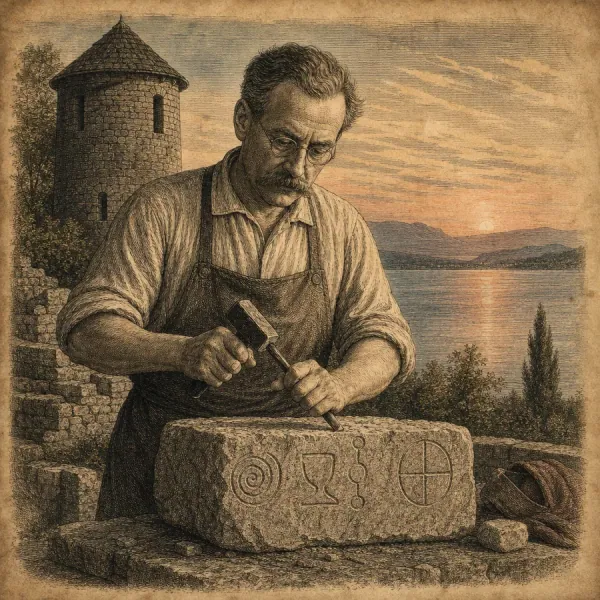
A solitary and introverted child, Jung felt very early on that he was two people: a “personality No. 1,” the schoolboy of his time, and a “personality No. 2,” an old, dignified and powerful man, as if from the 18th century. He would later see them as the conscious and the unconscious parts of himself. He also carved a little manikin at the end of his ruler, hid it in his pencil case with a painted stone and placed it in the attic, where he brought it messages written in a secret language. The ritual calmed him. As an adult, he would discover very similar practices in distant cultures, such as the sacred stones of Aboriginal Australians, and saw in them a first clue to what he would call the collective unconscious.
😵 “What a neurosis is”
At twelve, shoved by a classmate, he fell and hit his head. A thought came to him: from now on, he would not have to go to school. From then on, he fainted every time he had to leave for class or do his homework, and stayed home for six months. One day, he overheard his father confiding his worry: what would become of the boy if he could not earn a living? Jung then threw himself into a Latin grammar, fought off the fainting spells and finally overcame them. He would say that he understood that day what a neurosis is.
🎓 From medicine to psychiatry
As a teenager, he devoured Goethe (Faust), Kant, Schopenhauer and Nietzsche. In 1895, he began studying medicine at the University of Basel on a scholarship. His father died on January 28, 1896; an uncle lent him money to finish his studies. At the same time, he took part in spiritualist séances in which his young cousin Hélène Preiswerk acted as a medium: they would become the subject of his dissertation, On the Psychology and Pathology of So-Called Occult Phenomena (1903). Reading Richard von Krafft-Ebing's textbook of psychiatry made up his mind: psychiatry at last brought together the biological and the spiritual, the two worlds that fascinated him.
🔬 The Burghölzli and the association experiment
In December 1900, Jung joined the Burghölzli, the University of Zurich's psychiatric clinic, then one of the most modern in Europe, as a junior doctor. His chief, Eugen Bleuler, was the man who would coin the word “schizophrenia” to replace the old “dementia praecox.” Jung, who had been mainly interested in neuroses, now became fascinated by psychotic patients. In the winter of 1902–1903, he went to study in Paris, where he attended the lectures of the psychologist Pierre Janet.
⏱️ A stopwatch and a list of words
With his colleague Franz Riklin, Jung refined a simple experiment: the experimenter reads out a list of words and the patient must answer as quickly as possible with the first word that comes to mind. The reaction time is measured with a stopwatch. Jung noticed that certain words provoked abnormal reaction times or unusual answers: they touched a sensitive, often painful point in the subject's life. He added a galvanometer that recorded changes in the skin's electrical activity. This setup is often presented as an ancestor of the lie detector; it was even used by the Zurich courts, which consulted Jung as an expert, for instance to unmask a thief among three nurses.
For Jung, a cluster of memories, images and emotions linked to an emotionally charged experience, which lives autonomously in the unconscious and disrupts conscious thought when touched. The word has passed into everyday language (“inferiority complex”).
These Studies in Word Association, published from 1904 on, made Jung famous in the medical world. Freud got hold of a copy: the results seemed to confirm his idea of an active unconscious.
💍 A marriage that changed his life
In 1903, Jung married Emma Rauschenbach (1882–1955), daughter of a wealthy industrialist from Schaffhausen who owned the IWC watch company. This fortune gave the couple lasting financial security. They would have five children, born between 1904 and 1914. Emma assisted her husband in his research and would herself become an analyst. In 1905, Jung became deputy medical director at the Burghölzli and a lecturer (Privatdozent) at the University of Zurich.
🩺 Sabina Spielrein
At the Burghölzli, Jung also treated a young Russian patient, Sabina Spielrein, hospitalized for hysterical attacks. He applied Freud's new method with her; she became his student and then, according to most historians, his lover, which Jung eventually admitted to Freud in their letters. Spielrein herself would become a psychoanalyst, and she would be the analyst of a young Swiss researcher named Jean Piaget. Their story inspired the film A Dangerous Method (David Cronenberg, 2011).
The rest of the course
This page publishes the first 2 parts. The full course has 9: here is what the next ones cover.
- 🤝 Freud: the father, the heir, the break
Meeting Freud in 1907, the trip to the United States in 1909, the presidency of the International Psychoanalytical Association, disagreements over libido and the occult, then the break in 1913.
- 🌀 The “confrontation with the unconscious” and the Red Book
After the break with Freud, Jung went through a crisis of visions, invented active imagination, recorded everything in the Black Books and then the Red Book, drew mandalas and founded his own circle in Zurich.
- 🎭 Collective unconscious, archetypes, shadow and persona
The great notions of analytical psychology: the personal and collective unconscious, archetypes, the persona, the shadow and projection, anima and animus, the Self and individuation.
- 🧭 Psychological types, synchronicity and alchemy
The 1921 theory of types (introversion, extraversion, four functions), its afterlife in the MBTI, then synchronicity, developed with Wolfgang Pauli, and the psychological reading of alchemy.
- 🌍 The “sage of Zurich”: tower, travels and fame
The years of maturity: building the Bollingen tower, journeys to the Pueblos, Mount Elgon and India, famous patients, an indirect role in the birth of Alcoholics Anonymous and international recognition.
- ⚖️ The 1930s: the controversy over Nazism
His presidency of an international psychotherapy society under the Nazi regime, the 1934 remarks on the “Jewish unconscious,” actions pointing the other way, his role as an informant for the Allies and the historians' debate.
- 🏛️ Last years, death and legacy
His last works (Aion, Answer to Job, a modern myth about flying saucers), the BBC interview, the autobiography Memories, Dreams, Reflections, his death in 1961, then Jung's worldwide influence and the scientific criticism he draws.
Study “Carl Gustav Jung” with flashcards and quizzes
In Oria, you read the full course, then practice on it: flashcards, multiple-choice quizzes, open questions or the Feynman method. Cards and questions then come back in your daily review, paced by spaced repetition.
Study this topic in OriaSources
These notes draw on the sources below. If a point seems doubtful, refer back to them.