Philosophy
Montaigne: Biography and Study Notes
The man who invented the essay by taking himself as his subject
Study this topic in OriaThe essentials
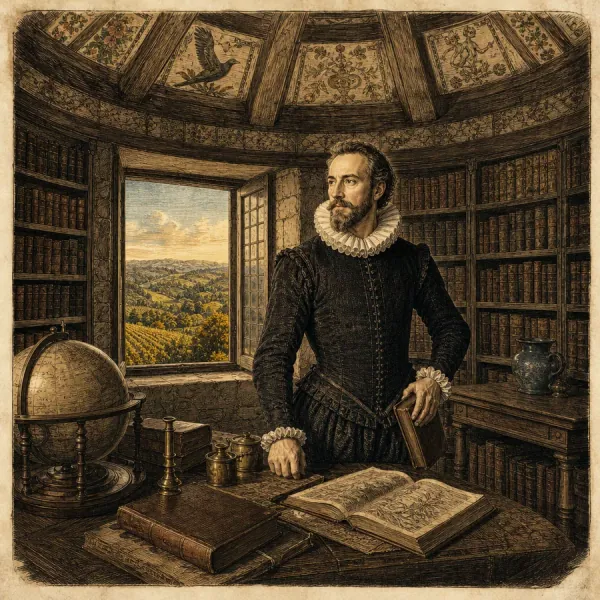
Raised in Latin from the cradle, Michel de Montaigne was a magistrate in Bordeaux when the death of his friend La Boétie devastated him. Withdrawing to his tower, he invented a new form, the essay, in which he portrays himself in order to understand what it is to be human. You'll discover his life, from his extraordinary education to his travels and his time as mayor of Bordeaux, his great ideas (doubt, “What do I know?”, tolerance, the art of living), and the immense influence of the Essays, from Shakespeare to Nietzsche.
Key dates and facts
- 1533
- Born at the Château de Montaigne
- 1546
- Finishes his studies at the Collège de Guyenne
- 1554
- His father becomes mayor of Bordeaux
- 1571
- Retires to his tower
- 1572
- Begins writing the Essays
- 1576
- “What do I know?” medal
- 1580
- First edition of the Essays
- 1581
- Elected mayor of Bordeaux
- 1585
- Plague in Bordeaux, end of his term
- 1588
- Essays in three books, the Bastille
🏰 A childhood in Latin
Michel Eyquem was born on February 28, 1533, at the Château de Montaigne, in the Périgord, not far from Bordeaux, in the province of Guyenne in southwestern France. He was the couple's first child to survive, after two babies who died in infancy, and the eldest of a family of eight children. The name Montaigne, which he alone would keep, comes from the family estate; at the time it was pronounced “Montagne.”
⚓ Merchants turned lords
On his father's side, the Eyquems were wealthy Bordeaux merchants, enriched in particular by the trade in salted fish. In 1477, his great-grandfather bought the lordship of Montaigne, a first step toward nobility. His father, Pierre Eyquem, left trade for arms, fought in Italy under Francis I, and would become mayor of Bordeaux in 1554. On his mother's side, Antoinette de Louppes de Villeneuve came from a merchant family from Aragon, in Spain, said to descend from Jews who had converted to Christianity; various authors also suppose a Marrano origin for the Eyquems. In his writings, Montaigne speaks a great deal about his father, with admiration, and almost never about his mother.
🎶 An experimental education
Pierre Eyquem, an enthusiast for the ideas of humanists such as Erasmus, devised an extraordinary education for his son. The baby was first entrusted to a peasant family in a nearby village, so that he would learn the simplest way of life and later look toward those who needed help. Back at the château, the child was given as tutor a German doctor who spoke no French, and an absolute rule was imposed on the whole household: he was to be spoken to only in Latin. Father, mother, valets, and maids learned a few words so they could answer him.
“Without books, without grammar, without the whip and without tears, I had learned Latin, a Latin as pure as my schoolmaster knew it.”
Montaigne, Essays, Book I (1580) (translated)
He would recount that at over six years old he understood no more French or Périgord dialect than Arabic. So as not to jolt his delicate senses, his father even had him woken in the morning to the sound of a spinet, a small keyboard instrument. The child was raised without constraint, on the principle that a taste for study should arise from his own will.
🏫 School, a “jail”
Around 1539–1540, Michel entered the Collège de Guyenne in Bordeaux, one of the great centers of humanism, where renowned teachers such as the Scotsman George Buchanan taught. There he read Ovid, Virgil, and Terence, acted in Latin tragedies, and finished the curriculum around thirteen, in 1546. But he kept a bitter memory of the discipline of the time: the school, he would write, is “a real jail for captive youth,” where fearful children are led by masters “armed with whips.” Of his life between fourteen and twenty-two almost nothing is known: he probably studied law, in Toulouse or Paris, though no document settles the question.
⚖️ Magistrate in Bordeaux and friendship with La Boétie
Around twenty-one or twenty-two, Michel de Montaigne became a councilor at the Cour des Aides of Périgueux, a tax court, taking over his father's office. When this court was abolished in 1557, its magistrates joined the Parlement of Bordeaux, one of the kingdom's great courts of justice. Montaigne sat there for thirteen years in a chamber charged with examining complex cases. The parlement did more than judge: it registered the king's laws and, in times of unrest, helped keep order.
👑 Between the court and the wars
His office took him about ten times to the court of Kings Henry II, Francis II, and Charles IX. In 1562 he accompanied the young Charles IX to the siege of Rouen. It was the beginning of the Wars of Religion between Catholics and Protestants, which would ravage France for more than thirty years. Attracted by the atmosphere of the court but too independent to become a courtier, he did not seek a career there.
🤝 “Because it was he, because it was I”
At the parlement, around twenty-five, he met a slightly older colleague, Étienne de La Boétie. A learned jurist and poet, La Boétie was the author of a daring text, the Discourse on Voluntary Servitude, an indictment of tyranny that seeks to understand why a population submits to the authority of one man. Between the two men grew a friendship that became legendary, the kind one meets, according to Montaigne, only “once in three centuries.”
“If I am pressed to say why I loved him, I feel that it can only be expressed by answering: Because it was he, because it was I.”
Montaigne, Essays, Book I, “Of Friendship” (translated)
The famous phrase appears only in the posthumous edition of 1595. Montaigne had added it by hand in the margin of his own copy: first “because it was he,” then, in a different ink, “because it was I.”
🕯️ The death of a friend
Four years after they met, in August 1563, La Boétie died, probably of plague or tuberculosis, at thirty-two. During three days of agony, he showed a strength of soul that fascinated Montaigne, who described it in a letter to his father and in 1571 published his friend's works. The translator Donald Frame suggested that the Essays were born of this grief: a way of continuing to talk, with the reader taking the place of the lost friend.
💍 A marriage of reason
On September 23, 1565, Montaigne married Françoise de La Chassaigne, twenty, from a family of Bordeaux magistrates. Like many in his time, he distinguished marriage from love. The couple had six daughters, but only one, Léonor, survived early childhood. In June 1568 his father died of gravel (kidney stones). Michel inherited the estate, a sizable fortune, and the title of Lord of Montaigne. Shortly afterward he published a translation, requested by his father, of the Natural Theology of the Catalan theologian Raymond Sebond. Passed over for a promotion at the parlement, he resigned his office on July 23, 1570.
The rest of the course
This page publishes the first 2 parts. The full course has 8: here is what the next ones cover.
- 📚 The tower and the birth of the Essays
His retirement in 1571 to the tower library of the château, the riding accident, the writing that began in 1572, the 1576 “What do I know?” medal, the kidney-stone illness, and the first edition of the Essays in 1580.
- 🐎 The great journey through Europe
The seventeen-month journey (June 1580 – November 1581) through France, Switzerland, Germany, and Italy, to treat his illness and discover the world, the stay in Rome, the examination of the Essays by the papal censors, and the Travel Journal.
- 🏛️ Mayor of Bordeaux during the Wars of Religion
His two terms as mayor (1581–1585), the plague of 1585, his role as mediator between Henry III and Henry of Navarre, the war and wandering of 1586–1587, the Bastille in 1588, Marie de Gournay, and his death at the château in 1592.
- 🪞 The Essays: portraying oneself
What the Essays are: a work in three books and 107 chapters, the project of self-portrayal, the meaning of the word “essay,” a free style “by leaps and gambols,” the choice of French, and additions up to the Bordeaux Copy.
- 💡 Doubt, tolerance, and the art of living
The great ideas of the Essays: skepticism and the critique of reason, human diversity and the relativity of customs (“Of Cannibals”), an education that shapes judgment, death and nature, and the wisdom of ordinary happiness.
- 🌍 A book that has traveled the world
The reception of the Essays: immediate success, criticism from Pascal and the Jansenists, placement on the Index in 1676, admiration in the Enlightenment, influence in England (Florio, Shakespeare, Bacon), the United States (Emerson), and Germany (Nietzsche), and Montaigne today.
Study “Montaigne” with flashcards and quizzes
In Oria, you read the full course, then practice on it: flashcards, multiple-choice quizzes, open questions or the Feynman method. Cards and questions then come back in your daily review, paced by spaced repetition.
Study this topic in OriaSources
These notes draw on the sources below. If a point seems doubtful, refer back to them.