History
World War I: Summary and Study Notes
The Great War that upended the 20th century
Study this topic in OriaThe essentials
In 1914, an assassination in the Balkans drags the whole of Europe into a war everyone thought would be short. It lasts more than four years, digs itself into the trenches, mobilizes factories, women, and colonies, and kills between 15 and 22 million people. You'll understand the chain reaction of the summer of 1914, the hell of Verdun and the Somme, the Armenian genocide, the turning point of 1917, the armistice of November 11, 1918, the peace treaties, and the memory of this war.
Key dates and facts
- June 28, 1914
- Sarajevo assassination
- July 28, 1914
- Austria-Hungary declares war on Serbia
- August 1, 1914
- Germany declares war on Russia; France mobilizes
- August 4, 1914
- Invasion of Belgium, the United Kingdom enters the war
- April 24, 1915
- Roundup of Armenian elites in Constantinople
- May 1915
- Start of the mass deportations
- July 1916
- End of the main phase of the massacres
- September 2023
- 33 countries recognize the genocide
- March 1917
- Revolution in Russia, abdication of Nicholas II
- April 6, 1917
- The United States enters the war
🧨 The chain reaction of summer 1914
World War I, also called the “Great War,” pitted two coalitions against each other from 1914 to 1918: the Triple Entente (France, the United Kingdom, Russia, and their allies) and the Central Powers (Germany and Austria-Hungary, later joined by the Ottoman Empire and then Bulgaria). It began with an assassination in the Balkans, but its roots run much deeper.
🧭 A Europe of rivalries
At the start of the 20th century, the great European powers headed empires spanning several continents, and their rivalries were sharpening. Germany, unified in 1871, had become a major industrial power; its emperor Wilhelm II demanded his place in the world and clashed with France over Morocco in the crises of 1905 and 1911. In the Balkans, from which the Ottoman Empire was retreating, Austria-Hungary and Russia were at odds. Serbia, backed by the tsar, wanted to unite the South Slavs, some of whom lived under Habsburg rule after Austria-Hungary annexed Bosnia-Herzegovina in 1908. Two Balkan wars, in 1912 and 1913, enlarged Serbia and heightened tensions further.
Two systems of alliances faced each other. The Triple Alliance united Germany, Austria-Hungary, and Italy. Opposite it, the Franco-Russian alliance (1891–1893), the Anglo-French Entente Cordiale (1904), and the 1907 Anglo-Russian agreement formed the Triple Entente. Everywhere, the arms race was accelerating: in France, compulsory military service rose to three years in 1913, facing a Germany of 67 million people against roughly 40 million for France. Historians still debate where responsibility lies: Fritz Fischer stressed the German leadership's will to go to war, while Christopher Clark instead describes a collective loss of control by statesmen.
🔫 Sarajevo, June 28, 1914
On June 28, 1914, in Sarajevo, the young Bosnian Serb nationalist Gavrilo Princip shot and killed Archduke Franz Ferdinand, heir to the Austro-Hungarian throne, and his wife Sophie, with two pistol shots. The conspirators, members of the “Young Bosnia” movement, had received their weapons from extremists in the Serbian Black Hand organization. Vienna saw this as a chance to finish off Serbia. On July 5, Germany assured its ally of its unconditional support, whatever the consequences.
⚙️ The July crisis
On July 23, Austria-Hungary sent Serbia a ten-point ultimatum. Belgrade accepted nearly all of it, except for allowing Austrian police to investigate on its soil. On July 28, Austria-Hungary declared war on Serbia. The web of alliances then swept the continent into war: Russia ordered general mobilization on July 30, Germany declared war on Russia on August 1, and France mobilized the same day. The day before, the pacifist socialist Jean Jaurès had been assassinated in Paris. To carry out the Schlieffen Plan, which called for a quick victory over France through Belgium before turning against Russia, Germany declared war on France on August 3 and invaded neutral Belgium on the 4th. The United Kingdom, guarantor of Belgian neutrality, entered the war that same evening.
“The lamps are going out all over Europe; we shall not see them lit again in our lifetime.”
Edward Grey, British Foreign Secretary, early August 1914, quoted in his memoirs Twenty-Five Years (1925)
🪖 From a war of movement to the trenches
In the summer of 1914, almost every belligerent in World War I believed the war would be short. General staffs counted on the offensive. Within a few months, this illusion collapsed and the Western Front froze into trench warfare.
🏃 August 1914: offensive and shock
German armies crossed Belgium, where they met resistance from the forts of Liège and committed atrocities against civilians, as at Dinant or Leuven, whose library was burned down. The French offensive in Lorraine failed. In the Battle of the Frontiers, the losses were appalling: from August 20 to 25, 1914, 40,000 French soldiers were killed, 27,000 of them on August 22 alone, the bloodiest day in French history. The Allies retreated to the Marne, and the government left Paris for Bordeaux.
🚕 The “Miracle of the Marne”
Instead of swinging west around Paris, General von Kluck's German army pursued the French east of the capital and exposed its flank. Joffre and Gallieni launched a counteroffensive in early September: the Battle of the Marne. Requisitioned Paris taxis carried reinforcements, an episode that became famous but had little real impact. The Germans retreated to the Aisne: the Schlieffen Plan had failed. Each side then tried to outflank the other to the north, all the way to the North Sea: the “Race to the Sea.” By the end of 1914, a continuous line of trenches 700 to 800 kilometers long ran from the Belgian coast to the Swiss border.
In the east, the Russians invaded East Prussia but were crushed at Tannenberg in late August 1914 by Hindenburg; they did, however, prevail over the Austrians in Galicia.
⛏️ Life in the trenches
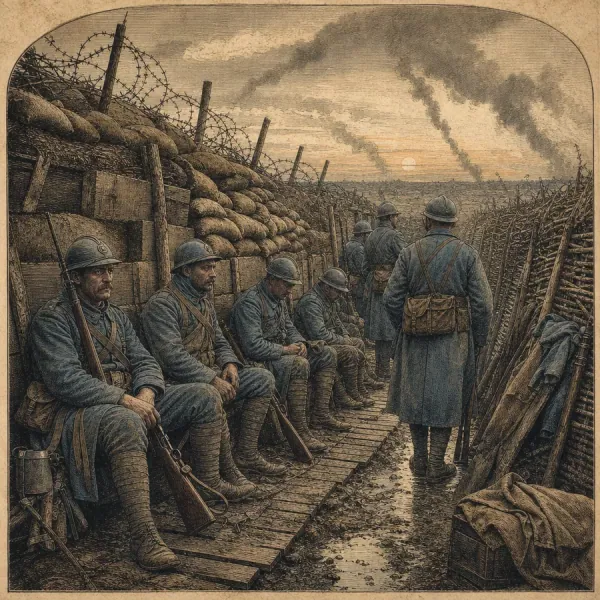
The soldiers, known to the French as poilus, lived in lines of trenches linked by communication trenches, amid mud, rats, lice, and the smell of corpses. In front of them lay no man's land, strung with barbed wire and swept by machine guns. Danger was constant, even in quiet sectors. Artillery caused nearly 70% of casualties, so much so that a third of the bodies of poilus were never identified. The Adrian helmet did not replace the French kepi until September 1915. One episode remains famous: at Christmas 1914, around Ypres, British and German soldiers fraternized in no man's land, exchanged gifts, and played football.
A form of warfare in which armies, dug in facing each other, can no longer break through the enemy's front. Offensives cost tens of thousands of men to gain a few kilometers, or even a few meters. On the Western Front, it lasted from late 1914 to the spring of 1918.
☠️ 1915: looking for a breakthrough
To escape the stalemate, the belligerents innovated. On April 22, 1915, near Ypres, the German army used a gas, chlorine, on a massive scale for the first time; every side would go on to use chemical weapons, despite their prohibition under the Hague Conventions. On April 25, 1915, the Allies landed at Gallipoli, on the Dardanelles, to strike the Ottoman Empire: the operation, in which Australians and New Zealanders distinguished themselves, was a total failure. On May 23, 1915, Italy entered the war on the side of the Entente, opening a new front against Austria-Hungary.
The rest of the course
This page publishes the first 2 parts. The full course has 9: here is what the next ones cover.
- 🔥 1916: Verdun and the Somme
The two great battles of attrition of 1916 on the Western Front: Verdun (February – December) and the Somme (July – November), their objectives, their course, and their human cost.
- 🏭 Total war: the home front, the economy, and propaganda
How World War I mobilized entire societies: the war economy, women's work, the Union Sacrée, censorship and propaganda, debt, the blockade, and the role of the colonies.
- 🕯️ The Armenian genocide
The genocide of the Armenians carried out by the Young Turk government of the Ottoman Empire during World War I: preparation, deportations, massacres, death toll, and recognition.
- 🔄 1917, the year of the turning point
1917 in World War I: the failure of the Chemin des Dames offensive and the French mutinies, the Russian revolutions and Russia's exit from the war, submarine warfare, and the entry of the United States.
- 🕊️ 1918: the final offensives and the armistice
The last year of World War I: the German spring offensives, the Allied counteroffensives of the summer, the collapse of Germany's allies, the German revolution, and the armistice of November 11, 1918 at Rethondes.
- 📜 The toll and the peace treaties
The human, material, and economic toll of World War I, then the peace treaties of 1919 – 1920: the Treaty of Versailles, the dismantling of empires, the League of Nations, and reparations.
- 🌹 The memory of the Great War
How World War I is remembered: war memorials, the Tomb of the Unknown Soldier, November 11, military cemeteries, Franco-German reconciliation, the centenary, and historians' perspectives.
Study “World War I” with flashcards and quizzes
In Oria, you read the full course, then practice on it: flashcards, multiple-choice quizzes, open questions or the Feynman method. Cards and questions then come back in your daily review, paced by spaced repetition.
Study this topic in OriaSources
These notes draw on the sources below. If a point seems doubtful, refer back to them.