Entrepreneurs & innovators
Akio Morita: Biography and Study Notes
The Sony co-founder who changed the meaning of “Made in Japan”
Study this topic in OriaThe essentials
The eldest son of an old family of sake brewers, Akio Morita gave up the family business to found Sony with the engineer Masaru Ibuka in a bombed-out Tokyo department store in 1946. Transistor radio, Trinitron, Betamax, Walkman, compact disc: in forty years, he turned a small postwar startup into one of the most admired brands in the world. You'll follow his life step by step, his ideas on management, his failed bets and the stances that irritated Americans as much as the Japanese.
Key dates and facts
- 1921
- Born in Nagoya
- 1944
- Physics degree in Osaka
- 1946
- Founding of Tokyo Tsushin Kogyo, the future Sony
- 1958
- The company takes the name Sony
- 1979
- Launch of the Walkman
- 1989
- Purchase of Columbia Pictures
- 1993
- Cerebral hemorrhage
- 1999
- Dies in Tokyo
🍶 The heir to a sake-brewing house
Akio Morita was born on January 26, 1921, in Nagoya, a major industrial city in central Japan, into a well-off family. He was the eldest son of Kyuzaemon Morita and his wife Shu. Since 1665, the Moritas had been making sake, miso and soy sauce in the village of Kosugaya, now part of the city of Tokoname, on the Chita Peninsula in Aichi Prefecture. Akio was destined to become the fifteenth head of this line of brewers.
🏮 An heir with his path laid out
The eldest of four children, he was groomed from elementary school onward to succeed his father at the head of the family business. In interwar Japan, the eldest son's succession went without saying, and the family kept up its standing: his mother was the daughter of a regional bank president, and the Moritas were related to several families of industrialists and publishers.
🎶 The phonograph revelation
But in middle school, the teenager became fascinated by the family's phonograph, a device still rare in Japan. He wanted to understand how the machine reproduced sound and became a dedicated amateur electronics tinkerer: he built a rudimentary phonograph and a radio receiver himself. This love of sound, which would later give Sony its name, never left him.
He discovered a real calling for mathematics and physics. After the Eighth Higher School in Nagoya, he entered the physics department of Osaka Imperial University in 1942, when Japan had been at war with the United States since the attack on Pearl Harbor. He graduated in 1944.
⚓ The war and meeting Masaru Ibuka
In January 1944, Akio Morita joined the Imperial Japanese Navy through a program that allowed science students to continue their research instead of fighting. In 1945, he was commissioned as a technical lieutenant and assigned to avionics research near the Yokosuka naval base.
🤝 The decisive meeting
It was on a navy wartime research committee, working among other things on heat-seeking weapons, that Morita met Masaru Ibuka. Born in 1908, thirteen years his senior, and a graduate of Waseda University, Ibuka was a brilliant engineer who already ran a company making measuring instruments. Despite their age difference, the two men formed a friendship that would last their whole lives. Their personalities complemented each other: Ibuka was an inspired inventor, able to push his engineers beyond their limits; Morita, curious about everything and gifted at persuasion, would prove to be an exceptional salesman.
🏚️ A country in ruins
In August 1945, Japan surrendered after the atomic bombings of Hiroshima and Nagasaki. The country was devastated: cities burned, industry destroyed, food shortages, runaway inflation. Under the American occupation, the big industrial conglomerates, the zaibatsu, were broken up. Morita returned to his family in Kosugaya.
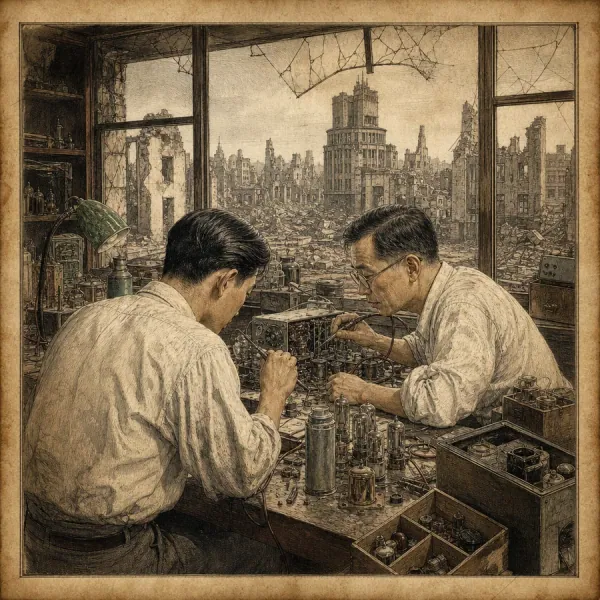
In September 1945, Ibuka set up in Tokyo with a few colleagues in a cramped room on the third floor of the Shirokiya department store in Nihonbashi, a cracked building that had narrowly survived the fires. There he repaired radios and made adapters for receiving shortwave broadcasts, much in demand among Japanese people hungry for news of the world. One day, Morita read a short column in the major daily Asahi Shimbun about this little workshop that mentioned his friend's name. He wrote to him immediately; Ibuka replied that he should come to Tokyo. Morita, who was offered a teaching post at the Tokyo Institute of Technology at the same time, joined the venture.
🙇 Persuading the father
One major obstacle remained: Morita was the heir to the sake house. Ibuka, Morita and another partner traveled to the Nagoya area to beg Kyuzaemon to release his son from his obligations. The father agreed, and a younger brother, Kazuaki, would volunteer to take over the brewery. Better still, Kyuzaemon would become one of the new company's backers.
The rest of the course
This page publishes the first 2 parts. The full course has 9: here is what the next ones cover.
- 🔌 Tokyo Tsushin Kogyo, a startup in the ruins
The founding of Tokyo Tsushin Kogyo in May 1946, its improvised first products, the first Japanese tape recorder, the transistor license obtained from Bell Labs and the first transistor radios.
- 🌍 Sony conquers the world
Morita's first trips to the West, his refusal of the Bulova order, the choice of the name Sony in 1958, the creation of Sony Corporation of America, the New York listing and the Morita family's move to Manhattan.
- 🎧 At the head of Sony: Betamax, Walkman and the compact disc
Morita as president and then chairman and CEO of Sony, Betamax's defeat by VHS, the birth of the Walkman in 1979 and its worldwide success, and the compact disc created with Philips.
- 🧭 Morita's ideas about business
Akio Morita's management philosophy: degrees don't matter, a sense of community, lifetime employment, three kinds of creativity, a long-term vision and a critique of American-style management.
- 🇺🇸 Ambassador and provocateur between Japan and the United States
Morita's role in U.S.–Japan economic relations in the 1980s: lobbying, Keidanren, the controversial book “The Japan That Can Say No,” the purchase of CBS Records and Columbia Pictures, and its losses.
- 🌺 The stroke, Hawaii and death
Morita's cerebral hemorrhage in 1993, his resignation as Sony's chairman in 1994, his years of rehabilitation in Hawaii and his death in Tokyo in 1999.
- 🏯 Legacy: the face of “Made in Japan”
What remains of Akio Morita: Japan's image transformed, Sony as the brand Americans most admired, his honors, his wealth and the criticism of him and of Sony.
Study “Akio Morita” with flashcards and quizzes
In Oria, you read the full course, then practice on it: flashcards, multiple-choice quizzes, open questions or the Feynman method. Cards and questions then come back in your daily review, paced by spaced repetition.
Study this topic in OriaSources
These notes draw on the sources below. If a point seems doubtful, refer back to them.