Entrepreneurs & innovators
Bill Gates: Biography and Study Notes
From software king to giant foundation, a billionaire both admired and contested
Study this topic in OriaThe essentials
A teenager obsessed with programming in Seattle, Bill Gates left Harvard in 1975 to found Microsoft with his friend Paul Allen. Within twenty-five years, MS-DOS and then Windows made him the richest man in the world, until a landmark antitrust trial condemned his company's methods. You'll follow his life step by step: the birth of personal computing, the Gates Foundation and its fight against disease, his bets on climate and AI, and the criticism his power and influence attract.
Key dates and facts
- 1955
- Born in Seattle
- 1968
- First computer terminal at Lakeside
- 1973
- Enters Harvard
- 1985
- First version of Windows
- 1987
- Youngest billionaire, at 31
- 1995
- Windows 95 and first place among the world's fortunes
- 2000
- Steve Ballmer succeeds him as CEO
- 2021
- Bill and Melinda Gates divorce
- 2025
- Memoir Source Code and announcement that the foundation will close
- 2045
- Planned closure of the Gates Foundation
🏡 A Seattle childhood and a terminal at school
William Henry Gates III was born on October 28, 1955, in Seattle, Washington, in the northwestern United States. His father, Bill Gates Sr., was a prominent lawyer; his mother, Mary Maxwell Gates, sat on the boards of a bank and of the charity United Way. He grew up with two sisters, Kristi, the elder, and Libby, the younger. He was nicknamed “Trey” (as in “three”), after the “III” that follows his name. So this is no rags-to-riches story: the family was well-off and cultured, and encouraged competition even in card games and outdoor sports.
Small for his age, he was picked on at school. His parents found him hard to motivate and decided, when he was 13, to enroll him in an upscale private school, Lakeside. Gates told the BBC in 2025 that the expense was “a stretch, even on my father's salary.”
⌨️ The shock of the first computer
In 1968, the Lakeside Mothers' Club used the proceeds of a rummage sale to buy a Teletype terminal connected to a General Electric computer, along with a block of computing time. Gates was fascinated: the machine always ran the code exactly as it had been written. He learned the BASIC language and wrote his first program, a game of tic-tac-toe against the computer. He was even excused from some math classes so he could program.
That is where he bonded with another student, Paul Allen, and with his best friend, Kent Evans. When the computing credit ran out, the group looked for computer time elsewhere. A local company, Computer Center Corporation, banned them for a whole summer after catching them exploiting flaws in its system to get free hours; they then offered to hunt down bugs in its software in exchange for machine time. Gates spent hours studying the programs' source code.
💔 First contracts, first loss
In 1971, a teacher asked Gates and Evans to computerize the school's class scheduling. But at the end of their junior year, Kent Evans died in a mountaineering accident at 17. Gates would describe that day as one of the saddest of his life; he finished the project with Paul Allen. At 17, he and Allen launched a small business, Traf-O-Data, which analyzed road traffic counts using an Intel 8008 processor. An outstanding student, he scored 1590 out of 1600 on the SAT college entrance exam and entered Harvard in the fall of 1973.
🎓 Harvard, the Altair and the birth of Microsoft
At Harvard, Bill Gates never declared a major. He took math courses known to be extremely hard and graduate-level computer science classes. There he met Steve Ballmer, who would much later succeed him at the head of Microsoft. In a combinatorics class, he proposed a solution to an unsolved problem, “pancake sorting”; his algorithm remained the fastest known for more than thirty years and was published with the computer scientist Christos Papadimitriou.
📰 A magazine cover that changed everything
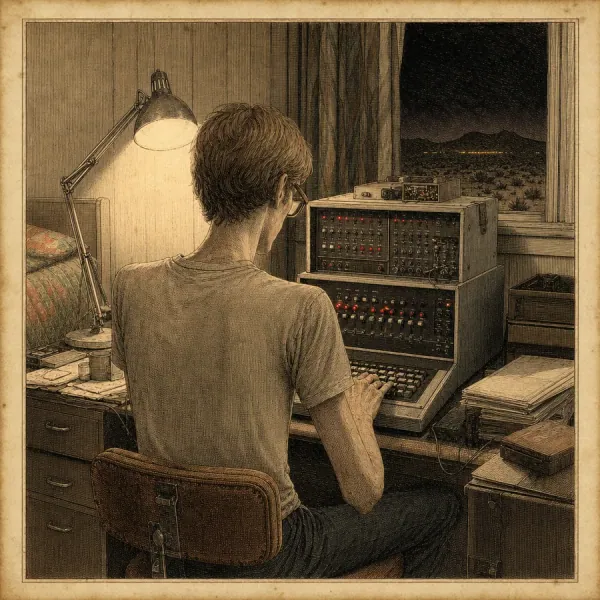
In January 1975, Popular Electronics magazine featured the Altair 8800, a microcomputer sold as a kit by MITS, a company in Albuquerque, New Mexico. Gates and Allen saw their chance: they contacted MITS claiming to be working on a BASIC interpreter for the machine. In reality, they had neither an Altair nor a single line of code; they only wanted to test the company's interest. The boss, Ed Roberts, agreed to a demonstration. Within a few weeks, they wrote an Altair emulator on a mainframe computer, then the interpreter itself. The demonstration in Albuquerque was a success: MITS would distribute their software as Altair BASIC.
Allen was hired by MITS; Gates took a leave of absence from Harvard and joined him in November 1975. Allen named their partnership “Micro-Soft,” a blend of microcomputer and software. The hyphen soon disappeared, and the name Microsoft was registered on November 26, 1976. Gates never went back to finish his degree. He explained his decision pragmatically:
“If things hadn't worked out, I could always go back to school. I was officially on leave.”
Bill Gates, on leaving Harvard
✉️ The “Open Letter to Hobbyists”
Microsoft's BASIC was popular with enthusiasts, but a copy circulated before its release and was freely duplicated. In February 1976, Gates published an Open Letter to Hobbyists: according to him, more than 90% of users had not paid, and if developers were not paid, no one would produce quality software. The letter irritated part of the community, for whom sharing code was a given. But it laid down an idea that would make Gates's fortune: software is a product that can be sold, independently of the machine.
Microsoft broke away from MITS in late 1976 and developed programming languages for many computers. Gates reviewed, and often rewrote, every line of code the company produced during its first five years. On January 1, 1979, the company left Albuquerque for Bellevue, near Seattle.
The rest of the course
This page publishes the first 2 parts. The full course has 8: here is what the next ones cover.
- 💾 The IBM masterstroke: MS-DOS
The 1980 deal with IBM, the purchase of 86-DOS, the choice to keep the rights, the break with Paul Allen and the 1986 IPO.
- 👑 The Windows empire and a feared boss
Microsoft's dominance from the late 1980s to 2000, Gates's management style, his marriage and his record fortune.
- ⚖️ The antitrust trial: Microsoft found guilty
The United States v. Microsoft trial (1998–2001) for abuse of monopoly, Gates's deposition, the breakup order and the final settlement.
- 💉 The Gates Foundation: vaccines, malaria and polio
The creation of the Bill & Melinda Gates Foundation in 2000, its causes, Gates's gradual exit from Microsoft, the Giving Pledge and criticism of its influence.
- 🦠 Pandemic, climate and conspiracy theories
Gates's 2015 warning about pandemics, COVID-19 and conspiracy theories, the debate over vaccine patents, and his investments in clean energy.
- 🔭 Divorce, a memoir and a final challenge: give it all away
The 2021 divorce, the renamed foundation, the 2025 memoir, the decision to close the foundation in 2045, his warnings about AI and his current fortune.
Study “Bill Gates” with flashcards and quizzes
In Oria, you read the full course, then practice on it: flashcards, multiple-choice quizzes, open questions or the Feynman method. Cards and questions then come back in your daily review, paced by spaced repetition.
Study this topic in OriaSources
These notes draw on the sources below. If a point seems doubtful, refer back to them.